


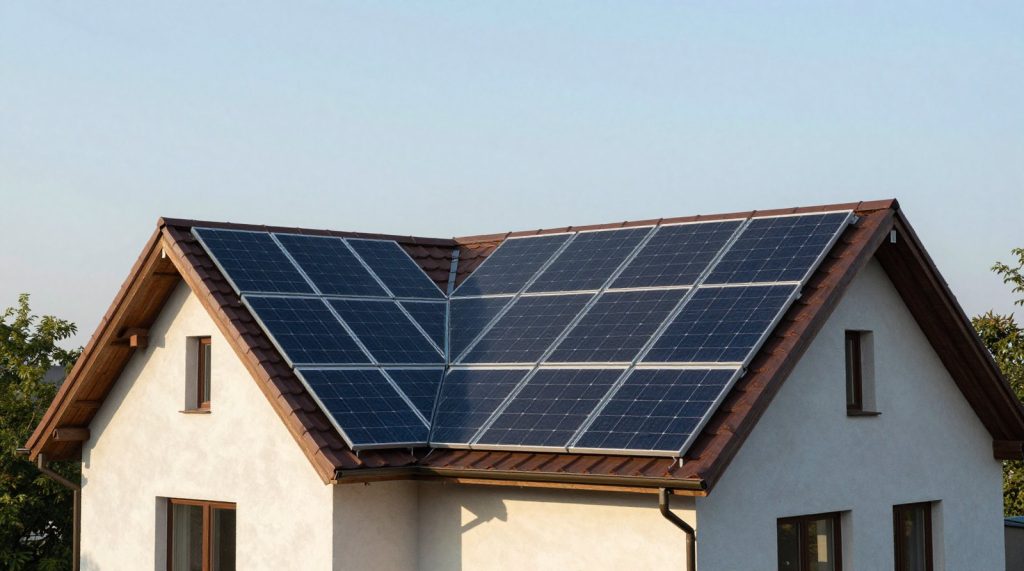
If you are weighing feed-in tariff or self-consumption for your next home solar installation, a December 2025 brief from the International Energy Agency (IEA) offers a practical answer: self-consumption is emerging as the more resilient choice for new residential solar systems. The argument is not ideological but financial: the Guaranteed Buyer’s outstanding debt to renewable generators has surpassed €335 million, and the majority of new private solar power plants in Ukraine are now being installed without feed-in tariff registration.
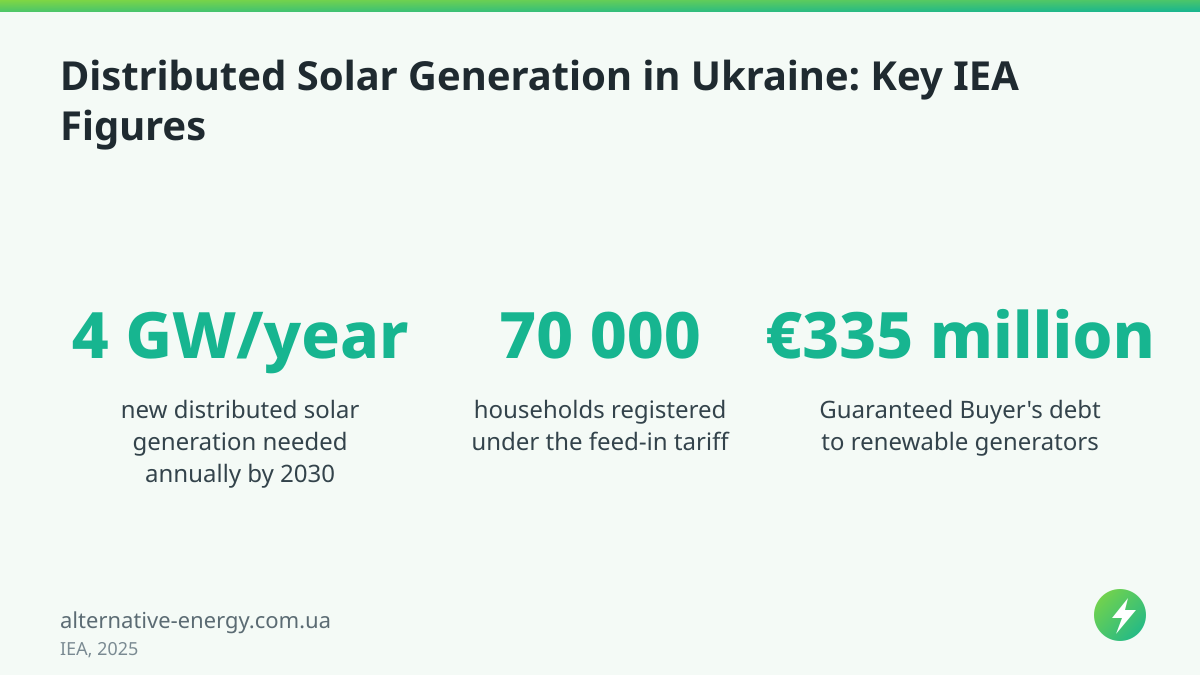
Key figures from the IEA report:
- the Guaranteed Buyer’s debt to renewable energy generators — over €335 million;
- approximately 70,000 households officially registered under the feed-in tariff;
- Ukraine needs to add 4 GW of distributed solar generation every year through 2030 (24 GW in total);
- alongside this, 5.6 GW of new energy storage capacity must be built.
Why the IEA Recommends Self-Consumption
According to the International Energy Agency, following the full-scale invasion in 2022, Ukraine’s available dispatchable generation fell from roughly 38 GW to 19 GW, and after the heavy strikes in spring 2024 it dropped further to 12 GW. By end-2024, around 3 GW had been restored, with recovery efforts continuing through 2025 despite further attacks. Against this backdrop, centralised infrastructure remains highly vulnerable, and the IEA characterises distributed solar generation as a cost-effective and rapid means of both expanding capacity and strengthening overall system resilience.
A second problem emerged on the payments side. The Guaranteed Buyer has accumulated more than €335 million in arrears owed to renewable energy producers. For a household banking on feed-in tariff payments over decades, this represents a direct risk of delayed or missed receipts. It is precisely this risk, the IEA notes, that is already driving most new residential solar power plant owners to install systems without registering and instead use solar energy “behind the meter” — primarily to cover their own consumption.
The Scale of the Task by 2030
The IEA sets a clear benchmark: to put Ukraine’s energy system on a modernisation trajectory, the country must add 4 GW of distributed solar generation every year — 24 GW in total by 2030. Without storage, integrating that volume of variable generation into the grid is difficult, which is why the same report identifies a need for 5.6 GW of new energy storage capacity. For context, around 70,000 residential systems are currently operating under the feed-in tariff — a base that needs to be significantly expanded.

Self-Consumption “Behind the Meter”: What It Means for Homeowners
Self-consumption means the solar system first covers the household’s own electricity needs, while any surplus either flows into storage or is exported to the grid without relying on a fixed feed-in tariff payment. The economics of this model do not depend on whether the Guaranteed Buyer transfers funds on time: every kWh you avoid purchasing from your supplier is real savings here and now. The IEA report presents this approach as the more resilient option given wartime risks and ongoing payment gaps in the renewables sector.
This does not mean the feed-in tariff is finished: for already-registered systems it remains a valid scheme. But for a new home solar power plant, the combination of panels, an energy storage system, and self-consumption is becoming the rational default — especially given that the IEA explicitly prescribes a 5.6 GW expansion of the country’s battery storage capacity by 2030.
A Practical Takeaway for Solar System Owners
If you are planning a residential installation in 2026, the IEA analysis provides an additional reason to look beyond module prices and compare configurations that include storage for self-consumption. For those whose systems are already running under the feed-in tariff, the report signals that the systemic risk has not gone away: the state buyer’s arrears are not a temporary glitch but a structural problem that international analysts are placing front and centre. It is also worth monitoring the government’s response to the IEA recommendations, since the rules governing self-consumption, metering, and the battery storage market will directly shape the economics of private solar systems in the years ahead.
Sources: International Energy Agency (IEA)
Illustration generated with AI
Prepared by the Alternative Energy editorial team with the help of AI based on the sources listed; facts and figures were checked against them during automated editorial review.