


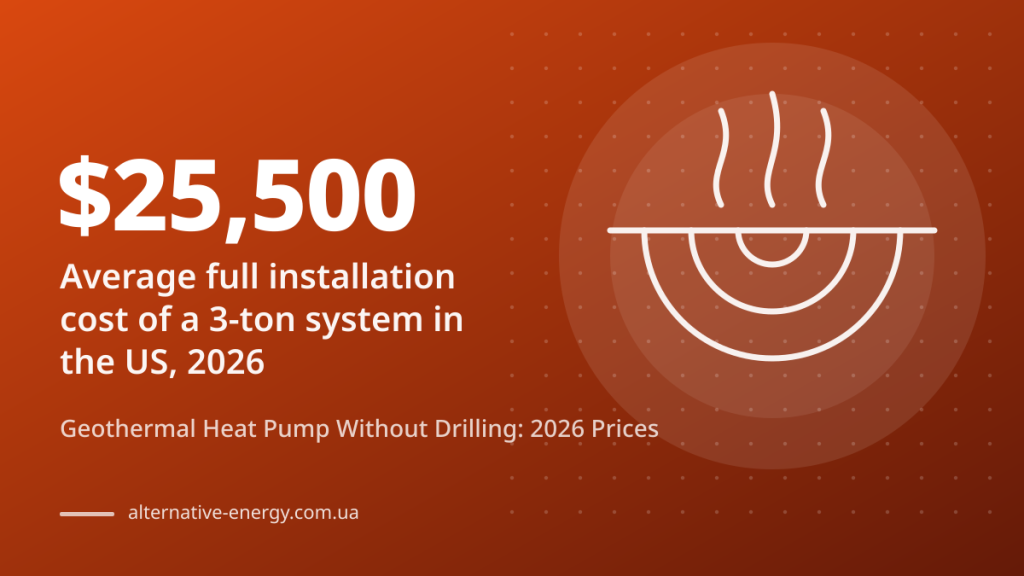
Reader question: “What does a geothermal heat pump actually cost in 2026 without drilling vertical boreholes, and what no-drill ground loop options are available?” The short answer: a complete 3-ton system installation in the US this year averages $25,500 — and among drill-free solutions, the pond loop is the cheapest while the slinky coil offers the best balance between cost and land use.
Key takeaways:
- Average total installed cost of a 3-ton geothermal heat pump in the US in 2026: $25,500 (range $20,000–$27,000).
- Horizontal trenched loop costs $4,000–$8,000 and suits properties with at least 0.4 acres of open land.
- Slinky loop runs $3,500–$7,000 and saves space through coiled pipe installation in shallower trenches.
- The federal §25D residential tax credit was eliminated as of January 1, 2026 — only state-level incentives remain.
Three Drill-Free Loop Types and Their Costs
Most geothermal heating content leads with vertical boreholes — the most expensive option requiring specialized drilling equipment. But for residential properties with available land, the US market offers three solid alternatives that skip the deep drill entirely. According to Geothermal Finder (USA), ground loop costs in 2026 break down as follows:
| Loop Type | Cost (USD) | Key Details |
|---|---|---|
| Horizontal | $4,000–$8,000 | Trenches 4–6 ft deep; requires 0.4+ acres of open ground |
| Slinky (coiled) | $3,500–$7,000 | Coiled pipe in shallower trenches — less land than horizontal |
| Pond loop | $3,000–$6,000 | Lowest cost option when a sufficiently large and deep water body is on-site |
| Vertical (for reference) | $8,000–$18,000 | Boreholes 150–400 ft deep; requires a drilling rig |

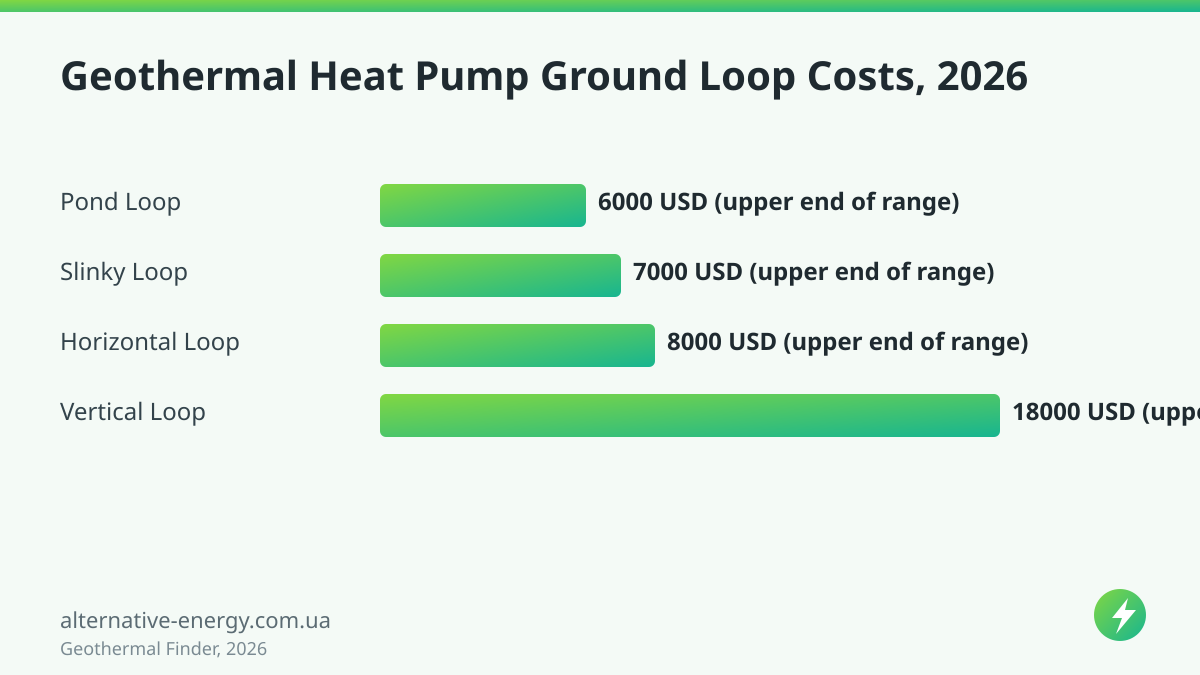
For a residential property with a modest lot, the horizontal or slinky loop is the most practical starting point: no drilling rig needed, and excavation can be handled with a standard backhoe. The pond loop is theoretically the cheapest but requires a suitable water body on the property — uncommon even for larger private estates.
What Makes Up the Full System Cost
The ground loop piping is just one of three major cost components. Interior equipment — the heat pump unit itself, ductwork modifications, and optionally a desuperheater for domestic hot water — adds $4,000–$9,000. Labor accounts for another $8,000–$20,000, representing 40–60% of the total budget. On vertical projects, the underground loop combined with drilling alone consumes 50–70% of the total cost — the single largest line item.
For context: a standard 3-ton US system in average soil runs $20,000–$27,000, while rocky New England ground conditions can push costs to $35,000–$50,000 or more. The indoor unit is rated for 20–25 years of service, while the buried polyethylene loop piping is designed to last 50–75 years or longer. For a deeper look at common misconceptions and real-world performance data, see our article on heat pump myths and realities.
Why 2026 Changed the Economics: The End of §25D
The biggest news for US homeowners this year is the elimination of the federal §25D residential geothermal tax credit effective January 1, 2026. Previously, 30% of the total installation cost could be reclaimed through a tax return. What remains now are state-level programs and utility rebates, while the commercial sector still has access to the §48 credit. For US buyers, this means thousands of dollars added to the real out-of-pocket cost. The broader lesson is clear: government incentives have a decisive impact on payback periods, even in the world’s largest economy.
Frequently Asked Questions
Does the slinky loop work in climates outside the US?
The technology is climate-agnostic: coiled pipe is laid in shallower trenches than a standard horizontal loop (which requires 4–6 ft depth). The key requirements are soil that standard excavation equipment can handle and less surface area than a conventional horizontal field — making it widely applicable wherever residential ground-source systems are installed.
What share of the total budget goes to the ground loop itself?
According to Geothermal Finder, vertical projects allocate 50–70% of the total budget to the underground loop and drilling combined. For horizontal and slinky loops, that share is lower — deep drilling costs disappear, and the budget is split more evenly between excavation work and the heat pump unit itself.
US pricing serves as a useful benchmark for proportional cost structure elsewhere: the ratio of equipment cost, loop cost, and labor share holds fairly consistent even when local installation rates differ significantly. The most important decision — which loop type to use — is determined not by a product catalog but by the size and geology of the specific site.