



The global home energy storage market is set to reach a record 46.1 GWh in 2026, with three manufacturers each holding roughly 11% of supply. Taiwan-based analytics firm InfoLink Consulting notes the industry is entering a maturity phase — the focus is shifting from raw capacity growth toward integrated energy systems combining solar, storage, and smart management.
Key highlights:
- Global supply forecast: 46.1 GWh in 2026.
- Europe alone accounts for 15.4 GWh of that total.
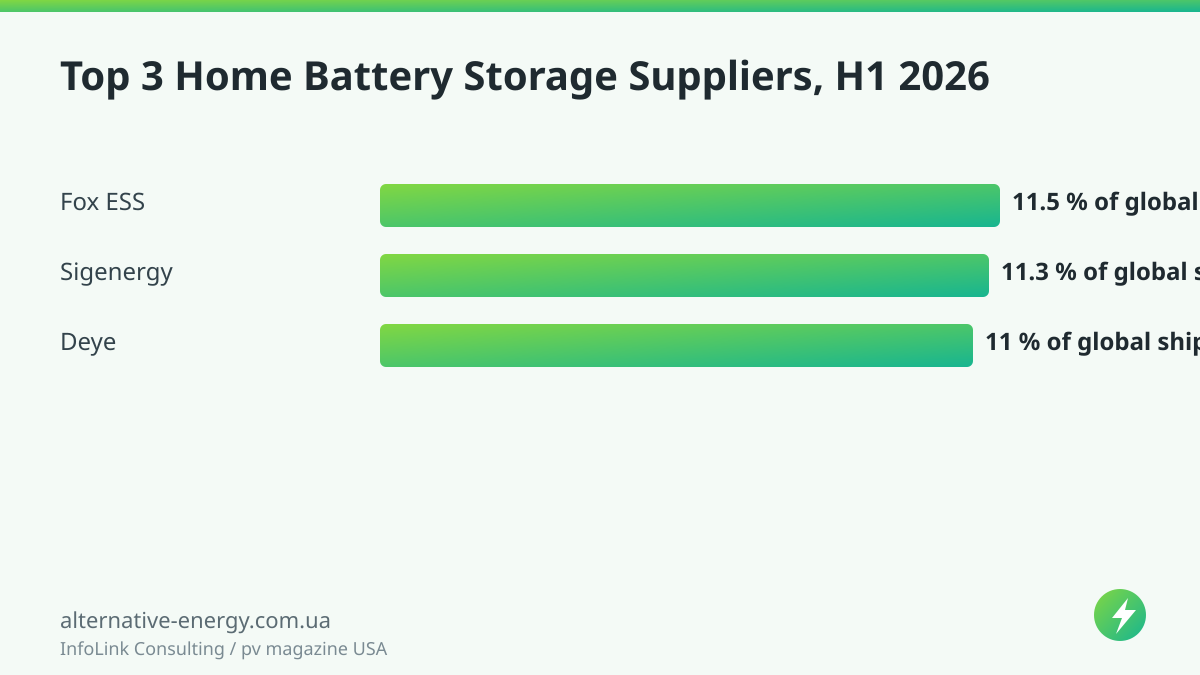
- Top 3 suppliers in H1 2026: Fox ESS (11.5%), Sigenergy (11.3%), Deye (11.0%).
- Eastern Europe is among the fastest-growing regional markets.
Who Leads the Residential Battery Market
According to pv magazine USA, citing InfoLink Consulting, the market remains highly fragmented — the gap between leaders and runners-up is razor-thin. Fox ESS holds 11.5% of global H1 2026 shipments, Sigenergy 11.3%, and Deye 11.0%. A long tail of Chinese and European brands follows, each with low single-digit market shares. The fact that even the number-one player falls short of twelve percent of the global market tells you everything about how competitive this space has become.
A few years ago, this segment revolved around a handful of players who effectively set prices. Today, competition stretches across dozens of manufacturers, compressing margins and accelerating feature rollouts. For buyers, that means more choice — but also a greater need to vet suppliers carefully. Brand name alone is no longer enough.

Why Europe and Australia Are Driving Demand
Europe remains the dominant regional market at 15.4 GWh in 2026. The main drivers are Germany, Italy, Austria, the Netherlands, and the UK — all markets with active support programs or favorable feed-in structures for solar-plus-storage households. Oceania and Asia are gradually closing the gap. Australia in particular has a strong shot at becoming the single largest national market, thanks to its Cheaper Home Batteries program, which launched on 1 July 2025 and significantly reduces installation costs for homeowners. In Pakistan and the Philippines, demand is driven by grid instability and high electricity tariffs — a scenario that will feel familiar to many buyers in Eastern Europe.
Five Trends Shaping the Market
InfoLink identifies five key directions. First, all-in-one solar-plus-storage kits — inverter, battery, and controller in a single enclosure — are replacing assemblies of separate components. Second, manufacturers are expanding into commercial and industrial applications as well as micro-storage for balcony solar systems. Third, whole-home energy solutions that integrate photovoltaics, storage, EV charging, and heat pumps are gaining ground. Fourth, smart management algorithms and virtual power plant (VPP) connectivity are turning household batteries into shared grid-balancing assets. Fifth, regional differentiation is sharpening: mature markets prioritize efficiency and features, while emerging markets focus primarily on cost per kWh of capacity.
What This Means for International Buyers
Eastern Europe is explicitly flagged by InfoLink as an accelerating demand hotspot. Years of grid disruptions have made residential battery systems less of a bill-reduction investment and more of an energy resilience necessity. We have covered the outlook for large-scale storage deployment separately, and locally manufactured home batteries are also developing at the national level. The sharp rise in global competition translates into a wider product selection and gradually falling per-kWh prices for buyers everywhere. At the same time, it pays to look beyond the brand — in a fragmented market, not every manufacturer has a mature warranty and service network in your country.
Frequently Asked Questions
What is an integrated solar-plus-storage system?
It is a ready-made kit in which the inverter, battery, and controller are housed in a single enclosure or optimized to work together out of the box. This approach simplifies installation, lowers total system cost, and reduces the number of potential failure points. According to InfoLink, it is one of the defining trends in the industry in 2026.
Can a home battery participate in a virtual power plant?
Yes. Modern systems support VPP connectivity — platforms that aggregate thousands of residential batteries and provide grid-balancing services. In Europe and Australia, such schemes already generate supplemental income for owners. In many emerging markets, VPP programs are still in early stages but are expected to scale quickly as penetration rises.
Sources: pv magazine USA