


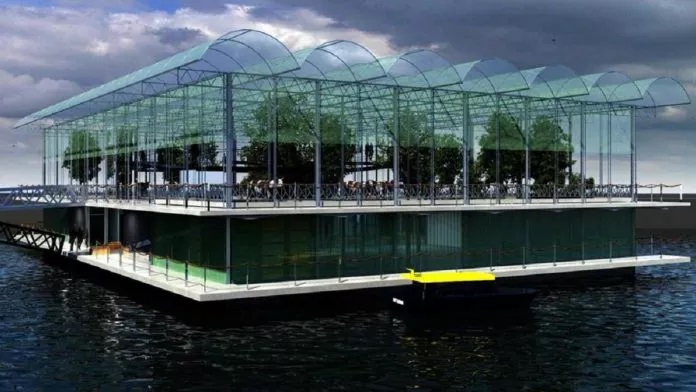
Dutch engineers surprised the world public with a statement that the opening of a dairy farm, which will be located on the surface of the water in the bay of Mervehafen, will soon take place. The farm will provide dairy products to the city of Rotterdam. According to the idea of the organizers of the project, this facility will house 40 animals capable of supplying 1,000 liters of milk throughout the day.
The ecological company will belong to the development company Beladon. Representatives of the company said that such a crazy at first sight idea – to build a farm on the water; it is justified and has a clear goal.
The initiative to build such an unusual facility belongs to one of the employees of the company-developer Peter van Wingerden. A man for several years before witnessed the hurricane Sandy, which was held at that time in the United States. An engineer by training, Peter drew attention to the fact that fragile and unstable logistics chains are used to provide food for cities. After the storm, New York became very close to starvation. All the ways of delivery of products from wholesale depots to shops have been destroyed.
It was this event that prompted the man to create a project to build a farm in the city. Such production reduces the risk of hunger in emergency cases tenfold and raises food security for residents.
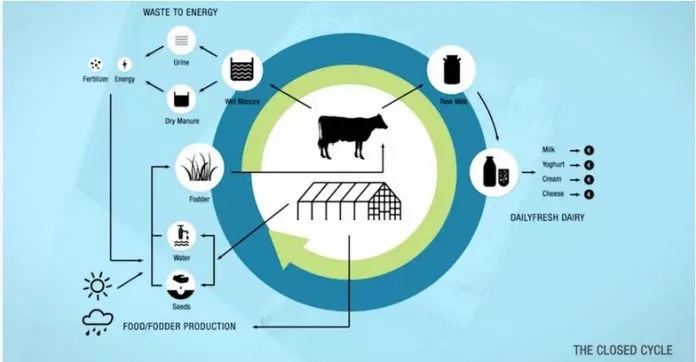

Wastes from the livelihoods of cows will be used as fertilizers for the plantation. As a stimulating factor for accelerated development of plants, special illumination will be applied. On the floating platform will grow duckweed, clover and alfalfa, which the cows love so much.
Cleaning of manure will be handled exclusively by robotics. In addition to being used as a fertilizer, cattle waste will also be used to generate electricity. On the platform will install a power plant. Photovoltaic modules will provide the electricity needed for the electrolysis of hydrogen. On one of the lower levels of the floating object, yoghurt production and pasteurization of the milk received from the cows will be carried out.
Floating objects began to appear gradually around the world. Two years ago, Janine Hung created an eco-farm on the water. The project was named Jellyfish Lodge. These objects look like jellyfish. They move along the surface of reservoirs and perform a purifying function in the process of food production.
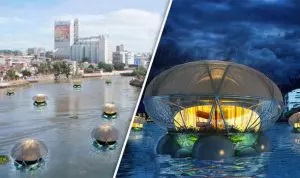

On top of floating objects are installed solar panels, under which is located a green fragrant garden. The irrigation system operates on filtered water from reservoirs on which the gardens are located.
In addition to collecting debris from water bodies, “jellyfish” make a water test for the presence of toxins. If the level of toxicity is increased, then through the special reservoirs of microbiological digestion the water is purified with its further return to the reservoir.
Man’s productive activity in the food industry has a colossal negative impact on nature. The issues of waste management are growing more and more acute every year. Such projects, combining food production and alternative technologies, allow minimizing pollution of the environment.