


You are free to use these materials for educational purpose.
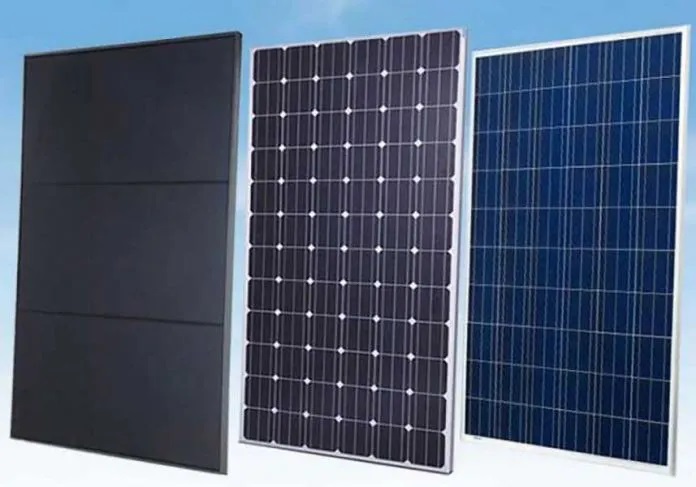
In the pursuit of maximum efficiency, as well as maximum power per dollar value, solar panel manufacturers from around the world are constantly improving their products and looking for ways to even more efficiently convert sunlight into electricity. Thus, there are currently seven main types of solar panels that are the most popular and widely used:
- single crystal;
- multi crystal;
- polycrystalline;
- thin-film;
- of amorphous silicon;
- based on cadmium telluride;
- based on CIGS.
Monocrystalline solar panels

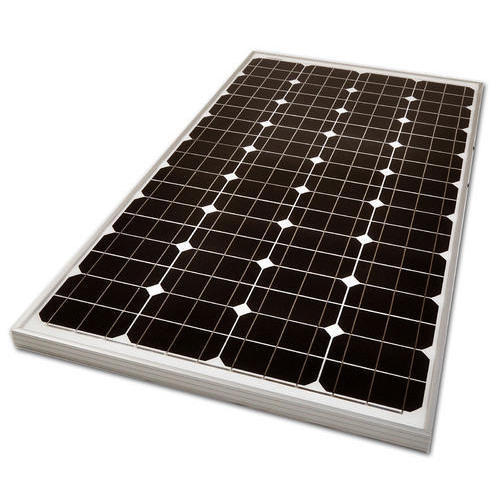
Monocrystalline solar panels are the most popular and widely used in the world. Their production process begins with the casting of a cylinder with a diameter of 13-20 cm and a length of up to 200 cm from high-purity silicon. After it hardens, the cylinder is cut into sheets with a thickness of 250-300 micrometers. A feature of this method is a solid crystal lattice, which improves the mobility of electrons and allows to achieve an efficiency of 23.5%, which is more than analogues.
In a solar cell, a sheet of silicon is pierced with electrodes and closed with shockproof glass. They can be identified by the dark blue or black color of the photocells.
Features of single-crystal panels:
- High efficiency (14-23.5% in the finished battery depending on the manufacturer and quality, record 43.6%);
- Durability (up to 50 years);
- High price (one of the lowest watts / dollar).
The disadvantage of single-crystal panels is also the shape of the photocells in the form of polygons, which are very difficult to effectively fill the area, which reduces the power level per square meter.
Multi crystal solar panels
Cheaper and easier to manufacture are multi-crystal solar panels. In them, the role of photocells is played by randomly collected sheets of crystals with different crystal lattices. This leads to a drop in efficiency of up to 15%, but significantly reduces the cost of panel production and increases the capacity per dollar spent.
Features of multi-crystal panels:
- Relatively low cost of production;
- High power per dollar;
- Efficiency reduction (Max. 15%);
- Service life is 25 years.
Polycrystalline solar panels
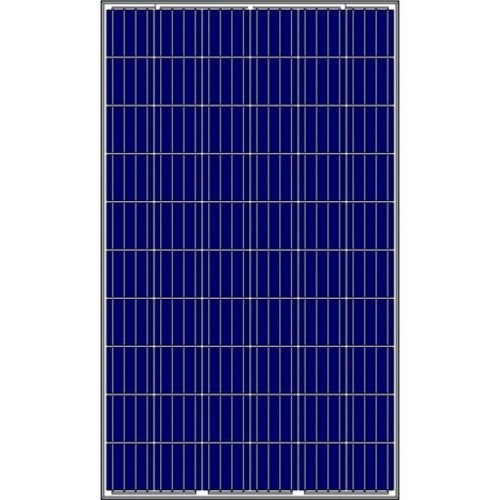
A more effective analogue of single-crystal panels are polycrystalline. They use aggregate crystals with crystal lattices of different shapes and orientations. Use of this technology allows to reach indicators very close to single-crystal panels. You can identify a polycrystalline solar cell by the bright blue color of the photocells.
Features of polycrystalline panels:
- High efficiency (up to 18%);
- High power per dollar;
- Low efficiency in the shade and sensitivity to the angle of incidence of sunlight;
- Relatively short service life (10 years).
Thin-film solar panels

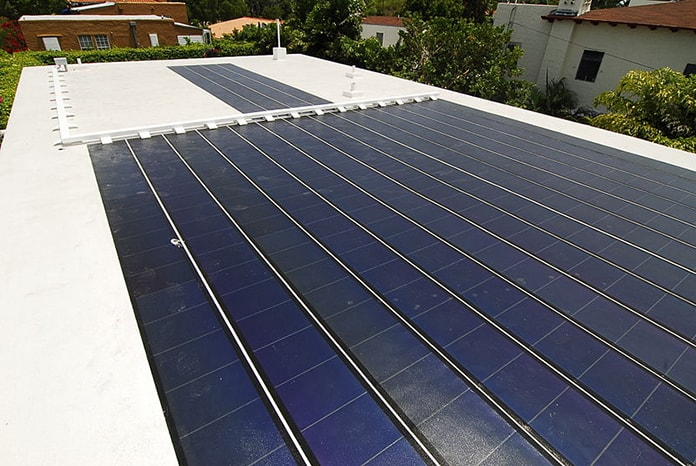
The efficiency of thin-film solar panels is much lower than that of analogues. Such panels of the second generation have this figure at 8-12% depending on the manufacturer. But thin film solar panels have some undeniable advantages. First, they are made of ultra-thin sheets of silicon only a few microns thick on a very thin glass or metal base. Their production is much less expensive than that of single-crystal panels, which makes them one of the best in terms of power per dollar.
Second, thin-film solar panels produce energy much better than their counterparts from reflected light, in the shade, in cloudy weather, and in the evening when the sun’s rays fall at an unfavorable angle. This is what has made thin-film solar panels one of the most popular solutions for regions with few sunny days.
Features of thin-film panels:
- Low price;
- One of the highest power per dollar;
- Work in the shade, with reflected light and at unfavorable angles of incidence of sunlight;
- Low efficiency, which requires the installation of more panels.
Solar panels made of amorphous silicon

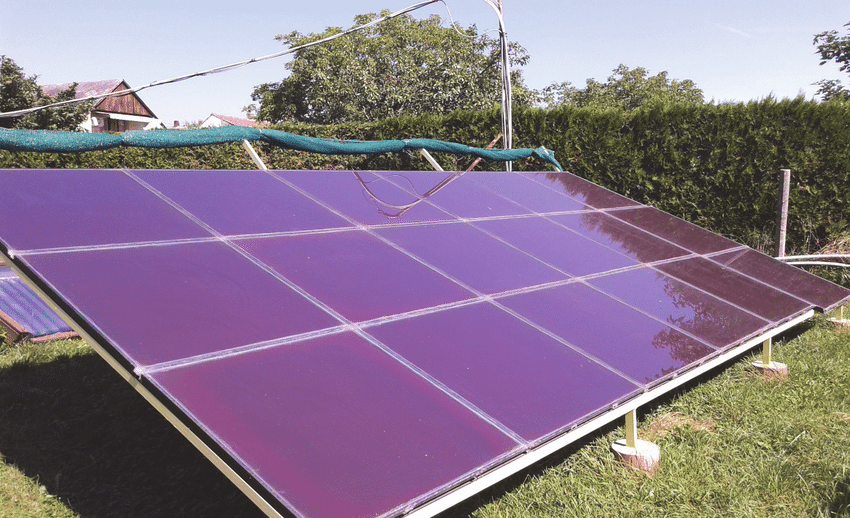
Amorphous silicon due to the peculiarities of the structure does not allow to achieve a high level of efficiency. Such solar panels have this figure at the level of 6-8%, but they have a very low cost and one of the highest power indicators per dollar value. They are also called first-generation thin-film solar panels.
Features of amorphous silicon panels:
- Produce the cheapest electricity, high power per dollar value;
- Low efficiency 6-8%.
- Work in the shade, with reflected light and at unfavorable angles of incidence of sunlight.
Solar panels based on cadmium telluride


The production process of CdTe solar panels is similar to film. The semiconductor has a thickness of several hundred micrometers and is also applied to a solid substrate. Such panels are relatively cheap, especially compared to single crystal. Their disadvantage is the relatively low efficiency of 11%.
Features of solar panels based on cadmium telluride:
- Low cost;
- Efficiency at the level of 11%;
- Work in the shade, with reflected light and at unfavorable angles of incidence of sunlight.
Solar panels based on CIGS

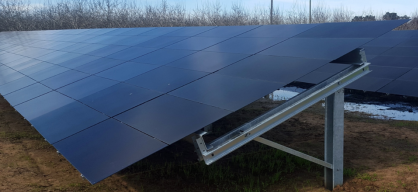
The use of semiconductors based on copper, indium, gallium and selenium allowed to increase the efficiency to 15%. These panels are also made of film technology, which significantly reduces their cost and gives advantages when working in the shade or in cloudy weather.
Features of panels based on CIGS:
- Work in the shade, with reflected light and at unfavorable angles of incidence of sunlight;
- More efficiency up to 15%.
Conclusions
Solar panels of the above types cover different needs. For example, single crystals are best suited in situations where it is necessary to achieve maximum power with a minimum mass and area of the solar panel. Namely in the space industry, although they also continue to be used in certain situations.
Polycrystalline solar panels will be the most optimal farms because of their price. But it is important to set them correctly at the right angle to the horizon, and without objects around that can obscure the photocells.
For other situations, thin-film solar panels that do not require ideal conditions for maximum efficiency are recommended.