



This conclusion was made by scientists after a series of studies conducted at NASA, as well as at Honda and Caltech. For the manufacture of traditional batteries, lithium is used as the main component. Scientists say that for the purpose of storing energy, fluoride or fluoride ion can be equally effective. It is worth noting that this element has the largest negative charge.
According to theoretical data, the battery, created on the basis of fluoride, is capable of holding 10 times more charge than in comparison with lithium representatives. Until now, the creation of a real project using a fluoride battery was hard to achieve due to the fact that the normal functioning of this type of battery is available only when it is heated to 150 degrees Celsius.
The engineers of the above organizations, working in one research group, managed to create a special electrolyte in a liquid state, which was called BTFE. This substance has one indisputable advantage – it dissolves fluoride at room temperature.
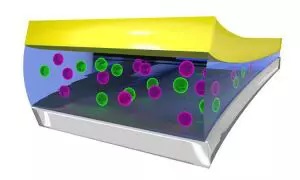

The real release of such fluoride energy storage today is a big question. Obviously, some theoretical and practical aspects require additional refinement and experimental work. The stumbling block, in addition to temperature, is the duration of the existence of copper components in the battery. The fact is that the anode and cathode succumbed to complete dissolution in fluoride. Scientists are now actively working to increase the life of these components.
Scientists have achieved positive results in the laboratory – this is a fact. That’s just to reproduce this experience in reality, it takes time. There is a small chance that this technology will become a real breakthrough in the future. With the same likelihood, development can be a dead end. Work on this project continues and the fact that it is such global giants that develop this theory gives hope for its success.

Solid-state batteries are distinguished by the fact that the traditional electrolyte, which has a gel-like consistency, is replaced by a conductive component presented in a solid state. This innovation is characterized by increased reliability and safety. Solid-state batteries are not flammable. In addition, these batteries have an increased energy density, and the full charge time is minimized.
The opened plant will be able to produce batteries, the total capacity of which is 100 megawatt-hours per year. The energy density in these batteries is more than 400 watt-hours per kilogram.
New research on finding alternative ways to store energy is being conducted around the world. This gives hope for cheaper energy and increase its environmental friendliness.