



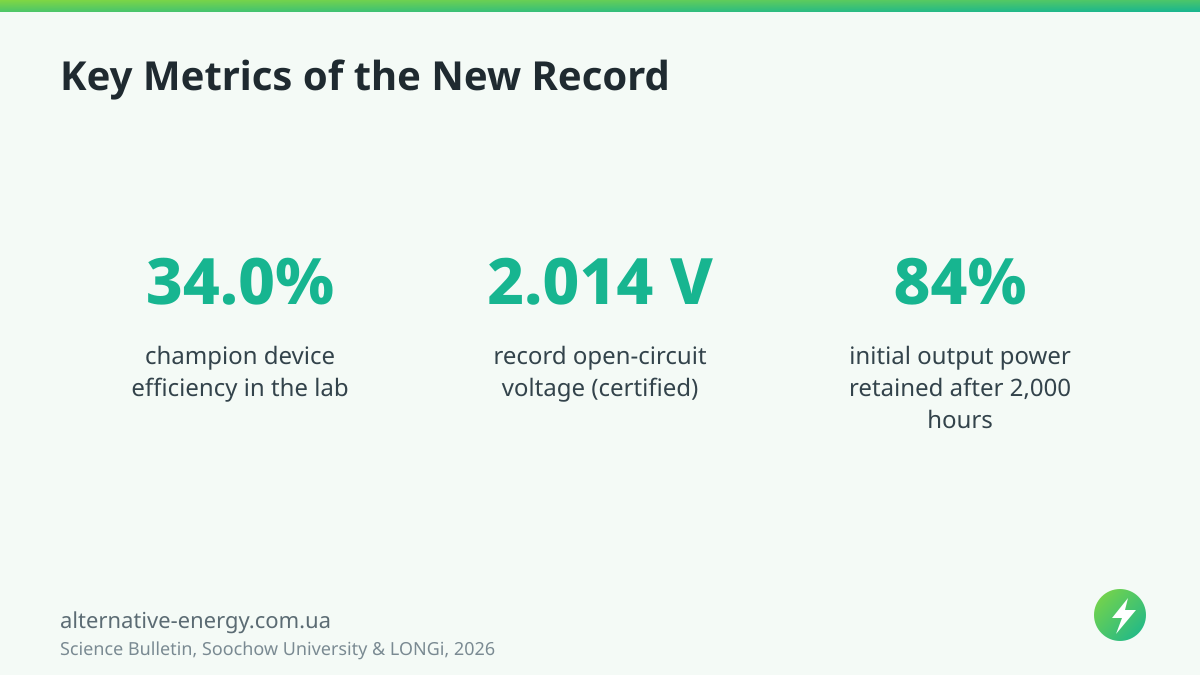
A perovskite-silicon tandem solar cell has set a new benchmark: in the lab, the champion device delivered a power conversion efficiency of 34.0% at an open-circuit voltage of 1.997 V, while independent certification confirmed a stabilized efficiency of 33.5% and a record open-circuit voltage of 2.014 V. The device retained 84% of its initial performance after 2,000 hours of continuous operation under one-sun illumination.
The result comes from a team at Soochow University working in collaboration with LONGi’s R&D center. The findings were published in Science Bulletin, and the key to the breakthrough is a nanoscale scaffold of zirconium dioxide (ZrO₂) particles embedded between the cell’s functional layers.
- 34.0% champion efficiency in the lab and 33.5% independently certified
- Open-circuit voltage of 2.014 V under certification — among the highest on record for this cell class
- 84% of initial output power retained after 2,000 hours of MPPT operation under one sun
- Carrier lifetime increased from 1.46 to 2.81 µs
What the Soochow team did
The tandem cell pairs a wide-bandgap perovskite top subcell with a silicon bottom subcell — a configuration that harvests a broader slice of the solar spectrum than a conventional silicon module. The well-known challenge: the perovskite film grows unevenly over the textured silicon surface, and non-radiative recombination at the hole-transport interface bleeds away the achievable voltage.
The team, led by professors Jiang Liu and Xiaohong Zhang alongside Dr. Hongbo Mo (Soochow University) and Dr. Bo He (LONGi), inserted individual particles of monoclinic ZrO₂ between the transparent conductive oxide and the self-assembled monolayer. The result is an intermittent nanostructure — a microscopic framework that does not impede charge transport.
ZrO₂ plays a dual role. First, it modifies the surface energy so that the liquid perovskite precursor spreads more uniformly across the substrate, yielding a dense film with large grains and no voids. Second, localized zirconia domains produce a local field effect that suppresses recombination, while the unoccupied areas of the monolayer remain open for fast hole extraction.

Why 2.014 V matters
Open-circuit voltage directly reflects how much useful work each photon can deliver. In perovskite/silicon tandems this figure has consistently fallen short of theoretical predictions — due precisely to interfacial losses. According to Solar Now (via EurekAlert), the certified record of 2.014 V was achieved by simultaneously suppressing recombination and preserving fast charge transport.
The champion device also recorded a short-circuit current density of 20.36 mA/cm² and a fill factor of 83.62% — metrics that point to strong overall electrical behavior. Spectroscopic measurements confirmed the mechanism: average carrier lifetime in the perovskite film nearly doubled, rising from 1.46 to 2.81 µs.
What this means for the market
In practical terms, higher efficiency means more electricity from the same roof or land area — critical in markets where suitable space for solar installations is limited.
LONGi, one of the world’s largest solar module manufacturers and a co-author on the study, has a proven record of scaling advanced cell architectures into mass production. The remaining open question is durability: 84% retention after 2,000 hours is encouraging, but long-term stability remains the central challenge for tandem technology. Parallel advances in flexible perovskite cells and high-efficiency concentrator modules suggest the industry is converging on a new efficiency threshold from multiple directions at once.
Frequently Asked Questions
When will these tandem cells reach rooftops?
The Soochow team is presenting a laboratory device, while LONGi is an industrial partner with experience in commercializing new solar technologies. The timeline will depend on further durability testing and manufacturing cost reduction.
How does a tandem cell differ from a standard silicon panel?
A tandem cell has two photoactive layers: the upper perovskite layer absorbs visible light, while the lower silicon layer captures infrared radiation. This allows more electricity to be extracted from the same solar flux than a single-junction silicon cell can deliver.
Sources: Solar Now (via EurekAlert)