


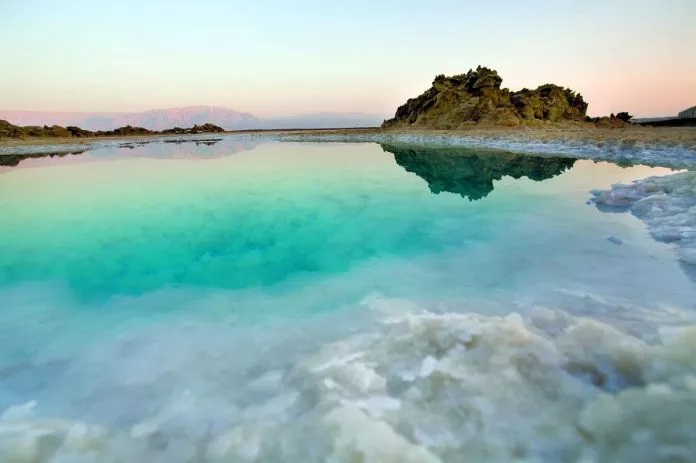
The salt solar pond is an artificially created reservoir, the depth of which is about two to four meters. The meaning of using such a pond is that in the bottom layer of the water of this pool has the maximum salt water. The dark bottom of the solar pond attracts the sun’s rays and, accordingly, the water on the bottom warms up, sometimes even to the boiling point.
The phenomenon that allows warming up water in this way is called “gravitational convection”. In nature, this kind of convection looks like this:
- water in a natural reservoir under the action of sunlight begins to warm up from the bottom;
- as the temperature rises, the density of water changes;
- a warmer liquid rises to the surface of the reservoir and gradually gives its temperature to the air.
In the solar pond, this process is completely eliminated by using layers of water of different salinity. In addition, the concentration of salt in the bottom layer of the solar pond increases during heating, as the salt dissolves more quickly in warmer water.
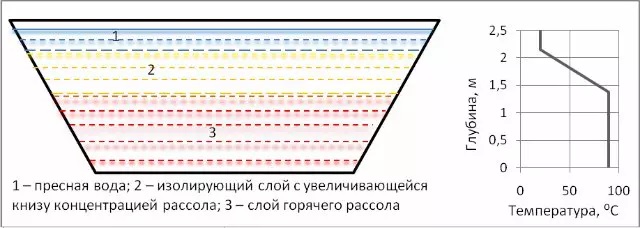

The temperature characteristics and heat transfer of the solar pond depends on a number of factors:
- activity of solar radiation in a certain region;
- the degree of transparency of the atmosphere;
- indicators of transparency of fresh water in the upper layer of the pond;
- concentration of brine in different layers of the reservoir;
- quality of thermal insulation on the bottom and side walls of the pond;
- the presence of concentration equipment that directs the sun’s rays directly into the pond;
- presence or absence of wind.
The upper layer in the solar pond consists of fresh water. The thickness of this layer, as a rule, is 10-30 cm. As a requirement for this layer of solar labor, smoothness of the surface appears which makes it possible to increase the level of absorption of sunlight, and the transparency of water. The upper layer of the solar pond is also called the convective zone.
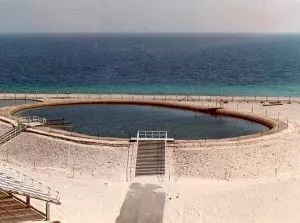

In modern energy, solar salt reservoirs use recycled materials from salt production enterprises. They contain a fairly large concentration of magnesium chloride, which cannot be eaten.
To prevent leakage, the bottom of the solar pond is covered with a plastic film. Alternative coating can be a furan resin. In some cases, to significantly reduce financial investments, use waterproof clay.
Among a number of advantages of solar ponds can be identified the following:
- the reservoir is able to accumulate scattered radiation, which is reflected from various objects, together with direct sunlight;
- the pond is able to perform simultaneously as a solar collector and a storage of thermal energy, while such a system is cheaper.
According to recent research, solar salt water reservoirs have the prospect of entering the top of the best alternative energy equipment. It should be noted that the power output generated from an area of one square meter is 20 kilowatts. The cost of such a pond is about 4,500 dollars per kilowatt.