


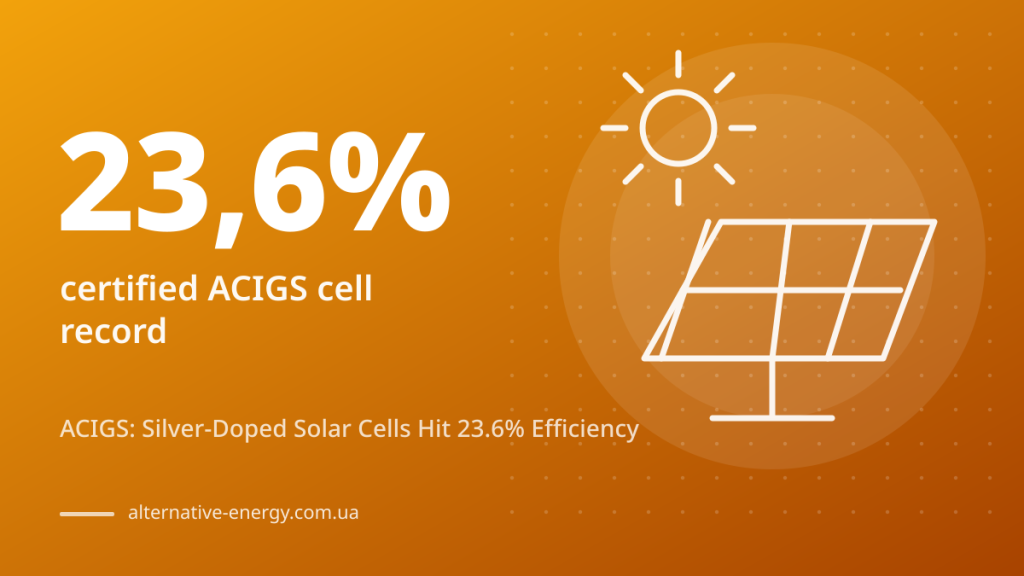
Portuguese physicists have systematically reviewed the advances in ACIGS solar cells — thin-film devices based on Cu(In,Ga)Se₂ in which copper is partially replaced by silver. The review, published on 28 October 2026 in the Journal of Physics: Energy, records a certified single-cell efficiency of 23.6% and a tandem efficiency of 30.71% with perovskite on a small area.
Key highlights:
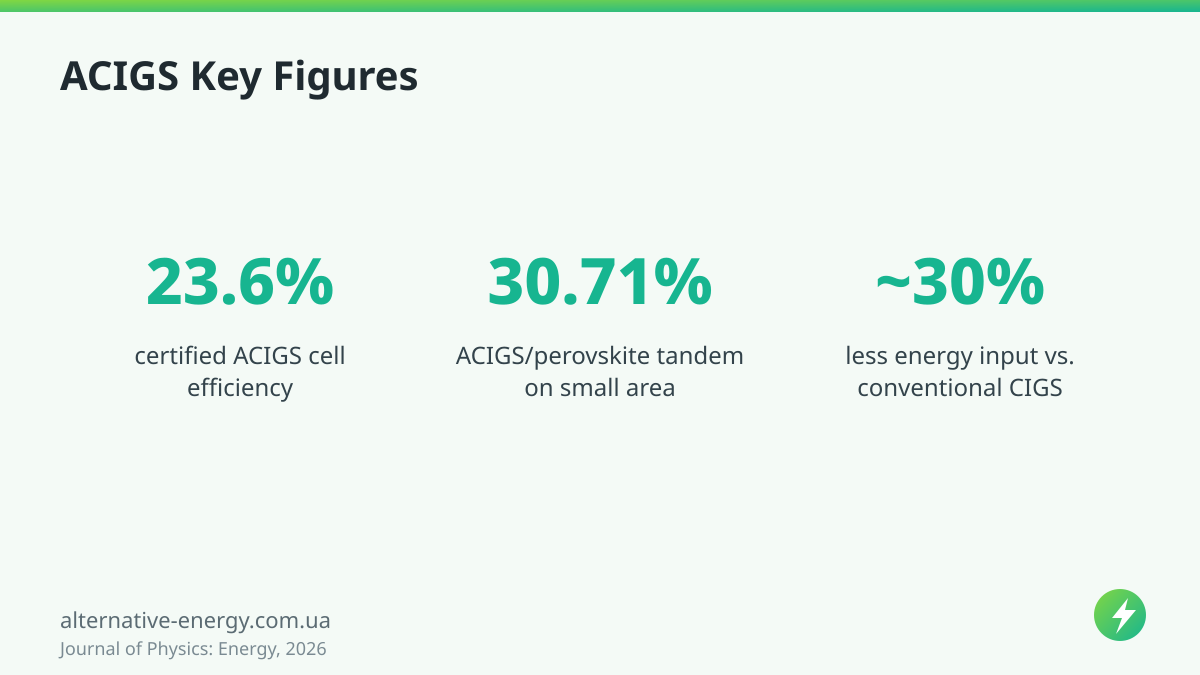
- Certified ACIGS cell efficiency — 23.6%.
- ACIGS/perovskite tandem — 30.71% on small area.
- Manufacturing energy consumption reduced by approximately 30% compared to conventional CIGS.
- Compatible with flexible substrates for BIPV and aerospace applications.
What Silver Substitution Brings
According to Journal of Physics: Energy (IOP Publishing), partially replacing copper with silver improves grain growth in the absorber layer, reduces structural defect density and grain boundary defects, and raises open-circuit voltage. The review’s authors — Paulo A. Fernandes and colleagues from the International Iberian Nanotechnology Laboratory (INL, Braga) and the University of Coimbra — highlight a key technological consequence: a lower film processing temperature.
Lower processing temperatures open the door to substrates that cannot withstand the harsh conditions of conventional CIGS fabrication — most notably flexible substrates. For the industry, this translates into lighter, bendable modules that can be integrated into building facades, curved rooftops, or weight-sensitive platforms.
The 23.6% Record and the Perovskite Tandem
The review records the certified ACIGS single-cell efficiency at 23.6%. In a tandem configuration with perovskite on a small area, efficiency reached 30.71%. The tandem combines layers that absorb different portions of the solar spectrum: perovskite handles shorter wavelengths while ACIGS covers the near-infrared range. The rationale for pairing perovskite with other materials is also explored in related research — see the article on perovskite solar cells without lithium.

Thin Films, Flexibility, and Economics
A thinner absorber reduces consumption of indium and gallium — materials considered critical to the photovoltaic supply chain. According to the review’s estimates, manufacturing ACIGS requires approximately 30% less energy than conventional CIGS, which affects both production cost and energy payback time.
Target applications cited in the publication include ultra-thin absorbers, flexible solar panels, bifacial and semi-transparent architectures for building-integrated photovoltaics (BIPV), and aerospace platforms.
Broader Significance
Rigid crystalline silicon modules are not always a practical fit. If ACIGS moves beyond laboratory cells into commercial module production, lightweight flexible panels could become a viable alternative wherever weight, substrate geometry, or facade integration matters. For now, the results pertain to individual cells and a review-level analysis — the milestones to watch next are early pilots at full module scale and their cost per watt.
Sources: Journal of Physics: Energy (IOP Publishing)
Prepared by the Alternative Energy editorial team with the help of AI based on the sources listed; facts and figures were checked against them during automated editorial review. How we prepare articles