


The November 2026 blackout season is once again reminding Ukrainian homeowners of an uncomfortable truth: modern heating stops the moment grid power goes out. Installation firm UnitechBau published an analysis of how to turn an ordinary boiler room into a blackout-proof boiler room — keeping the heat on even when the power has been out for a day or longer.
Key takeaways:
- A gas boiler with an electronic control board becomes useless without grid power, even if gas is still flowing in the pipes.
- A blackout-proof boiler room is built in three layers: a UPS first, then a generator or hybrid inverter with batteries, and as a last resort — a solid-fuel boiler.
- A standard UPS is not enough for a heat pump: it needs a powerful generator or a serious battery system.
- Pipes in unheated areas — basement, attic — must be insulated and fitted with drain valves; otherwise a prolonged winter blackout will split them.
Why the boiler shuts down with the lights
According to UnitechBau (Ukraine, installation company), electricity is involved in every step of combustion in an electronically controlled gas boiler. Without power, the control board cannot open the gas valve, trigger ignition, or monitor the flame — which is why a grid outage stops the boiler just as reliably as shutting off the gas supply.
The control board and ignition are not the only grid-dependent components. Without electricity, the forced-draft fan, circulation pumps for each heating circuit, room thermostats, weather-compensated controls, mixing units, and actuators all stop. The authors specifically note that in modern systems with small-bore pipework, the heating fluid moves purely by forced circulation. The boiler may be heating water in the boiler room, while the radiators on the upper floor stay cold — as long as the pump is not running.
A three-tier independence scheme
UnitechBau proposes building boiler room resilience in layers, where each successive tier covers a scenario the previous one cannot handle.
- Tier 1 — UPS. An uninterruptible power supply switches the boiler room to battery power instantly. It covers short to medium outages — from minutes to several hours.
- Tier 2 — Generator or hybrid inverter with batteries. Handles extended outages lasting a day or more, as long as fuel or solar generation is available.
- Tier 3 — Backup heat source. A solid-fuel boiler kicks in when both electricity and gas are unavailable simultaneously. The most extreme scenario — but the most critical one, because this is what prevents the house from freezing up.
For a city house where outages are mostly brief, Tier 1 is often enough. A rural property with lengthy grid failures will need the full scheme: generator plus a dedicated solid-fuel boiler. This approach fits naturally alongside other steps toward alternative energy supply for the household.

What matters when choosing a UPS
Installers highlight five parameters: output voltage waveform, load capacity, battery capacity, the neutral-ground-phase wiring scheme, and the type of UPS unit. A pure sine wave output is non-negotiable: a stepped waveform causes hum and overheating in pumps, and the boiler control board may log a fault and lock out the burner.
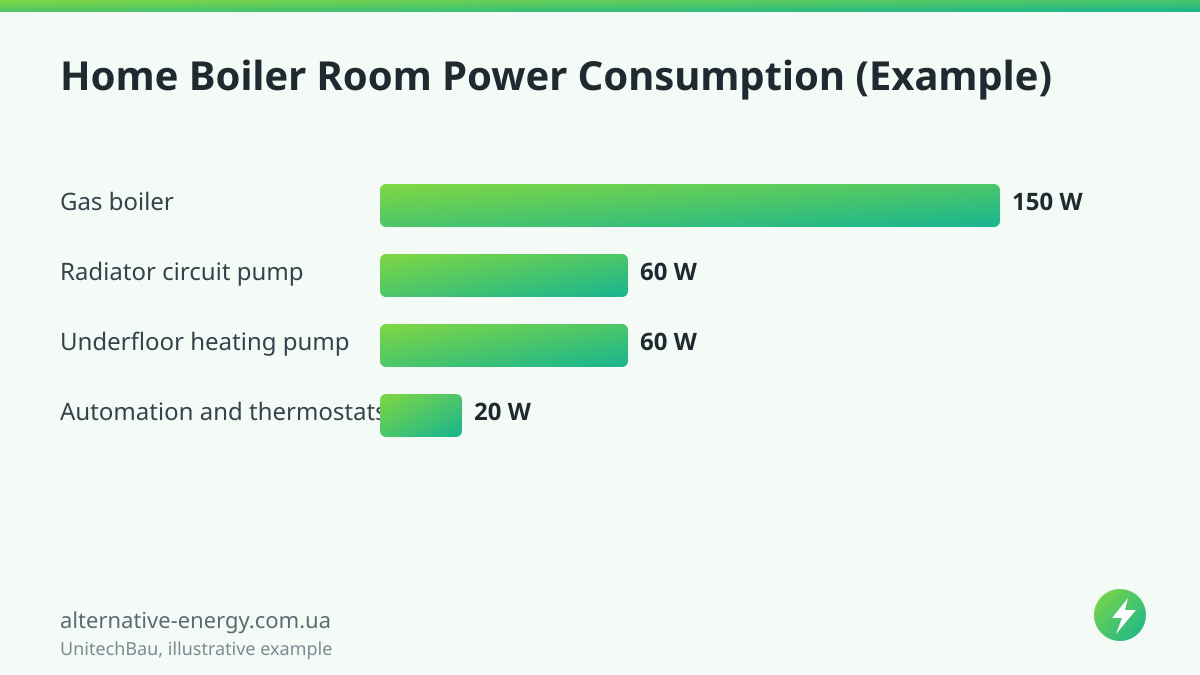
Capacity is sized by adding up the nameplate figures for everything in the boiler room, with headroom for pump inrush currents. UnitechBau gives an illustrative example: the gas boiler draws 150 W per its datasheet, the radiator circuit pump 60 W, the underfloor heating pump another 60 W, and automation with thermostats 20 W — a total of around 290 W. The UPS is selected with at least a one-and-a-half to two-times margin.
Battery capacity is matched to the actual outage schedules in your area. Two 12 V, 100 Ah lead-acid batteries together hold 2,400 Wh of energy. Allowing for a maximum discharge depth of half and an inverter efficiency of around 85%, the usable energy comes to roughly one kilowatt-hour. At an average draw of 200 W, that gives about five hours of autonomy. LiFePO4 batteries tolerate deeper discharge and more charge cycles; lead-acid units cost less upfront but degrade faster when regularly discharged deeply.
One additional detail: correct neutral and earthing connections matter. Many boilers verify flame presence via ionization current, and the control board needs to see the correct phase. If the UPS delivers a distorted neutral, the burner simply will not start — even if everything else is in order. This is why a boiler sometimes refuses to run from a portable consumer power station.
Why a heat pump needs more than a UPS
For heat pumps, the three-tier logic applies especially strictly. The compressor is entirely grid-dependent, and its inrush currents are high enough that a compact household UPS simply cannot handle them. The practical solution is a powerful generator or a hybrid system with sufficient battery capacity. Without that level of backup, it makes sense to have a second boiler running on a different fuel type, so that the home’s heating does not depend on a single power supply line.
Pipes, the hot-water cylinder, and the building’s thermal mass
Even with the boiler room cut off, a house does not freeze instantly. A thick underfloor heating screed acts as a thermal store and keeps releasing heat for several hours after the system stops. How quickly the indoor temperature falls depends on wall and roof insulation, window quality, the mass of the building structure, and outdoor conditions.
Before an anticipated outage, the thermal reserve can be topped up: pre-heat rooms by 1–2 °C in advance, fully reheat the indirect hot-water cylinder, and close doors to unheated zones. It is also worth inspecting pipes in the basement, attic, and service ducts: runs through cold zones should be insulated, and drain valves should be fitted at the low points — so that if a prolonged hard frost coincides with an outage, the heating fluid can be drained before pipes and radiators split.
What this means for the homeowner
UnitechBau’s three-tier logic is not a marketing pitch to buy everything at once — it is an honest separation of risks. A UPS covers everyday interruptions; a generator or hybrid system covers extended failures; a solid-fuel boiler covers the scenario where two resources disappear at the same time. For anyone building a new home or redesigning a boiler room, it pays to plan for this at the design stage: leave space for a battery cabinet, provision for a generator feed, and a flue connection for the backup heat source. That is cheaper and cleaner than retrofitting a boiler room on a freezing evening when the neighbours have already been without power for two days. For those setting up an off-grid energy system at a country property, the same principles apply at a smaller scale — and they are worth thinking through before the first outage hits.
Sources: UnitechBau, 0462.ua
Prepared by the Alternative Energy editorial team with the help of AI based on the sources listed; facts and figures were checked against them during automated editorial review. How we prepare articles