


Solar energy is set to become the world’s largest source of electricity by 2031. That is the headline finding of the tenth edition of DNV’s annual Energy Transition Outlook, published on 7 October 2026. According to the company’s modelling, solar’s share of global electricity generation will reach 46% by 2060.
Key takeaways:
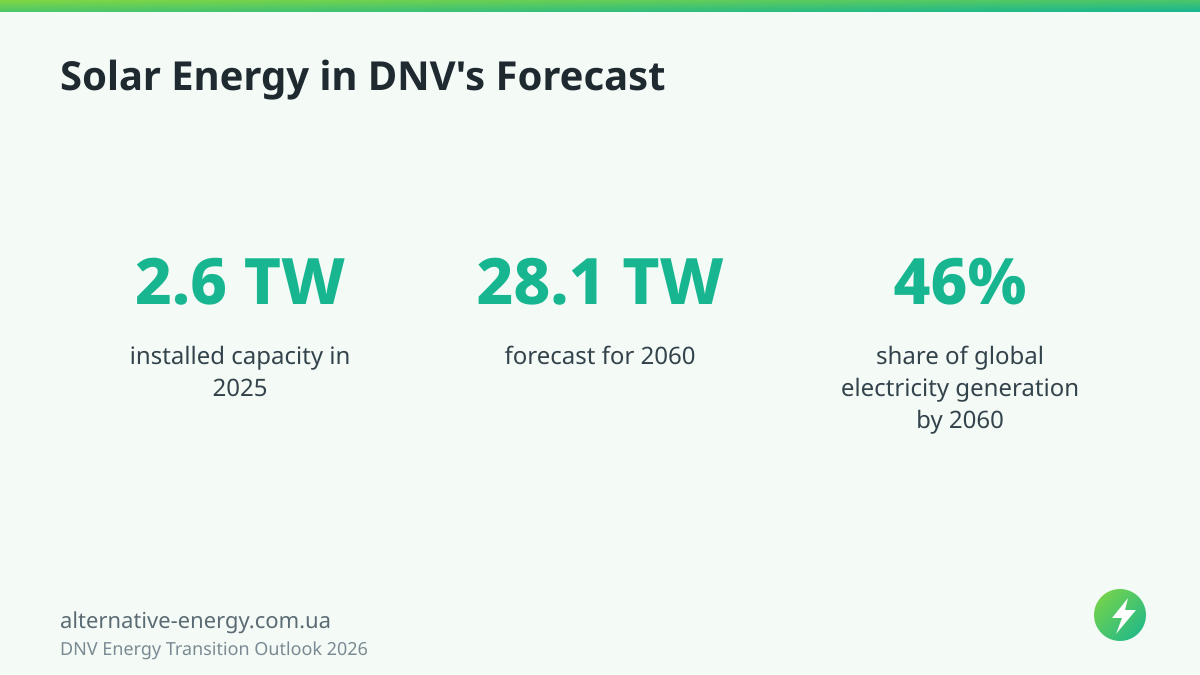
- Installed solar capacity stood at 2.6 TW in 2025; it will double by 2030 and reach 28.1 TW by 2060.
- By 2060, solar will supply 46% of global electricity, wind 31%.
- Annual investment in solar will average $600 billion over 2026–2035 — more than double the $240 billion average of 2016–2025.
- Total global electricity generation will rise from 33,000 TWh in 2025 to 84,000 TWh in 2060.
What DNV actually forecasts
According to pv-tech.org, the tenth edition of the Energy Transition Outlook puts installed solar capacity at 2.6 TW in 2025. That figure is expected to double by 2030 and grow tenfold by the late 2050s, reaching 28.1 TW in 2060. In every region except North-East Eurasia, solar will account for more than 40% of electricity generation.
Despite two decades of rapid growth, DNV expects annual additions of new solar capacity to peak in 2026 and then hold roughly stable for several years. The reason: grid constraints and rising curtailment in Europe and Greater China — the two regions with the highest existing installed capacity.
Utility-scale solar capacity is projected to reach 5,769 GW by 2040. Greater China alone will account for more than 1.8 TW, North America for 860 GW, and the Indian Subcontinent — eight countries including India, Pakistan, and Bangladesh — for a further 734 GW.

Investment doubles, storage becomes standard
Annual investment in solar PV is forecast to climb from an average of $240 billion (2016–2025) to $600 billion over 2026–2035 — more than double, and more than twice the level projected for wind over the same period. For broader context on where industry revenues are heading, see the outlook for global solar sector revenue over the next decade.
The market structure is also shifting. The share of solar plants co-located with energy storage systems will rise from 14% of installed capacity in 2025 to 30% in 2040 and 35% in 2060. In Europe, the share of new co-located installations will grow from 25% to 40% between 2024 and 2035; in Greater China, from 22% to 40%. The share of rooftop systems — residential and commercial — will remain broadly stable at around 40%.
Among all clean-energy technologies, energy storage is growing the fastest: annual additions increased 25-fold between 2020 and 2026. By comparison, solar PV grew fivefold over the same period, while wind doubled.
Energy security is redrawing the transition map
DNV places particular emphasis on the fact that building solar power plants and wind farms has become a matter of energy security. Energy-importing regions — Europe, China, and India — raised the share of non-fossil sources in their primary energy mix from 19% in 2021 to 22% in 2026. Energy exporters — the Middle East, North America, and Russia — moved only marginally, from 13% to 14%. The report concludes that importing nations are deploying clean energy three times faster than exporters. For large-scale regional projects, see also the overview of solar initiatives across the Middle East.
As one example, DNV has revised its Southeast Asia forecast upward: solar power plant installations in 2026 will be 25% higher than projected a year ago, and distributed solar generation 50% higher. In the EU, the AccelerateEU strategy launched in April 2026 aims to accelerate the clean-energy transition; DNV estimates that Europe’s solar fleet avoided €10 billion ($11.2 billion) in gas import costs between March and May 2026.
“Energy security is redrawing the energy-transition map. Importing regions are accelerating electrification, renewable generation, and storage to reduce dependence on the most volatile fossil-fuel markets,” said Ditlev Engel, CEO of Energy Systems at DNV.
What this means for the industry
The DNV forecast is not a declaration — it is a calculation based on the tenth iteration of an energy-transition model. For anyone planning a new solar power plant, it makes a strong case for building in an energy storage system as a core part of the project architecture, rather than treating it as an optional add-on.
Sources: pv-tech.org
Illustration generated with AI
Prepared by the Alternative Energy editorial team with the help of AI based on the sources listed; facts and figures were checked against them during automated editorial review. How we prepare articles