


Ukraine’s State Agency for Energy Efficiency and Conservation has officially confirmed that the western oblasts of Ukraine hold a substantial geothermal energy resource capable of partially substituting imported gas. The announcement came at a joint meeting between the Ukrainian agency and Iceland’s National Energy Authority, dedicated to the findings of Icelandic research into Ukraine’s subsurface geology.
Key takeaways:
- Priority regions with suitable thermal water deposits: Zakarpattia, Mykolaiv, Odesa, and Kherson oblasts.
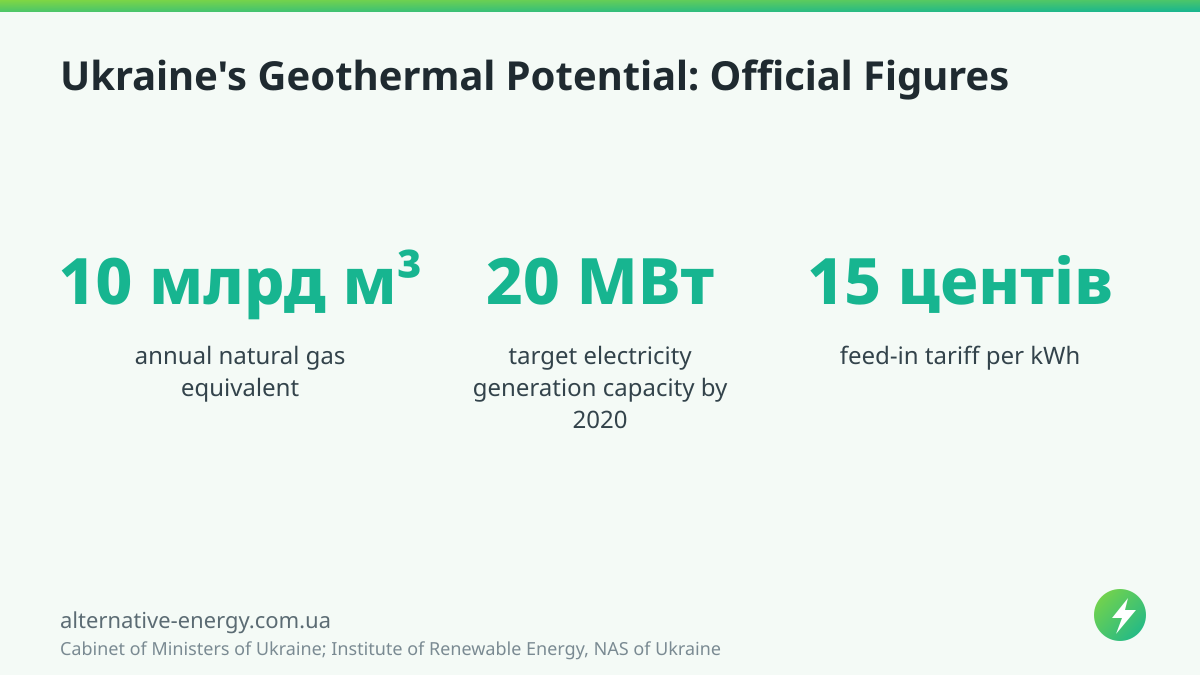
- Technically achievable annual potential estimated at the equivalent of roughly 10 bln m³ of natural gas (Institute of Renewable Energy, NAS of Ukraine).
- Ukraine’s renewable energy development plan through 2020 envisaged 20 MW of electricity generation from geothermal installations.
- A feed-in tariff of approximately 15 cents per kWh was introduced for the sector, pegged to the euro and fixed until 2030.
Where Ukraine’s underground heat is found
According to the Cabinet of Ministers of Ukraine, deposits of thermal water suitable for economic use are concentrated in four oblasts: Zakarpattia, Mykolaiv, Odesa, and Kherson. Western Ukraine was identified at the seminar as the most promising region for sector development.
Gudni Johannesson, head of Iceland’s National Energy Authority, specified which localities should be prioritized. He highlighted Uzhhorod and Berehove in Zakarpattia, Lviv and Mostyska in Lviv oblast, as well as Chernivtsi and Ivano-Frankivsk.
What the joint research with Iceland revealed
The meeting took place in Kyiv on November 11, 2016, and presented the findings of Icelandic research into Ukraine’s geothermal potential. The Ukrainian side was represented by the State Agency for Energy Efficiency; Iceland by the head of its national energy authority.
Experts stressed that realizing the sector’s potential requires a combination of factors: detailed geological data for each deposit, capable public institutions, access to long-term capital, modern drilling and heat-extraction equipment, and the involvement of external specialists.

Practical applications
Serhiy Savchuk explained that geothermal heat can be used for space heating in residential and public buildings, domestic hot water supply, and air conditioning. Ukraine’s renewable energy development plan through 2020 also included an electricity target of 20 MW from geothermal installations.
For investors, a feed-in tariff of approximately 15 cents per kWh was introduced in the sector. It is pegged to the euro and fixed until 2030 — designed to reduce currency and inflation risks over a long project horizon. A similar role in the low-temperature segment is played by heat pumps, which already tap “shallow” geothermal heat.
Why this matters at the government level
The figure cited by the Institute of Renewable Energy of the National Academy of Sciences of Ukraine represents the technically achievable annual potential — equivalent to roughly 10 bln m³ of natural gas. Public confirmation of that figure by the Cabinet of Ministers shifts geothermal energy from a “niche idea” into a declared national gas-substitution strategy.
For readers following the topic, this provides several practical reference points. First, if specific projects are of interest, look more closely at Zakarpattia and the southern oblasts named officially. Second, the long-term euro peg of the feed-in tariff is a meaningful signal for investors with extended payback horizons. Third, the 10 bln m³ figure is the upper bound of technical potential — not a forecast of actual output: the gap between the two is bridged by data, legislation, and capital. It is also worth following other regional assessments — for example, the geothermal resource of Kharkiv oblast, and the broader context of geothermal energy in Ukraine.
Sources: Кабінет Міністрів України
Illustration generated with AI
Prepared by the Alternative Energy editorial team with the help of AI based on the sources listed; facts and figures were checked against them during automated editorial review. How we prepare articles