


Greenpeace Ukraine, together with German charitable foundation BIOHAUS-Stiftung, has delivered equipment for a future hybrid solar power plant to the State Institution “National Scientific Center for Radiation Medicine, Hematology and Oncology of the National Academy of Medical Sciences of Ukraine.” The environmental organization announced the handover on November 26. The photovoltaic system with battery storage will allow the clinic to maintain power supply during disruptions to the centralized grid.
Key facts:
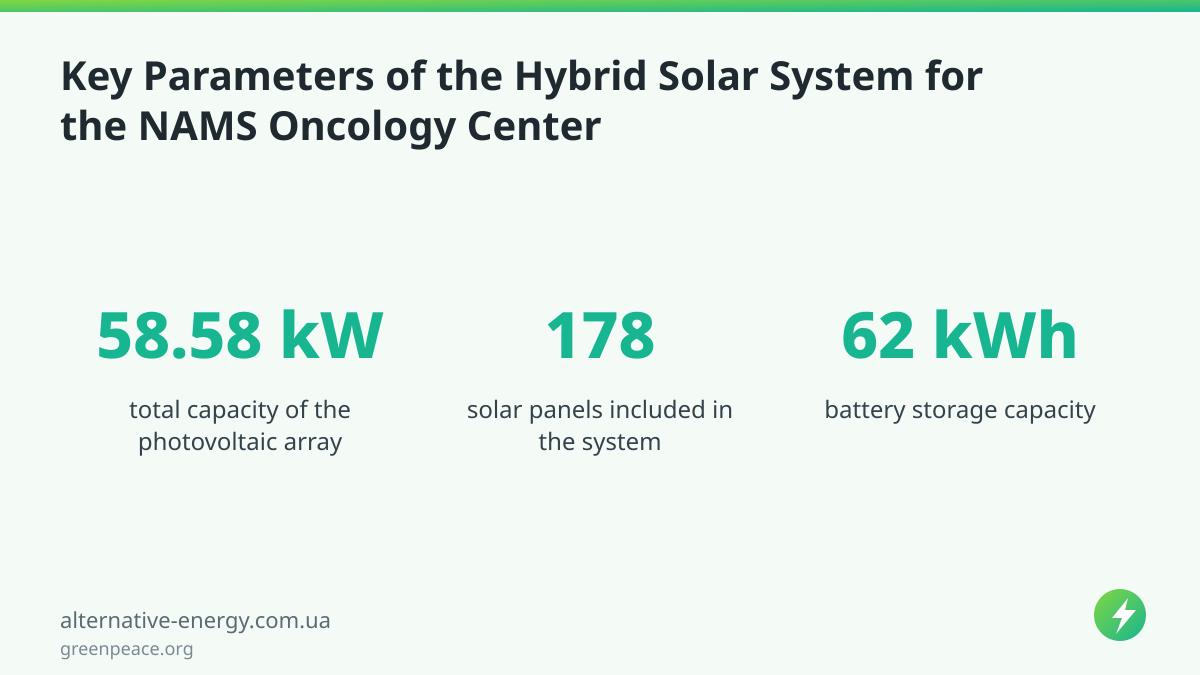
- Total photovoltaic array capacity — 58.58 kW.
- The system includes 178 solar panels and a 40 kVA inverter.
- The battery storage unit has a capacity of 62 kWh.
- Partner: German foundation BIOHAUS-Stiftung; installation is scheduled for 2027.
What Equipment the Oncology Center Received
According to greenpeace.org, the facility has already received 178 solar modules with a combined capacity of 58.58 kW, a 40 kVA inverter, and a battery storage unit with a capacity of 62 kWh. The hybrid solar power plant configuration means the system will simultaneously offset a portion of the hospital’s own consumption, charge the battery, and be capable of powering critical nodes when the external grid is unavailable. Installation and grid connection are planned for 2027 — the equipment was delivered as part of the “Sun for Ukraine” initiative.

Why This Hospital
The center treats patients with oncological, hematological, and radiation-induced conditions, including survivors of the Chornobyl nuclear disaster. In a facility of this kind, operating theaters and intensive care units cannot lose power even for a brief period.
Greenpeace Ukraine junior campaigner Illia Kuksenko connects the initiative to the 40th anniversary of the Chornobyl catastrophe, describing the transition of this particular hospital to renewable generation as a “worldview shift” in favor of human safety and environmental responsibility.
“Sun for Ukraine” in Context
The project is a joint initiative of Greenpeace Ukraine and BIOHAUS-Stiftung. Its goal is to help Ukrainian medical facilities maintain stable electricity supply in the face of systematic attacks on energy infrastructure.
Lessons for Other Medical Facilities
The NAMS oncology center case clearly demonstrates that a hybrid system with several tens of kilowatt-hours of storage capacity is a realistic backup power layer for operating rooms and intensive care units. When planning a similar installation, it is worth looking beyond the nominal capacity of the photovoltaic array and paying close attention to battery capacity and inverter specifications — these parameters determine how long a clinic can autonomously sustain its most critical equipment. If the “Greenpeace plus donor plus hospital” model scales up, it will create an additional resilience layer for the healthcare system outside the main grid.
Sources: greenpeace.org
Prepared by the Alternative Energy editorial team with the help of AI based on the sources listed; facts and figures were checked against them during automated editorial review. How we prepare articles