


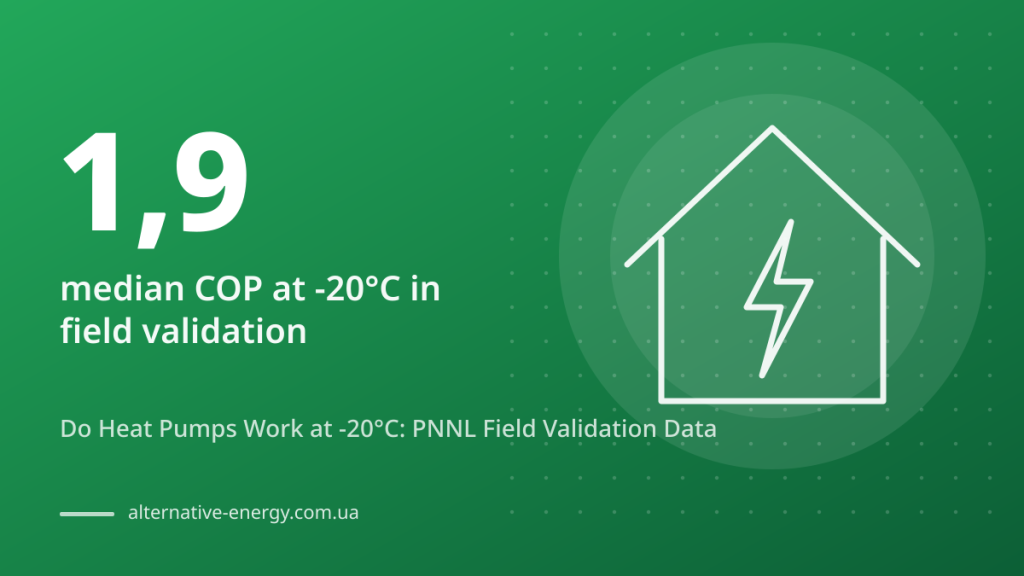
Do heat pumps genuinely hold their efficiency in severe cold, or is that mostly manufacturer marketing? The US government laboratory PNNL has published results from a large-scale field validation: a heat pump at -20°C in real residential homes achieved a median COP of 1.9 — twice as efficient as direct electric resistance heating. This is the first independent report based on actual housing data rather than laboratory test-bench figures.
Key figures:
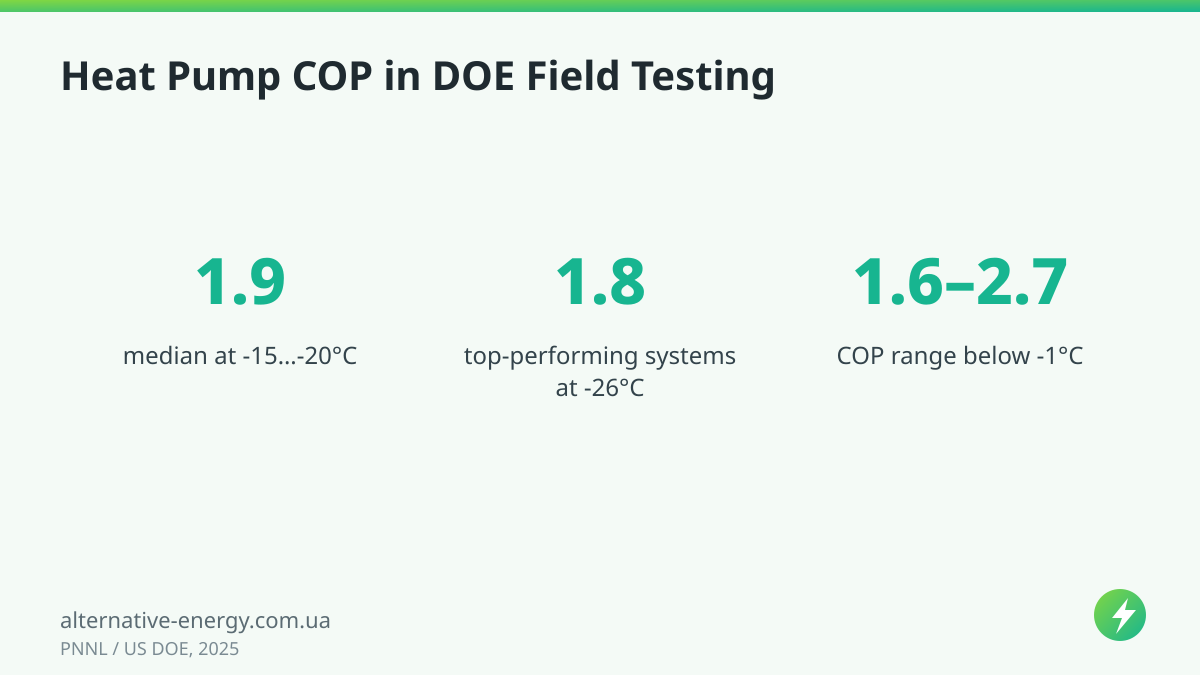
- Median COP = 1.9 at outdoor temperatures between -15°C and -20°C.
- Top-performing Challenge winners reached COP = 1.8 even at -26°C, accounting for all operating modes including backup electric resistance heat.
- Below -1°C, the median COP across models ranged from 1.6 to 2.7.
- Seven prototypes were tested in real homes across cold US climate zones from 2022 to 2024.
What DOE Actually Tested
The Cold Climate Heat Pump Challenge launched in 2021. According to Pacific Northwest National Laboratory (PNNL / US DOE), between 2022 and 2024 leading HVAC manufacturers developed prototypes optimized for operation at 5°F (-15°C) and below. Seven of those systems were installed in residential homes in cold US climate zones and monitored across two full heating seasons. These were not manufacturer marketing trials but field validation conducted by an independent government laboratory.
For context: according to PNNL, more than 40% of primary energy consumption in the US goes toward space heating, space cooling, and water heating. Conventional heat pumps have historically lost efficiency in extreme cold because extracting heat from frigid outdoor air becomes increasingly difficult — closing that gap was the central objective of the Challenge.
What COP 1.9 at -20°C Actually Means
COP (coefficient of performance) is the ratio of heat delivered to electricity consumed. A value of 1.9 means the unit delivers 1.9 kWh of heat for every 1 kWh of electricity used. Direct electric resistance heating — baseboard heaters, infrared panels — delivers roughly 1 kWh of heat per 1 kWh of electricity under the same conditions.
Below -1°C, the median COP across different models ranged from 1.6 to 2.7, meaning even the lowest-performing units outperformed electric boilers under real-world conditions. The top Challenge winners reached a COP of 1.8 at -26°C when all operating modes, including backup electric resistance heat, were factored in.

What This Means for Homeowners
The PNNL report gives homeowners the first authoritative numerical benchmark for evaluating manufacturer claims against real cold-climate performance. If a manufacturer advertises a consistently high COP at -20°C, there is now a concrete reference point: a median of 1.9 for prototypes that completed two years of field validation. It is worth confirming separately whether a quoted efficiency figure includes the backup heating element or covers the compressor alone.
For readers comparing air-source systems with ground-source heat pumps, the PNNL data provides a useful real-world benchmark for air-source performance in freezing conditions. Ground-source units draw from a relatively stable thermal reservoir below the frost line, making their winter efficiency less sensitive to outdoor temperature swings — though they carry a different capital cost profile. A broader overview of the technology options is available in the article on main types of heat pumps.
Editorial note. The PNNL report is a rare instance of an independent government laboratory validating heat pump performance under field conditions rather than on a controlled test bench. If you are selecting a heat pump for a region where temperatures regularly reach -15 to -20°C, a median COP of 1.9 and a range of 1.6–2.7 below -1°C represent a realistic baseline for expectations. Any manufacturer promise significantly above these figures is worth asking to back up with independent measurement data — not just a laboratory specification sheet.
Sources: Pacific Northwest National Laboratory (PNNL / US DOE)
Prepared by the Alternative Energy editorial team with the help of AI based on the sources listed; facts and figures were checked against them during automated editorial review. How we prepare articles