


At the SolarPlus Central Eastern Europe 2026 conference in Warsaw, senior developers and BloombergNEF analysts reached a shared conclusion: hybrid solar+BESS projects across Central and Eastern Europe present a compelling investment case even without government subsidies. The key driver is rising price spreads in spot markets, which makes energy storage economically justified on market terms alone.
Key takeaways:
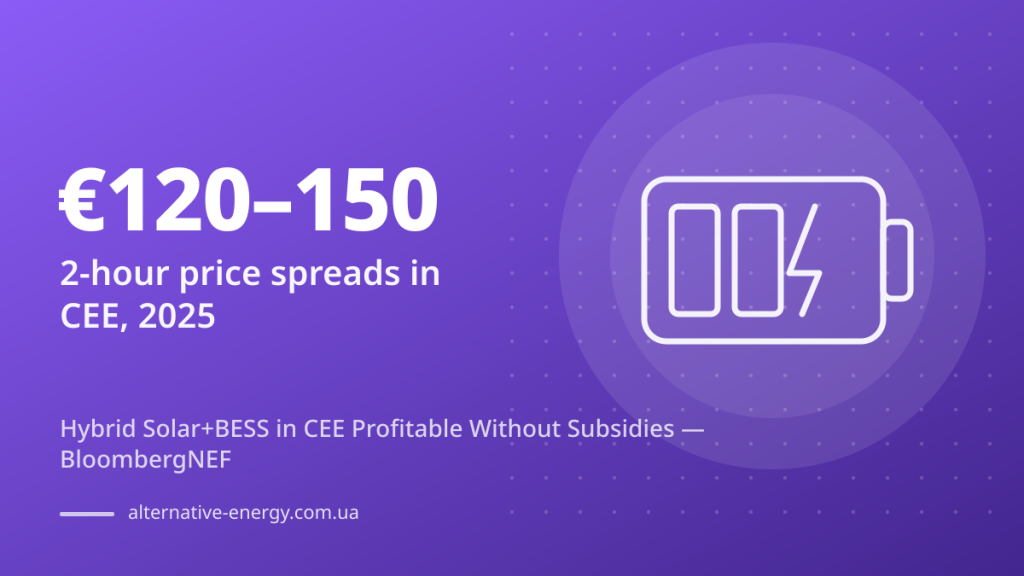
- 2-hour price spreads in CEE reached €120–150/MWh in 2025 (BloombergNEF).
- Co-locating solar plants with storage systems is now described as a “must-have” for the region.
- Core technical advantages: a shared grid connection point and an output profile closer to baseload.
- The sector lacks standardised contract frameworks for hybrid projects — a barrier to bankability.
Why Price Spreads Make BESS Economically Viable
In a BloombergNEF presentation at the conference, Sofia Perelli-Rocco cited the data: across Central and Eastern European markets, 2-hour price spreads in 2025 reached €120–150/MWh. “Price spreads are growing year on year,” the analyst noted. This gap between low and peak prices allows batteries to profit from arbitrage — charging during periods of excess solar generation and discharging when electricity is expensive.
For investors, this means the BESS business model no longer needs to rely on auction premiums or fixed feed-in tariffs. Reuven Gozal of Econergy stated that co-locating solar power plants and energy storage systems in today’s CEE market is already a prerequisite, not an option.
Technical Advantages of Co-location
Adrian Góralski, Head of M&A and Project Finance at Greenvolt Group, highlighted two key advantages of hybrid projects. First, the solar plant and the energy storage system share a single grid connection point — one of the most expensive and time-consuming elements of any project. Second, combining generation with a battery allows the output profile to approach baseload: during the evening peak, battery discharge offsets the decline in solar production.
The arbitrage logic is straightforward: the energy storage system charges at low daytime prices during peak solar output and discharges at higher price spreads. The result is a single site generating revenue from both solar generation and energy trading.
Market Education and Contract Standardisation
Danuta Tyrowicz, Chair of the Business Models Working Group at the Polish Energy Storage Association, outlined the core challenge: investors are confronted with the “unknown.” Despite strong interest in Polish and regional projects, established processes for hybrid projects are still absent — and this creates bankability risks for transactions.
Gozal added that much depends on outreach: “it’s a question of education” — meaning the gradual process by which market participants come to understand the logic of hybrid technologies. Conference speakers called for standardised contract models so that banks and funds can assess risks using familiar, replicable frameworks.
A Signal for Ukrainian Developers
The CEE experience demonstrates that if spreads in neighbouring jurisdictions hold at €120–150/MWh, hybrid projects can attract investor interest without subsidies — provided there is an open market and transparent grid connection rules. Regulators should track how European standards for hybrid contracts are taking shape: these will ultimately determine how accessible external capital becomes for Ukrainian solar power plants with co-located energy storage systems.
Sources: pv-tech.org
Prepared by the Alternative Energy editorial team with the help of AI based on the sources listed; facts and figures were checked against them during automated editorial review. How we prepare articles