


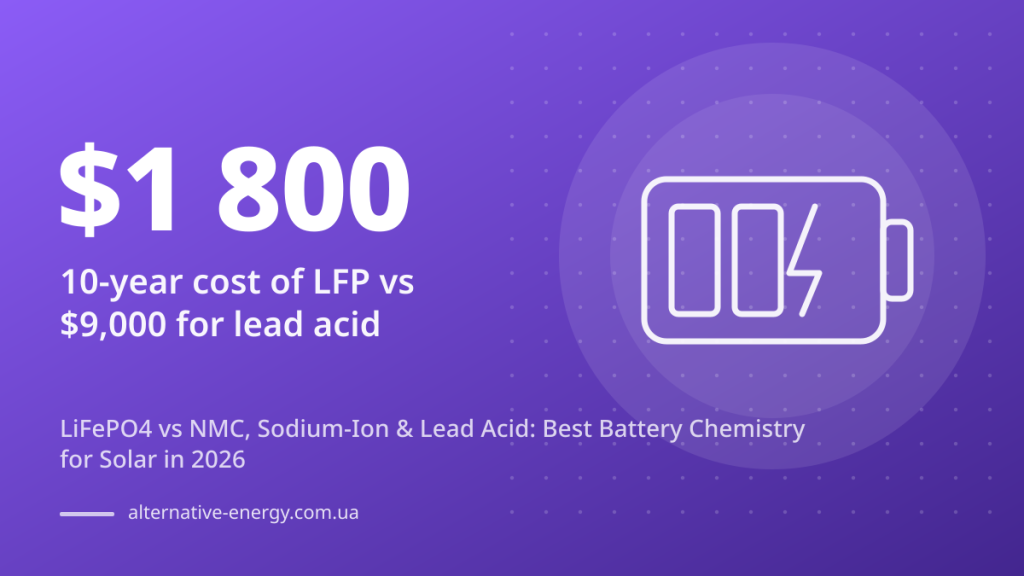
WattSizing analysts have published a head-to-head comparison of four battery chemistries for home solar systems in 2026: lithium iron phosphate (LiFePO4), nickel manganese cobalt (NMC), sodium-ion, and lead acid. The core takeaway: when choosing batteries for solar systems, purchase price is the wrong metric — total cost of ownership over 10 years can differ by as much as fivefold between technologies.
Quick summary:
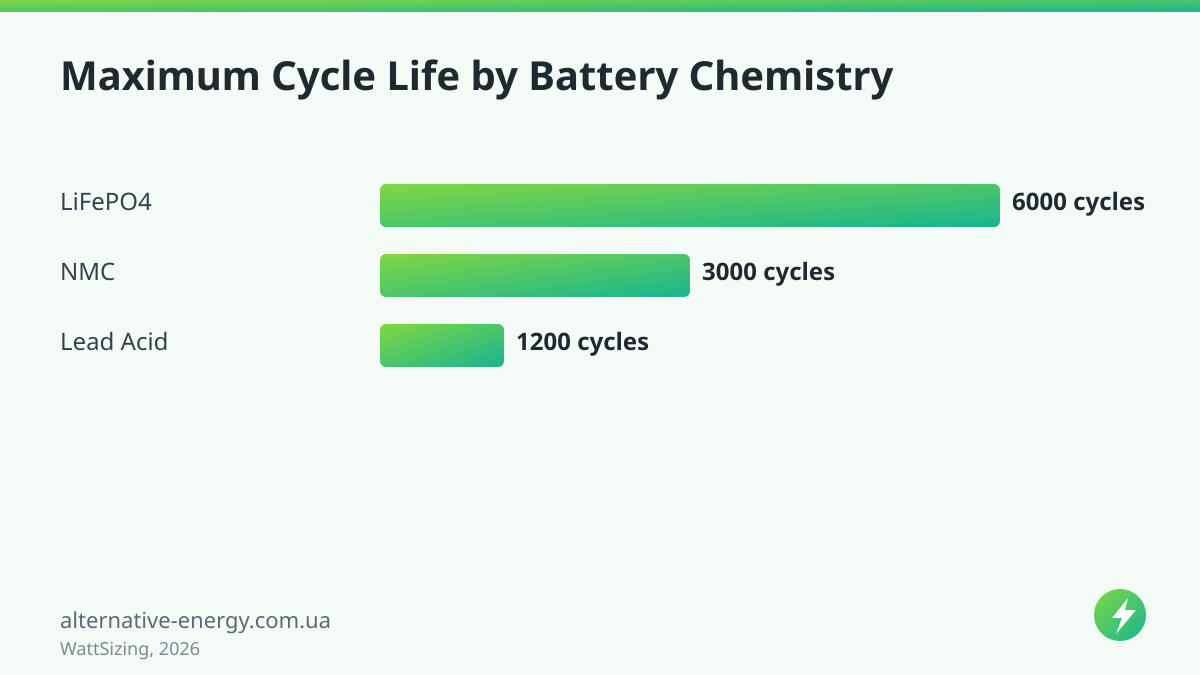
- LiFePO4: 3,000–6,000+ cycles, 80–90% usable depth of discharge, 10-year cost — ~$1,800 with no replacements.
- Lead acid (AGM): 300–1,200 cycles, only ~50% DoD; 10-year cost — ~$9,000 due to repeated replacements.
- NMC: 1,500–3,000 cycles, more compact, but carries a higher thermal runaway risk.
- Sodium-ion cells are actively entering the market in 2025–2026 as a cobalt- and lithium-independent alternative, though currently with lower energy density.
Why LiFePO4 Has Become the Default Choice
According to WattSizing, LFP chemistry dominates stationary solar and RV applications in 2026 for three properties that matter most in residential use: stability (thermal runaway is extremely rare), high usable capacity (80–90% discharge without degrading cycle life), and long lifespan — 3,000–6,000+ cycles, equivalent to over a decade of daily use. Compared to a lead acid bank of the same nameplate capacity, LFP delivers roughly twice the usable energy, since lead acid should only be discharged to ~50%.
10-Year TCO: Why Cheap Lead Acid Ends Up Expensive
WattSizing’s calculation for an off-grid home with a daily consumption of 5 kWh makes the economics clear. To deliver 5 kWh of usable energy at 50% DoD, you need a 10 kWh lead acid bank costing around $1,500. Its usable life is roughly 500 cycles — about a year and a half of daily cycling. Over 10 years, that bank needs replacing six times, adding up to ~$9,000.
A LiFePO4 bank for the same 5 kWh of usable capacity needs just 6.25 kWh of nameplate capacity (at 80% DoD). The upfront cost is higher — around $1,800 — but with ~4,000 cycle life that equals 11 years of daily use. No replacement is needed within the 10-year window. The result: $1,800 versus $9,000 for the same usable energy.

NMC, Sodium-Ion and Lead Acid: Where They Fit
NMC remains the choice where weight and size are critical: energy density is higher than LFP, but cycle life is lower — 1,500–3,000 cycles — and the risk of thermal runaway under damage or overheating conditions is greater. For indoor residential installations, installers more often recommend LFP.
Sodium-ion cells are coming to market in 2025–2026 as a low-cost alternative to lithium: simpler supply chain, good stability, and decent cold-weather performance. The main drawback today is lower energy density — the same capacity bank will be larger and heavier. For stationary storage where space is not a hard constraint, the technology is worth watching.
Lead acid batteries in 2026 make sense only for infrequent backup use or minimal-budget scenarios: under daily cycling, they lose out to LFP on both cycle life and total cost of ownership.
What BNEF Says: Battery Pack Prices Keep Falling
For stationary storage, prices have dropped to $70/kWh (−45% year-on-year), making this segment the lowest-cost application for lithium-ion batteries for the first time. LFP packs average $81/kWh, NMC packs $128/kWh. The main drivers of cost reduction, according to BNEF, are overcapacity among Chinese manufacturers, intense competition, and the mass shift to LFP chemistry. Combined with the multi-year decline in solar energy costs, this makes hybrid “panels + energy storage system” setups more financially accessible every year.
What Should a Homeowner Choose in 2026?
For new off-grid and hybrid installations, the case for LiFePO4 is now purely economic, not a premium choice: the higher upfront cost of an LFP pack is offset by the absence of replacements and roughly twice the usable capacity from the same nameplate rating. If budget constraints force a lead acid decision, the cost of future replacements should be built into the financial plan from day one. Sodium-ion is a technology worth tracking closely over the next year or two, especially for stationary systems where physical size is not a critical constraint. NMC remains a niche pick where every kilogram and every liter of space counts.
Sources: WattSizing, ESS News / BloombergNEF
Prepared by the Alternative Energy editorial team with the help of AI based on the sources listed; facts and figures were checked against them during automated editorial review. How we prepare articles