


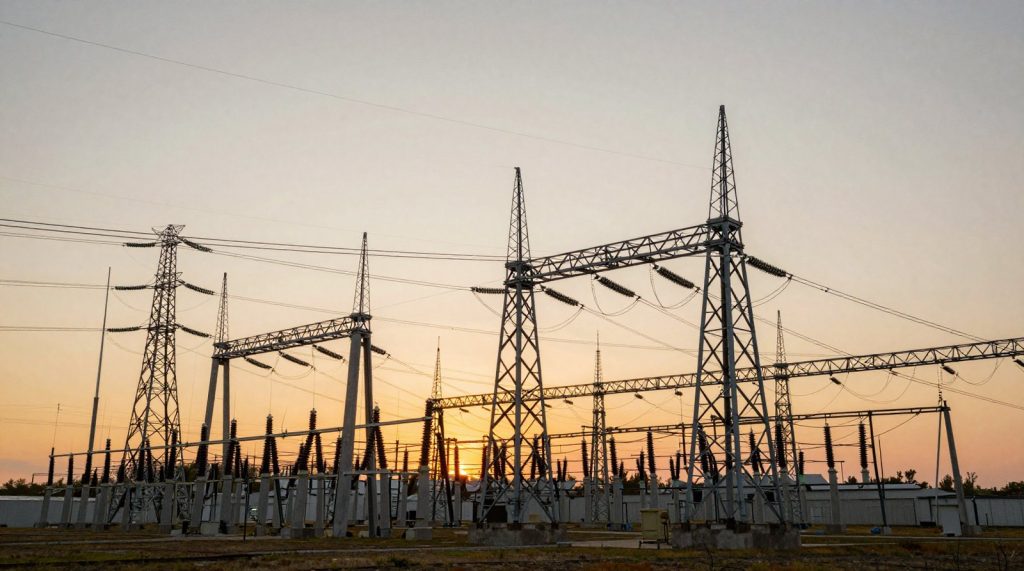
Ukraine’s National Energy and Utilities Regulatory Commission (NEURC) has expanded the geographic scope of the tertiary regulation market: generation asset owners from any region of the country can now supply this ancillary service to the transmission system operator, not just those based in the Kyiv region. The regulator’s move is designed to reduce the risk of electricity supply curtailments and support the stable operation of the Integrated Power System (IPS).
Key points:
- Geography: the interim procedure for procuring tertiary regulation services has been extended from Kyiv and the Kyiv region to the entire Ukrainian IPS.
- Eligible participants: suppliers with generation assets located anywhere in the country may now enter the transmission system operator’s auctions.
- Duration: the entire period of martial law, plus 30 days after it is terminated or lifted.
- Objective: to reduce the volume of potential electricity supply restrictions and keep grid parameters within acceptable limits.
What the regulator changed
According to ukrinform.ua, NEURC approved amendments to the Interim Procedure for Procuring the Replacement Reserve Ancillary Service — the official name for tertiary regulation in the regulator’s documentation. Previously, this mechanism applied only to the capital and the Kyiv region; it has now been extended to the entire territory of Ukraine.
The central change is the removal of the geographic restriction on participants. Ancillary service providers may enter the transmission system operator’s auctions regardless of where their generation assets are physically located within the IPS. The regulator’s announcement states that this makes it possible to draw on more available capacity to serve energy nodes experiencing deficits.
Tertiary regulation in plain terms
Tertiary regulation is the replacement reserve that the system operator activates manually once the faster mechanisms — primary and secondary regulation — have been exhausted. In practical terms, it is generation that a dispatcher can ramp up or load on command to bring the system back within acceptable limits following a sudden shortfall or a fault event.
The broader the pool of assets across different regions that can provide this service, the more flexible the dispatcher’s toolkit — and the less need to resort to consumer disconnections. This is precisely the argument NEURC uses to justify the decision.
Why this matters for distributed generation
For owners of generation assets outside the Kyiv region, a direct channel into the ancillary services market has opened up.
The rules will remain in force for the duration of martial law and for 30 days after it ends — a temporary but sufficiently long horizon to inform decisions about batteries or the upgrading of flexible capacity with an eye on additional ancillary service revenue. Broader context on electricity market reforms is available in our coverage of Ukraine’s energy market reform and the development of renewable energy in the country.
The opening of the mechanism to the entire country makes the ancillary services market more accessible to both large and smaller players alike.
Sources: Укрінформ
Illustration generated with AI
Prepared by the Alternative Energy editorial team with the help of AI based on the sources listed; facts and figures were checked against them during automated editorial review. How we prepare articles