


Solar panel production has reached consumer electronics scale. In 2026, factories worldwide produce around 62 modules per second — ten times more than in 2015. For every television manufactured globally, seven solar panels now roll off the line.
Key figures:
- around 62 panels per second in 2026 — 10 times more than in 2015;
- 1.4 billion modules vs. over 200 million televisions in 2025 — a 7:1 ratio;
- around 665 GW of combined capacity left factories in 2025 alone;
- average module output has grown from 150 W in 2008 to 475 W in 2025.
When Solar Panels Overtook Televisions
According to CleanTechnica, the turning point came in 2016, when annual solar module output surpassed TV production for the first time. The article’s author, Professor Ray Willis, had been using the TV comparison since 2015 as a maturity test for the industry — if more electricity-generating panels are being assembled than electricity-consuming screens, solar has entered an entirely different weight class.
The gap has only widened since. In 2021, the world assembled around 360 million panels; in 2022, roughly 790 million; by 2025, annual production had reached 1.4 billion modules. Television output for the same year came in at just over 200 million units — hence the seven-to-one ratio.
Speed and Wattage Rising Together
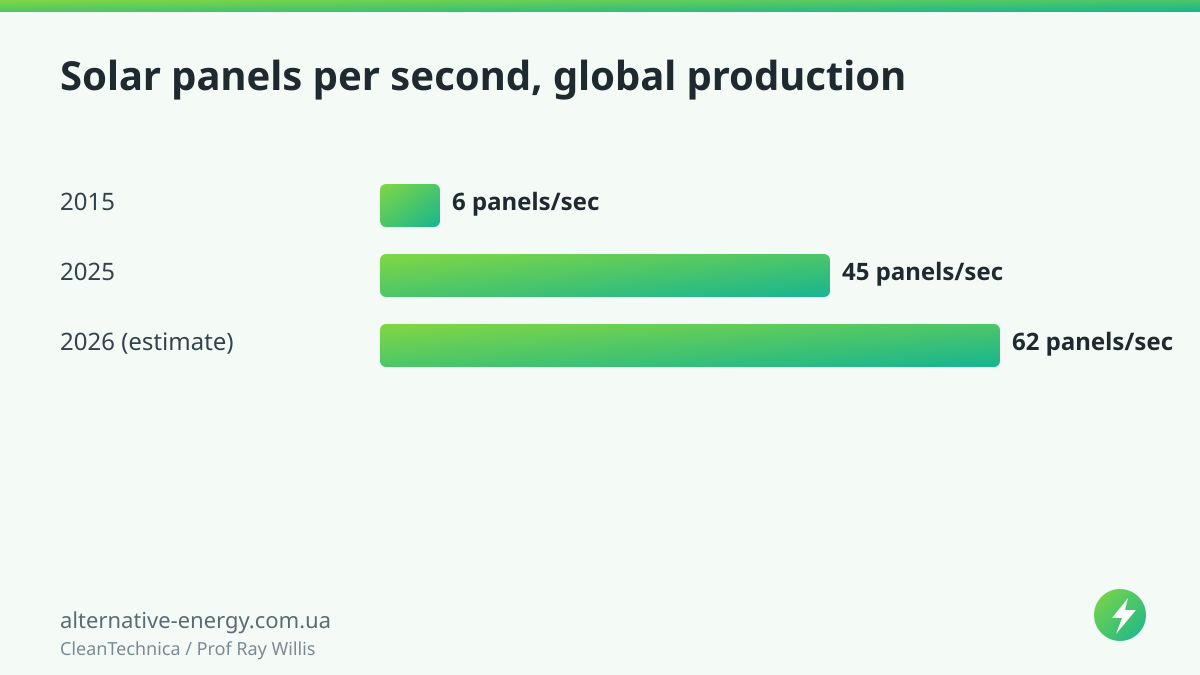
The pace of assembly becomes striking when measured in seconds. In 2015, all the world’s factories combined produced about six panels per second; by 2025 that figure stood at around 45; Ray Willis’s full-year estimate for 2026 is roughly 62 per second — approaching two billion modules a year.

Module wattage is climbing alongside volume. The average panel output has risen from 150 W in 2008 to 475 W in 2025. That is why 1.4 billion panels in 2025 translate to roughly 665 GW of new generating capacity added in a single year. We covered the ongoing push toward higher watts per square meter in our article on new solar module efficiency records.
Why This Statistic Matters for the Energy Transition
When annual output is counted in billions of units, solar photovoltaics has definitively ceased to be a “niche green technology.” It is a fully-fledged mass industry with the economies of scale typical of consumer electronics: the larger the volumes, the cheaper each module — and the easier it becomes to incorporate solar into any energy plan, from a private rooftop to large grid-scale projects. We examined the long-term link between scale and cost in our piece on how solar panels have driven down the cost of energy.
For anyone evaluating a solar investment today, this context matters on two levels. First, a solar module is now a commodity backed by a well-established global supply chain, not a scarce component — which substantially reduces procurement risk. Second, rising module wattage means meaningfully more kilowatts from the same roof area or ground footprint; that is worth keeping in mind when comparing quotes for new equipment against older stock.
The key question is no longer whether solar can achieve mass-market scale — it already has. The real challenge now is how quickly grids around the world can connect the billions of modules already rolling off production lines.
Sources: CleanTechnica
Prepared by the Alternative Energy editorial team with the help of AI based on the sources listed; facts and figures were checked against them during automated editorial review. How we prepare articles