


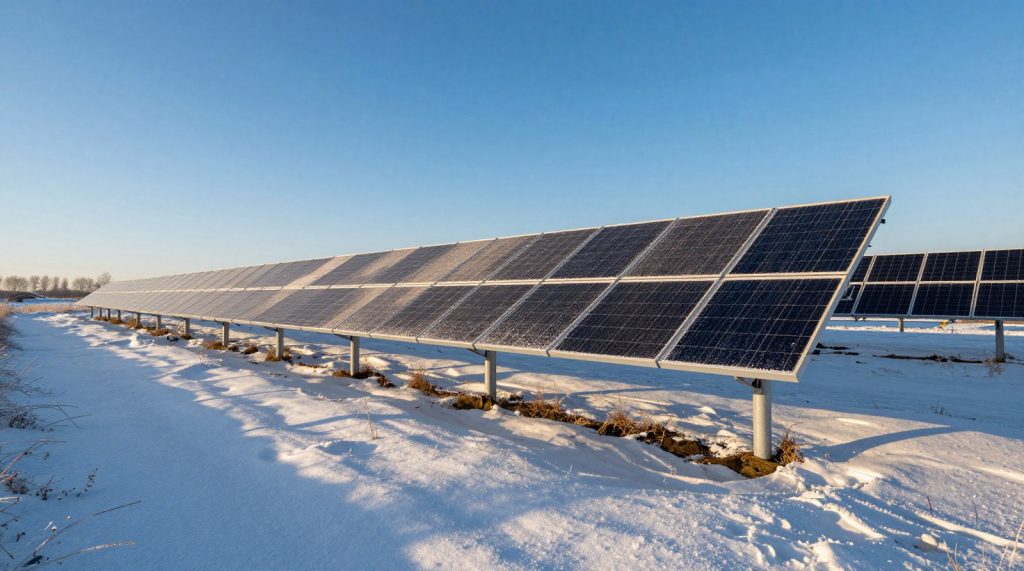
One of the most common questions before heating season arrives: do solar panels in winter actually deliver useful output when temperatures drop below freezing? The answer is counterintuitive at first glance — moderate frost helps generation rather than hurting it.
Key takeaways:
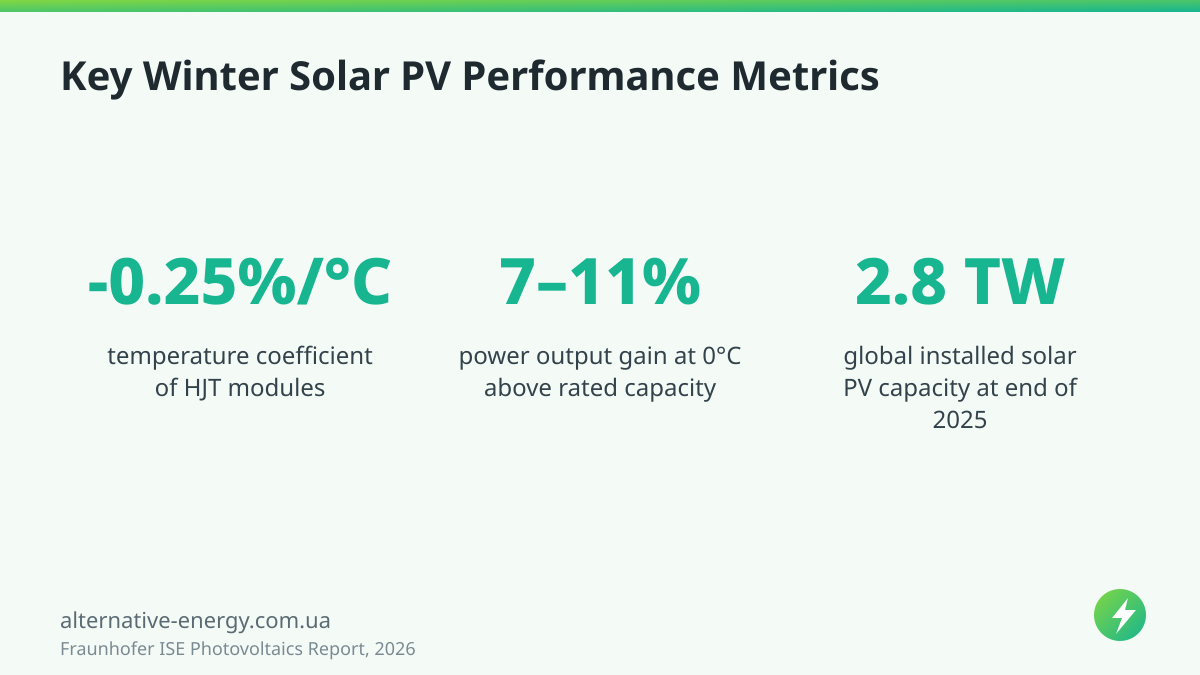
- The temperature coefficient of crystalline silicon ranges from -0.3 to -0.45%/°C: every degree below +25°C adds to output power.
- At 0°C, a module produces 7–11% more than its rated (nameplate) power.
- HJT panels (REC, Meyer Burger) carry the lowest coefficient — -0.25%/°C — making them the best fit for cold climates.
- Global installed solar PV capacity exceeded 2.8 TW at the end of 2025.
Why frost raises efficiency instead of reducing it
A solar module’s nameplate power is measured under Standard Test Conditions (STC), which set the cell temperature at +25°C as the baseline. In real-world operation, the parameter that fluctuates most is exactly that — temperature. According to Fraunhofer ISE, the power temperature coefficient for crystalline silicon falls in the range of -0.3…-0.45%/°C. The negative sign means that as cell temperature rises above +25°C, output falls — and conversely, every degree below STC delivers a gain.
The arithmetic is straightforward: at a module temperature of 0°C, a panel will produce 7–11% more than its rated power. That is why a crisp, sunny winter day with direct irradiance is often more productive than a sweltering July afternoon, when dark modules on a rooftop heat up dramatically and shed a portion of their nameplate output.

Which panel type to choose for cold winters: HJT vs. standard cSi
The lower a module’s temperature coefficient in absolute terms, the more stable its generation at temperature extremes. The Fraunhofer ISE report notes that HJT modules (heterojunction technology) achieve the lowest coefficient — -0.25%/°C. Manufacturers in this segment include REC and Meyer Burger. Compared with standard crystalline silicon (-0.3…-0.45%/°C), this translates to less power loss in summer heat and a larger gain in winter cold — resulting in a flatter, more predictable annual generation profile.
The temperature coefficient is only one of the parameters that determine real-world performance. Annual yield is also shaped by tilt angle, orientation, soiling, shading, and inverter topology. For a deeper look, see the articles on factors affecting solar system efficiency and ways to improve solar panel output.
Market scale puts the “northern climate” debate to rest
Global installed solar PV capacity surpassed 2.8 TW at the end of 2025, according to Fraunhofer ISE. This scale confirms that solar systems are economically viable across all climate zones — from sun-belt deserts to countries with long, hard winters.
The core takeaway for anyone sizing a system: panels do not sit idle in winter. The physics works in favour of solar PV — the real limiting factors are short daylight hours and cloud cover, not cold temperatures. If you are installing in a region with frosty but sunny winters, look beyond nameplate power and efficiency in the spec sheet. The temperature coefficient is the figure that determines how much real energy you will harvest over a full annual cycle and how stable generation will be during a January high-pressure spell.
Sources: Fraunhofer ISE
Illustration generated with AI
Prepared by the Alternative Energy editorial team with the help of AI based on the sources listed; facts and figures were checked against them during automated editorial review. How we prepare articles