


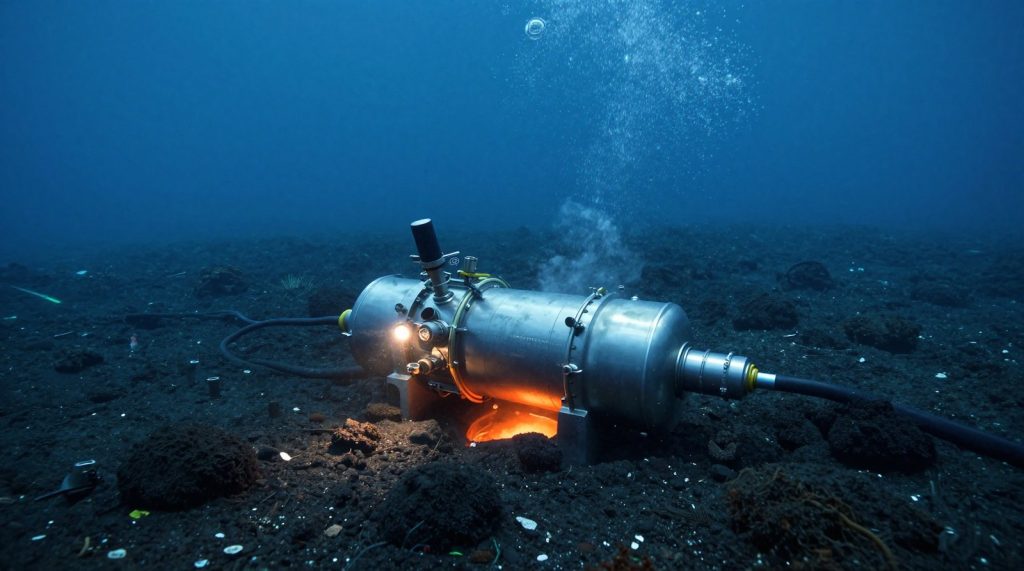
For the first time in history, a single subsea operation combined geothermal well drilling, power plant deployment, and real-time data transmission — all on the floor of the Pacific Ocean off Oregon in September 2026. American startup Endurance Energy announced that its Adélie subsea geothermal power plant generated net positive electricity at roughly 1,500 meters depth. The result was brief, but the company considers it proof that the concept of subsea geothermal energy can be assembled into a working system in a real ocean environment.
Key highlights:
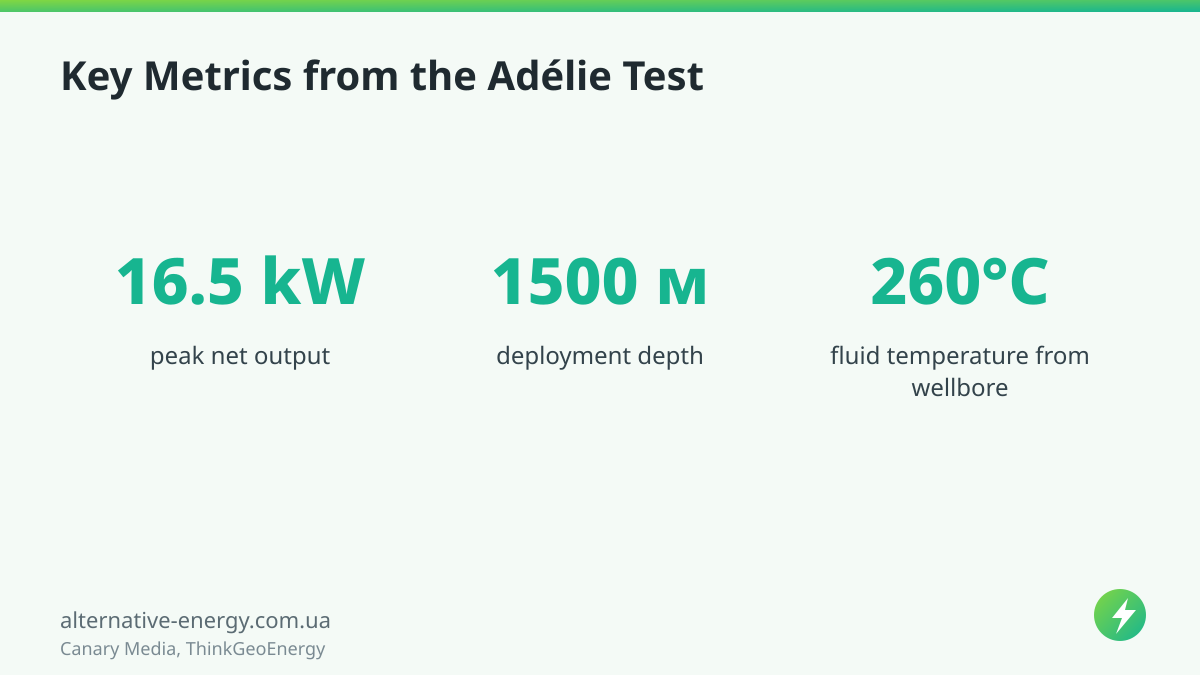
- Peak net output — 16.5 kW.
- Deployment depth — approximately 1,500 m below the Pacific Ocean surface.
- Geothermal fluid temperature: ~260°C from the drilled well and ~281°C from a natural hydrothermal vent.
- Total funding raised: $63 million, including $54 million in a Series A led by Founders Fund.
How Adélie Generated Power a Mile Underwater
According to Canary Media, Seattle-based Endurance Energy deployed its three-tonne Adélie unit roughly 300 miles off the Oregon coast during a three-week expedition in September 2026 — at Axial Seamount along the Juan de Fuca Ridge. There, the team drilled two closely spaced wells; the second, reaching 16 meters depth, was completed as a geothermal well and, after cementing, delivered fluid at approximately 260°C.
The unit was operated remotely from Seattle via the Regional Cabled Array subsea fiber-optic network, maintained by the University of Washington under a National Science Foundation program. The Adélie turbine spun up to approximately 26,000 rpm. For the final test, the module was connected not to its own well — whose flow rate proved insufficient — but to a nearby natural hydrothermal vent delivering fluid at ~281°C. The system maintained net positive output for 8.7 seconds, with a median of around 2 kW and a peak of 16.5 kW. A battery protection circuit triggered shutdown, and a subsequent attempt was cut short by a power cable fault.
Endurance Energy founder and CEO Andrew Redd, a former SpaceX engineer, told ThinkGeoEnergy that the core takeaway is straightforward: “every step of subsea geothermal can be executed at depth” — from drilling and well completion to operating a three-tonne power plant and sending telemetry back to Seattle. He also noted that the equipment landed on the seafloor within a few feet of its target position, and after recovery, Adélie was modified, recharged, and redeployed in under 16 hours.
Why Subsea Geothermal Still Faces Skepticism
Adélie was Endurance Energy’s fifth deepwater operation, but the first to combine well drilling, seafloor power generation, and data transmission to shore in a single expedition. Even so, the positive result leaves questions about project economics unanswered.
Geologist Emily Pope, a senior researcher at the Center for Climate and Energy Solutions, called the approach “eyebrow-raising”: working in an aggressive saline environment is costly and complex, and transmitting electricity from a remote offshore location to end consumers is technically demanding. For remote island nations, she argued, scaling up solar with energy storage systems is far simpler.
In response, Endurance Energy has built depth-specific engineering into the Adélie. The unit’s casing is made from titanium to resist corrosion. Its compact, car-sized footprint is possible precisely because it operates underwater: the ocean provides unlimited cold seawater for cooling and natural ambient pressure. The current drilling system can reach roughly 80 m — deeper wells, the company believes, will deliver the sustained flow rates needed for commercial viability. For context: in 2016, Chinese researchers extracted “a few watts” of stable power from a hydrothermal vent on the boundary of the southwest Indian and southeast Atlantic oceans, while Iceland’s state-backed project near the Mid-Atlantic Ridge ran into serious engineering difficulties due to the corrosiveness of seawater.

What’s Next: Gentoo, Leopard, and the Tonga Project
The next demonstration unit, Gentoo — an upgraded version of Adélie — is scheduled for deployment in the coming winter. In parallel, Endurance is developing the Leopard, a commercial 2-megawatt generator intended as the backbone of future subsea installations. The company’s first commercial project is planned for the Kingdom of Tonga: a memorandum of understanding has been signed, with the installation expected to reduce the archipelago’s dependence on imported diesel. Endurance is targeting the broader Pacific Ring of Fire — the U.S. Pacific Northwest and Alaska, Taiwan, and Japan.
Environmental stewardship is also part of the agenda. During the Axial Seamount expedition, Endurance collected water samples, filmed the seafloor, and monitored local organism communities; according to the company, preliminary monitoring detected no significant changes in hydrothermal activity, benthic ecosystems, or seismic-volcanic background levels. Over 40 samples have been sent for independent laboratory analysis. CEO Redd emphasizes that commercial installations will be sited away from sensitive vent ecosystems, with site selection guided by a combination of public and proprietary data on hydrothermal vent fields, heat flow, and young oceanic crust along spreading centers.
The Bottom Line
Subsea geothermal power generation remains an experimental technology: a few seconds of net positive output on the ocean floor is not a commercial product — it is proof that the chain of “drilling → installation → connection → generation → telemetry” can in principle be assembled underwater. If Endurance Energy can demonstrate sustained, stable operation, the approach could become a niche solution for volcanically active regions and remote islands where centralized grid infrastructure is either prohibitively expensive or simply not feasible. For the broader energy sector, this is worth watching primarily as a signal of where the frontier of deep geothermal energy is heading — not as an immediately transferable technology.
Sources: Canary Media, ThinkGeoEnergy
Illustration generated with AI
Prepared by the Alternative Energy editorial team with the help of AI based on the sources listed; facts and figures were checked against them during automated editorial review. How we prepare articles