


A five-story, 60-flat building at 53 Blahovishchenska Street was rebuilt after the Russian occupation of 2022 and converted entirely to renewable energy sources.
At a glance:
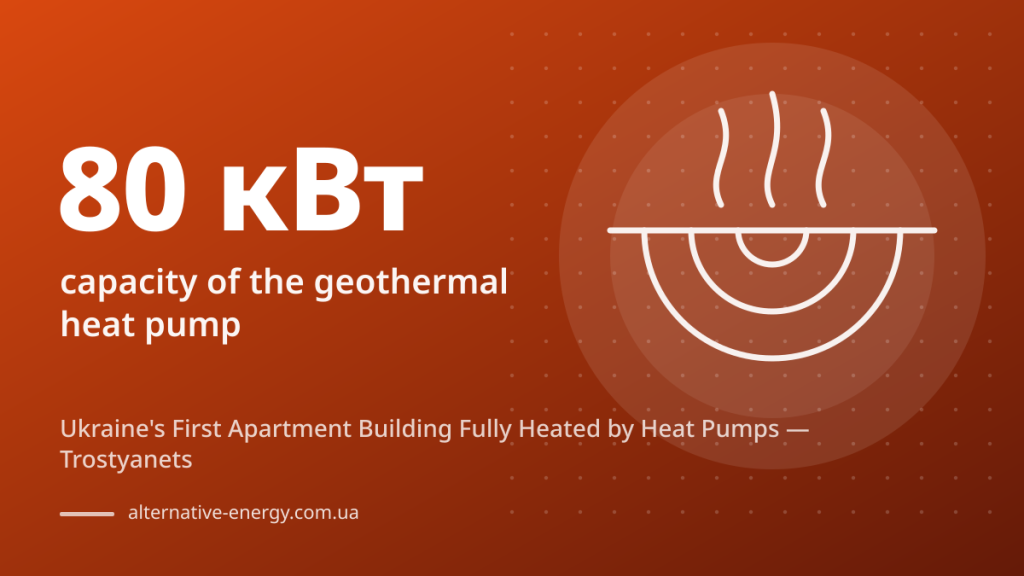
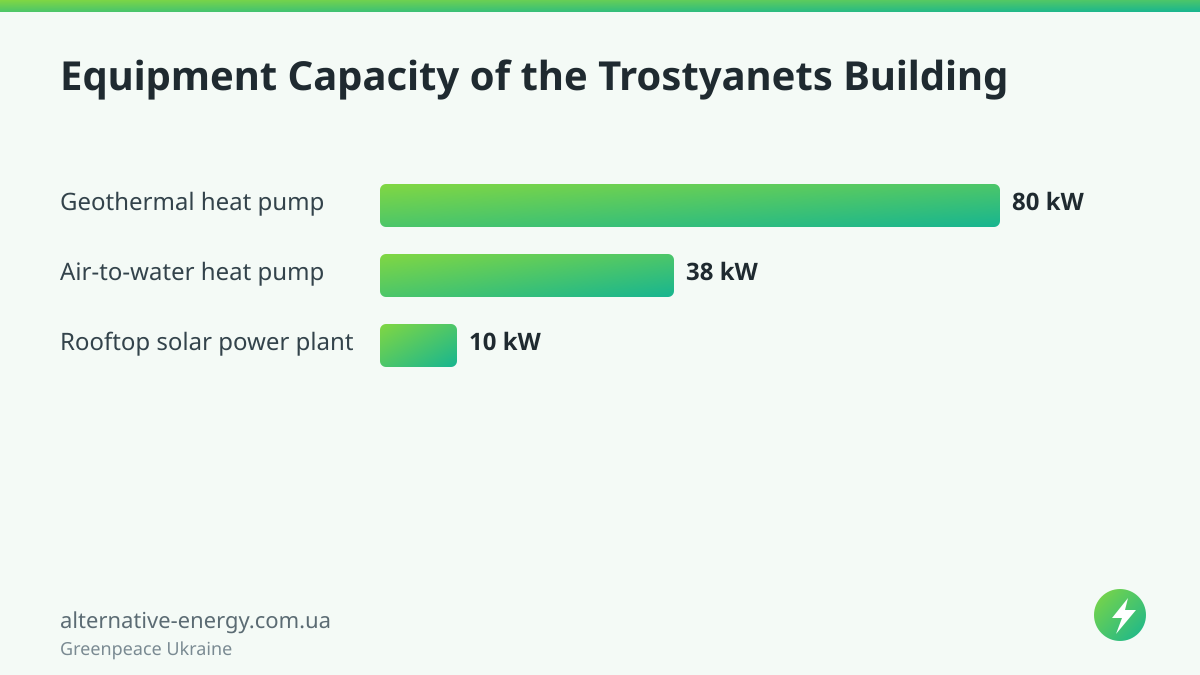
- 80 kW geothermal ground-to-water heat pump
- 38 kW air-to-water heat pump
- 10 kW rooftop solar power plant
- Five thermal storage tanks of approximately 2,000 litres each
- Total investment in the energy system — €218,000
How the heat pump system at Blahovishchenska 53 works
Heating and hot water are provided by two heat pumps of different types. An 80 kW geothermal ground-to-water heat pump extracts low-grade thermal energy from the ground, while a 38 kW air-to-water heat pump draws energy from outside air. A 10 kW rooftop solar power plant completes the setup. The domestic hot water circuit is supported by five thermal storage tanks of roughly 2,000 litres each and a high-performance heat exchanger, according to Greenpeace Ukraine. No fossil gas is used in the system.

Who funded the project and who delivered it
According to Greenpeace Ukraine, the project was implemented jointly by the city of Trostyanets, Greenpeace Germany, Greenpeace Ukraine, and the German green energy cooperative Green Planet Energy. Technical support was provided by Consulting IC Ukraine and CES Clean Energy Solutions — the same consultants who developed the city’s sustainable development strategy. Co-financing came from Green Planet Energy customers and the Greenpeace Environmental Foundation. Reconstruction of the building itself began in 2023 under a national programme, and the energy module forms part of the Green Reconstruction Master Plan developed by Trostyanets in 2023.
Context: war, gas, and frontline cities
“Heat pumps, geothermal energy and renewables are the future. They should be prioritised over fossil gas — at least in EU-supported reconstruction approaches,” Greenpeace Ukraine quotes the project lead at Greenpeace Germany. The same press release notes that 70% of Ukraine’s heat supply relies on fossil gas, and that since October 2025 Russian strikes have paralysed around 60% of the country’s gas supply. Trostyanets, located 35 kilometres from the Russian border, has deliberately chosen a path that reduces the community’s dependence on centralised infrastructure. Related Ukrainian-context reading: how heat pumps could partially replace imported gas and examples of renewable-based domestic hot water supply.
What another five-story block can take from this
The combination of geothermal and air-source heat pumps with a modest solar installation demonstrates that a typical Soviet-era apartment block can move away from gas and district heating — even in a frontline area. If the Trostyanets model can be replicated at scale, similar systems could reduce the vulnerability of multi-family housing during outages and attacks on gas infrastructure. For communities and donors planning reconstruction, this is a case for evaluating a hybrid configuration — a ground-source pump as the primary source, an air-source unit as backup, and the roof set aside for solar — before reconnecting a building to a gas boiler.
Sources: Greenpeace Ukraine, Interfax-Ukraine, Віднова
Prepared by the Alternative Energy editorial team with the help of AI based on the sources listed; facts and figures were checked against them during automated editorial review. How we prepare articles