


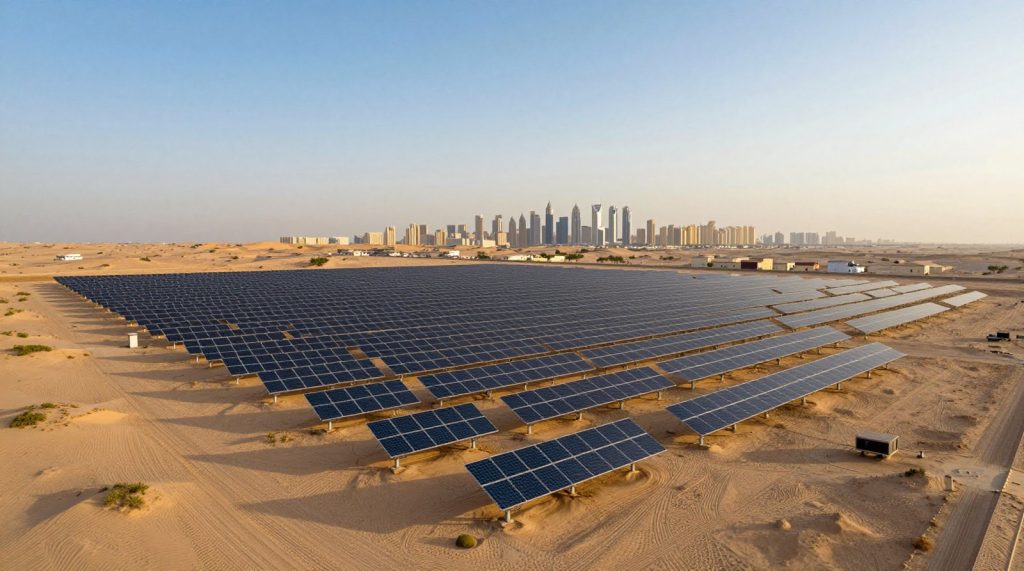
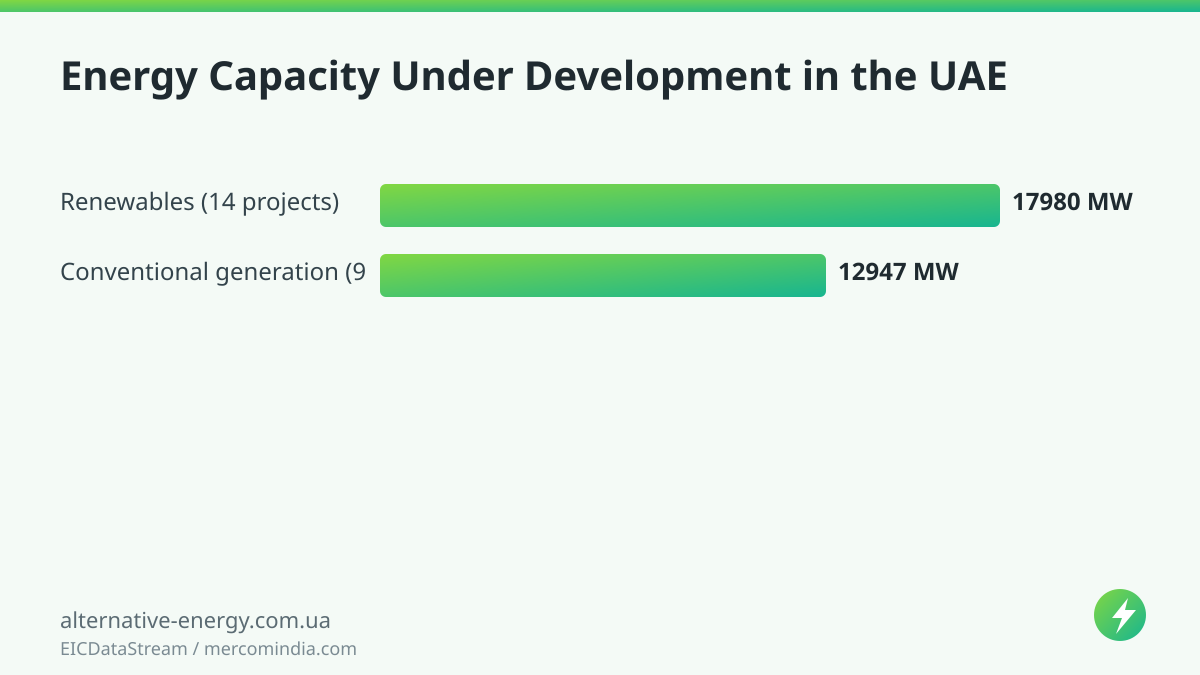
The United Arab Emirates is scaling up its clean power ambitions at pace: by 2030, the country plans to commission 17,980 MW of new capacity across 14 projects. Renewable energy in UAE has emerged as one of the most significant segments of the Gulf’s energy landscape — a notable shift even by the standards of the region’s oil-producing states.
Key figures:
- 17,980 MW of renewables across 14 projects scheduled before 2030;
- 12,947 MW of conventional generation across 9 projects — under development simultaneously;
- 11% — the share of renewable projects among 136 active energy initiatives in the country;
- $210 billion — the estimated total value of the UAE’s energy investment portfolio.
According to mercomindia.com, citing EICDataStream, this is the portfolio currently in active development across the country.
Renewables and Conventional Generation Advancing in Parallel
Despite a stated commitment to decarbonization, the UAE is simultaneously expanding conventional generation — 12,947 MW across 9 projects. This dual-track approach makes clear that renewables are not being positioned as a direct replacement for fossil fuel generation, but rather as a separate, large-scale segment growing alongside it.
In portfolio terms, renewable projects account for 11% of the 136 energy initiatives under way in the country — meaning their share in physical megawatts is considerably larger than their share by project count.

$210 Billion: Diversifying a Petro-Economy
The UAE’s total energy investment portfolio is valued at $210 billion. For a country whose economy has historically been built on hydrocarbons, an 18 GW renewables target is a clear signal: clean power capacity is becoming part of the core grid architecture, not a peripheral add-on. The regional picture is rounded out by neighboring countries — Saudi Arabia among them — which are pursuing similarly large-scale projects.
For equipment suppliers and EPC contractors, this suggests the Middle East deserves attention as one of the key markets through 2030. More examples of regional projects can be found in our overview of solar energy in the Middle East.
What This Means for the Industry
For those tracking the global energy transition, this is a useful benchmark of scale: the diversification of oil-dependent economies is happening not in policy statements, but in contracts and on construction sites. Investors and equipment manufacturers would do well to monitor tenders across the MENA region — it may account for a significant share of demand for solar modules, wind turbines, and energy storage systems in the years ahead.
That said, the 11% share of renewables by project count is a reminder that even under ambitious targets, hydrocarbon infrastructure in the UAE retains considerable inertia — a full departure from conventional generation is not what the current portfolio reflects.
Sources: mercomindia.com
Illustration generated with AI
Prepared by the Alternative Energy editorial team with the help of AI based on the sources listed; facts and figures were checked against them during automated editorial review. How we prepare articles