


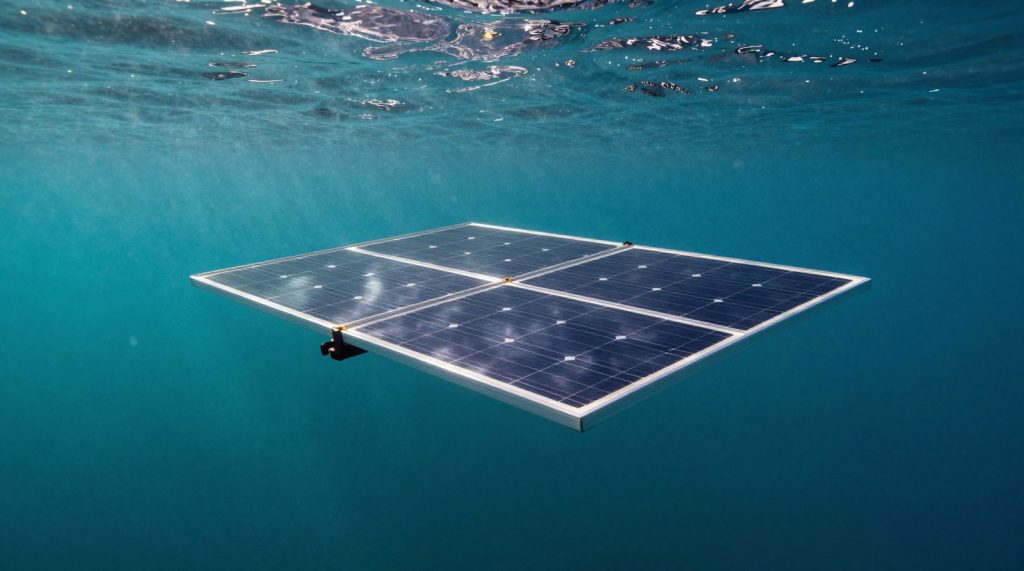
A research team at Yunnan University in China has shown that underwater solar cells based on perovskite can generate electricity at depths of up to 10 meters. Field experiments in the South China Sea recorded a light-to-electricity conversion efficiency of 34.71% within the blue-green spectrum that penetrates seawater at depth. The findings were published on September 11, 2026, in the journal Joule.
Key figures:
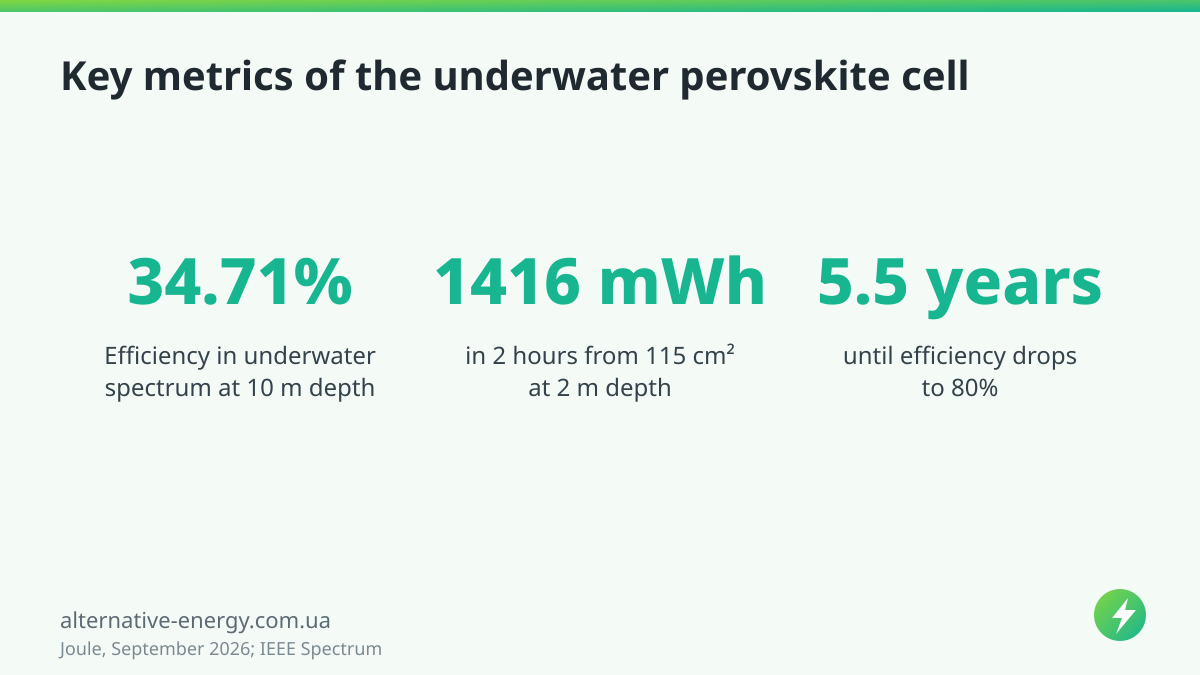
- 34.71% efficiency in the underwater spectrum at 10 m depth — versus 17.08% under standard terrestrial conditions.
- 1416 mWh generated in 2 hours from 115 cm² of cells at 2 m depth.
- 324 mWh in 2 hours at 10 m depth.
- Projected lifetime exceeding 5.5 years before efficiency falls to 80% of its initial value.
Why Perovskite Outperforms Conventional Panels Underwater
Seawater strongly absorbs the longer wavelengths of the solar spectrum — everything above 630 nanometers: red light, infrared, microwaves, and radio waves. Conventional panels are engineered for a broad 400–1100 nm range, which means a large portion of their working spectrum never reaches the cell at depth.
The team, led by Wen-Hua Zhang, dean of the School of Materials and Energy at Yunnan University in Kunming, designed perovskite cells around what actually survives at 5–10 m: the blue-green band from 400–600 nm. According to IEEE Spectrum, those same cells deliver 17.08% efficiency on land but reach 34.71% in the underwater spectrum at 10 m. For context, standard terrestrial panels average 20–25%. We covered related advances in photovoltaics in our article on improving organic solar cell efficiency.
Field Tests Near Weizhou Island
The cells were integrated into underwater mini-robots equipped with lithium-ion batteries and tested near Weizhou Island in the South China Sea. To protect against saltwater, the researchers sealed the cells in glass, synthetic rubber, and epoxy resin. The robots automatically maintained target depths so that output power could be compared across different water levels.
At 2 meters depth, 115 cm² of cells produced 1416 mWh over two hours — roughly half the capacity of a rechargeable AA battery. At 10 meters, the same area yielded 324 mWh in the same timeframe. Zhang noted that the 10 m results exceeded the team’s expectations by a factor of three to six.

Why Underwater Perovskite Lasts Longer Than on Land
Standard perovskite cells are cheaper and more efficient than silicon, but they degrade quickly under intense sunlight and high temperatures — on land, noticeable performance loss can occur within a year. Underwater conditions are gentler: illumination is weaker, and temperature is lower and more stable.
In laboratory tests simulating the spectrum at 10 m and the average annual seawater temperature near Weizhou — 25 °C — degradation was minimal. The authors calculate that the cells can operate continuously for approximately 5.5 years before efficiency drops to 80% of the initial value.
The researchers do acknowledge real-world constraints: strong currents would complicate deployment, and corrosion combined with biofouling from algae and barnacles would gradually reduce performance. Zhang also points to the absence of standardized testing protocols as a barrier — without them, comparing results across different laboratories is difficult.
Where This Technology Could Be Applied
The authors identify two main directions. The first is autonomous power for underwater sensors, cameras, lighting, and communications hardware forming an “underwater Internet of Things.” The second is extending the range and mission duration of submersibles and autonomous underwater vehicles. For offshore infrastructure, this raises the possibility of powering equipment without routing cables from the surface. It is not the first unconventional idea from Chinese researchers in the solar space — worth recalling the earlier story of “nighttime” solar panels.
The team’s next steps include testing at greater depths and integrating the cells with energy storage into a single module. For now, this remains a lab-and-field demonstration rather than a commercial product, and engineers still need to address questions around long-term stability, biofouling, and scalability. For anyone tracking offshore energy and marine robotics, it is a compelling reason to watch how perovskite behaves in unexpected environments.
Sources: IEEE Spectrum
Illustration generated with AI
Prepared by the Alternative Energy editorial team with the help of AI based on the sources listed; facts and figures were checked against them during automated editorial review. How we prepare articles