


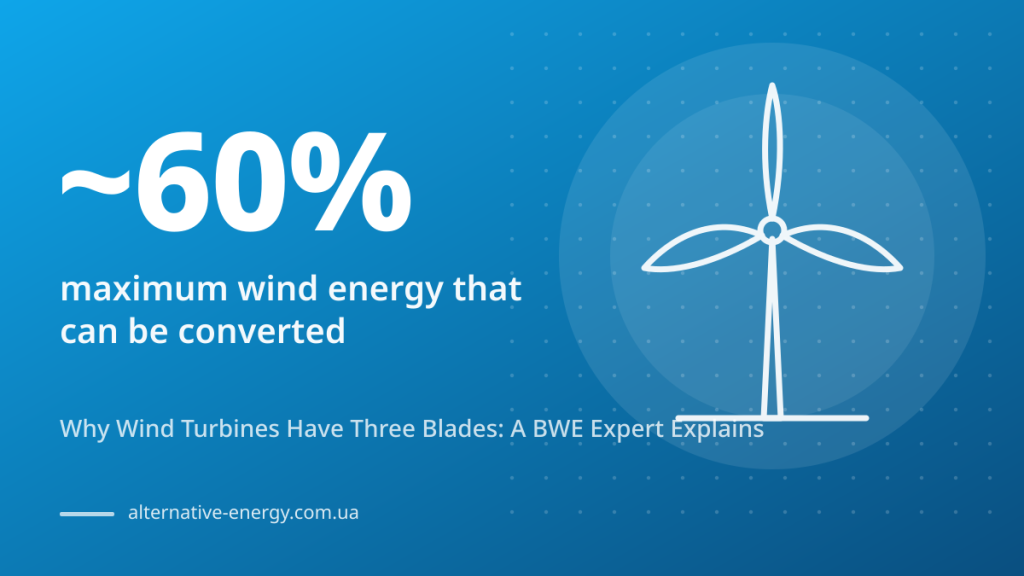
Why do almost all modern wind turbines have exactly three blades — not two, four, or more? The answer isn’t aesthetic; it’s a matter of engineering economics. Stefan Groth of Germany’s Federal Wind Energy Association (Bundesverband WindEnergie, BWE) laid out the reasoning in a piece published by the science portal wissenschaft.de.
In brief:
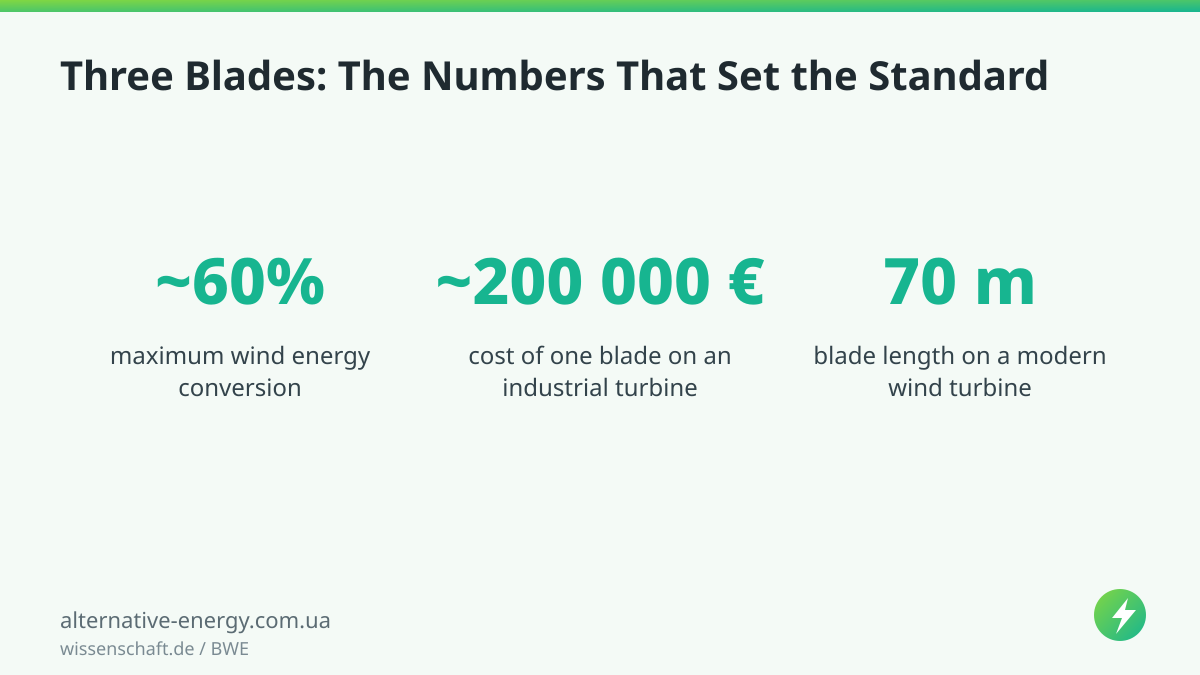
- The theoretical maximum for converting wind energy is around 60%.
- A single blade on a typical industrial turbine costs around €200,000.
- A fourth blade would add negligible output while disproportionately raising costs.
- An odd number (three) produces smoother rotor motion and reduces structural stress loads.
Economics: why a fourth blade doesn’t pay off
According to wissenschaft.de, Stefan Groth puts forward two core arguments — one economic, one mechanical. On the economics side, the theoretical maximum for converting wind into mechanical and then electrical energy sits at around 60%. Adding more blades does push a turbine closer to that ceiling, but beyond three the incremental gain becomes so small that it no longer covers the cost of the blade itself.
Groth specifies that a single blade on a typical industrial wind turbine costs around €200,000. Against that price tag, he says, the output gain from a fourth blade simply doesn’t add up.

Mechanics: why an odd count runs smoother
The second argument concerns material stress. Groth explains that in a four-blade turbine, one blade would regularly pass directly in front of the tower while the opposite blade sat in the “12 o’clock” position — fully exposed to the oncoming wind. This creates uneven loading on the rotor and imbalance during rotation. With three blades, that symmetrical tower-shadow effect doesn’t occur, so the rotor runs more evenly and the structure experiences fewer impact loads.
There’s also a straightforward weight factor. According to Groth, adding an extra 70 m blade would require a complete redesign of the tower’s structural calculations. For today’s large-scale turbines, that’s no minor adjustment — it amounts to an entirely new engineering project. We covered how these components are built in our article on making wind turbine blades yourself.
What this means in practice
The three-blade configuration is not a conservative nod to tradition — it’s a balance that engineers arrived at through hard numbers: each additional blade yields less energy than it costs, while simultaneously increasing the structural load on the tower. For anyone evaluating wind energy products, this is a useful reality check. If a vendor ever pitches a “more efficient” model with four or six blades, it’s worth asking about the conversion ceiling, the structural recalculations, and whether the added mass actually pays its way.
Sources: wissenschaft.de (Spektrum der Wissenschaft), RheinEnergie Blog — Windkraft-Serie Teil 8
Prepared by the Alternative Energy editorial team with the help of AI based on the sources listed; facts and figures were checked against them during automated editorial review. How we prepare articles