


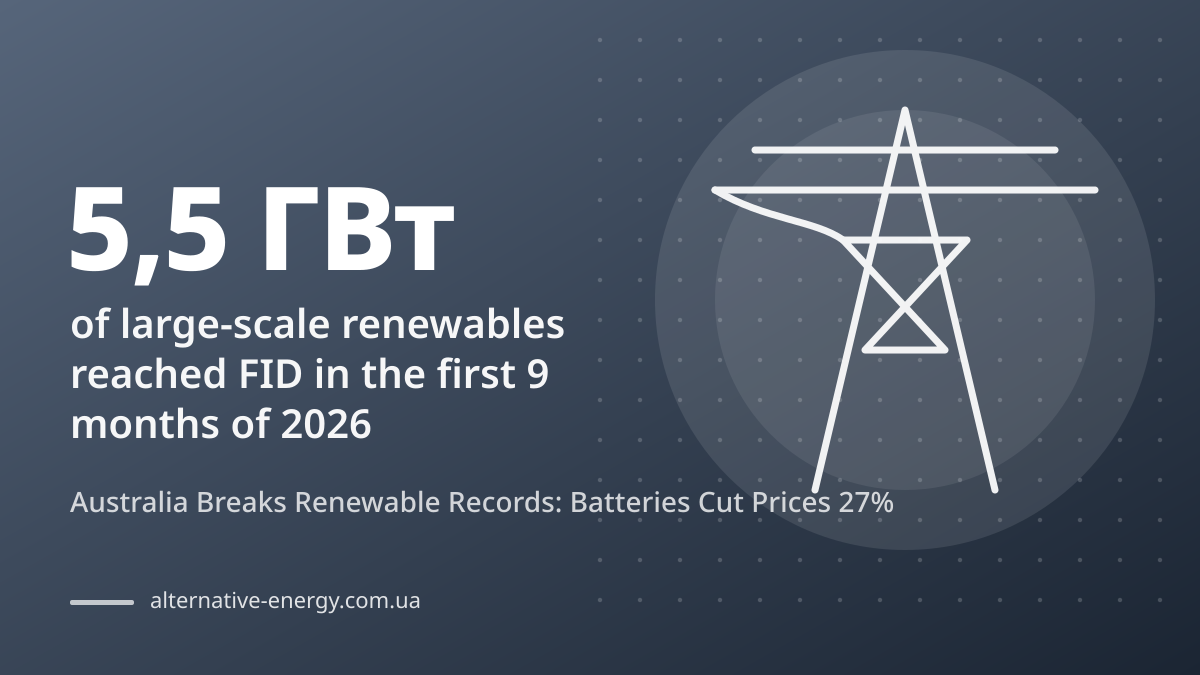
Australia renewable energy closed the first nine months of 2026 with a string of records: cumulative capacity of large-scale projects that reached final investment decision (FID) has already surpassed last year’s full-year total, the average size of new utility-scale batteries has more than doubled, and wholesale electricity prices fell 27% year-on-year. The figures come from reneweconomy.com.au, citing the Clean Energy Regulator’s (CER) Quarterly Carbon Market Report.
Key figures:
- 5.5 GW of large-scale renewable projects reached FID in nine months — an all-time annual record for Australia (the full-year 2025 figure was 4.9 GW).
- Wind power had its strongest quarter on record — 1.1 GW of new FIDs.
- The average size of a new utility-scale battery grew from 265 MWh in 2025 to 621 MWh in 2026.
- NEM wholesale prices in Q3 were the lowest since 2021, down 27% year-on-year.
Batteries scale up — prices come down
According to CER, new energy storage systems totalling 13.8 GWh reached FID in Q3 2026, bringing the year-to-date total to 20 GWh. The more striking shift, however, is in individual project size: the average capacity of batteries entering the grid more than doubled over the year, from 265 MWh to 621 MWh.

The regulator directly links this to wholesale market dynamics. In CER’s own words, increased participation of grid-scale batteries, combined with lower grid demand, contributed to a 27% fall in NEM wholesale prices compared with Q3 2025. CER Chair Tony Chappel adds that average Q3 spot prices are the lowest since 2021, driven by reduced evening demand, a greater number of large-scale batteries, and lower overall price volatility.
Rooftop solar and home batteries reshape the evening peak
In the first nine months of the year, Australians installed 2.8 GW of rooftop solar systems, including 890 MW in Q3 alone — the strongest September quarter on record. CER forecasts the full year will close above 3.2 GW. An additional boost is expected from the opening of applications under the updated SRES programme for systems between 100 kW and 1 MW, which extends the subsidy to mid-scale rooftop installations.
Home batteries have already reached 10.3 GWh of installed capacity under the Cheaper Home Batteries programme — so rapidly that CER revised its annual forecast upward from 8–12 GWh to 13–15.5 GWh. According to AEMO data cited by the regulator, households with both solar and a battery import 74% less electricity from the grid in the evening than those with solar panels alone.
Why this matters beyond Australia
The Australian case offers a rare example where the impact of energy storage on wholesale prices is visible in the same quarter’s data, not just in long-term models. Against the backdrop of global renewable energy growth forecasts, it makes a compelling argument for looking beyond installed megawatts — to the type of storage entering the market, its operating mode, and the support mechanisms that accompany it. For markets where battery incentives are still taking shape, this is a useful benchmark: tying support schemes to flexible energy storage systems can influence evening peak demand and price volatility faster than simply adding more generation capacity.
Sources: reneweconomy.com.au
Prepared by the Alternative Energy editorial team with the help of AI based on the sources listed; facts and figures were checked against them during automated editorial review. How we prepare articles


