


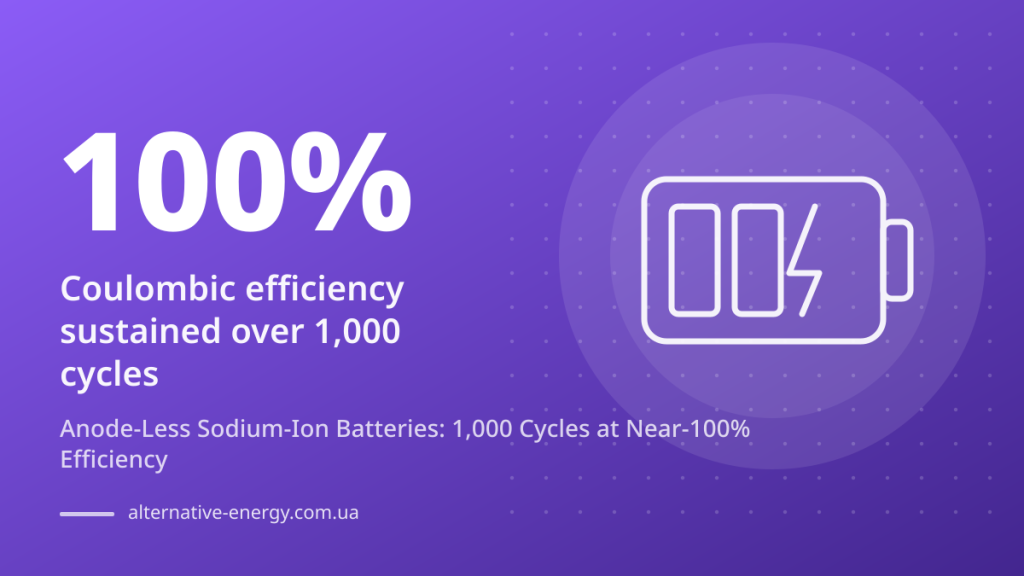
A team from the University of Camerino (Italy), working alongside colleagues from the International Iberian Nanotechnology Laboratory and the national electrochemical energy storage center GISEL–INSTM, has introduced a new approach to anode-less sodium-ion batteries. The researchers used zinc coordination polymers as a sodiophilic current collector and achieved near-100% Coulombic efficiency across 1,000 charge-discharge cycles. The findings were published open-access in the Journal of Physics: Energy on October 15, 2026.
Key figures:
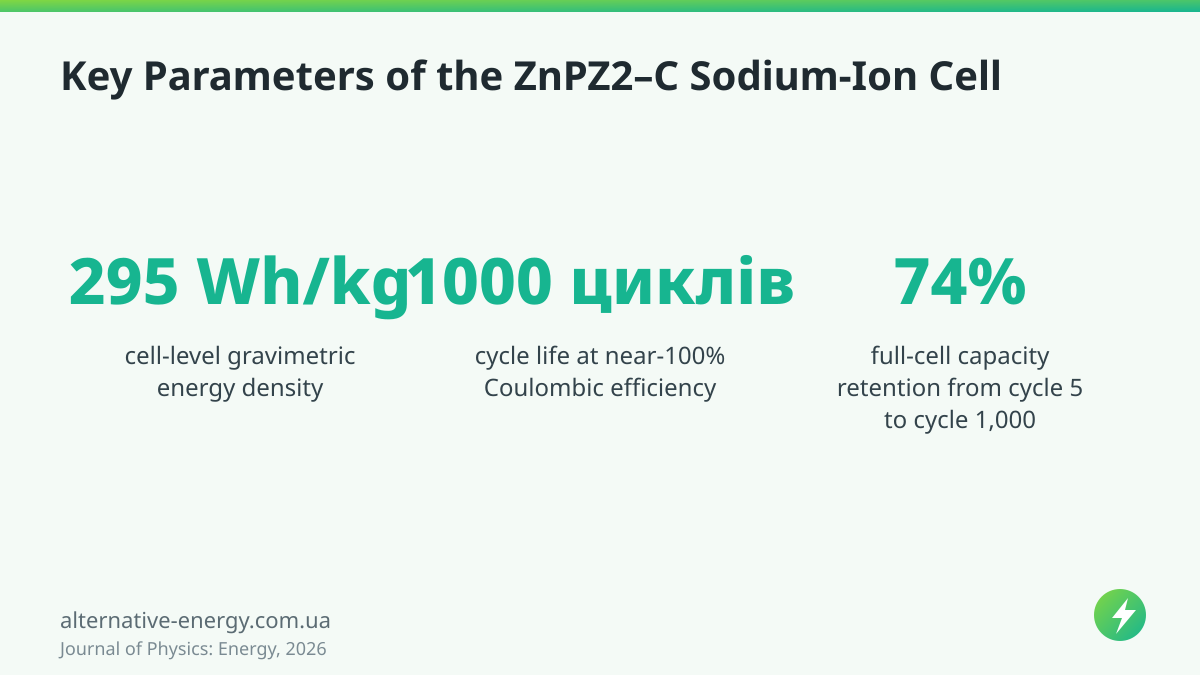
- optimized zinc coordination polymer (Zn-CP) — near-100% Coulombic efficiency over 1,000 cycles;
- sodium nucleation overpotential reduced to 10 mV, versus 110 mV on bare aluminum;
- cell-level gravimetric energy density — 295 Wh/kg;
- full cell with a Prussian blue analogue cathode retained 74% of capacity from cycle 5 to cycle 1,000.
Why Sodium, and What “Anode-Less” Means
Sodium is attractive for battery chemistry because of the abundance and low cost of raw materials compared to lithium. However, sodium’s larger ionic radius and atomic mass limit achievable energy density — a primary barrier to wider adoption of sodium-ion systems. The anode-less architecture helps sidestep this constraint: the active metal is deposited directly on the current collector during the first charge, reducing cell mass and simplifying electrode design. The challenge is that on conventional collectors, sodium deposits unevenly, forming dendrites — needle-like structures that shorten cycle life and create short-circuit risks. We covered related approaches to finding chemistries that could complement or replace lithium in our overview of alternatives to lithium-ion batteries.
Zinc Coordination Polymers as a Current Collector
To achieve uniform sodium deposition, the Italian group coated the current collector with zinc-based coordination polymers. According to Journal of Physics: Energy (IOP Science), the optimized zinc coordination polymer (Zn-CP) brings the sodium nucleation overpotential down to 10 mV — compared to 110 mV on bare aluminum. A lower nucleation overpotential means sodium ions more readily find energetically favorable surface sites, so the metal plates as a uniform layer rather than localized spikes that drive cell degradation. We covered another study where zinc serves as an active electrochemical component in our piece on zinc-air batteries from TU Darmstadt.

What the Tests Showed
In testing, the Zn-CP assembly sustained near-100% Coulombic efficiency across 1,000 charge-discharge cycles — the key indicator that sodium returns from the collector to the electrolyte each cycle without meaningful losses. In a full cell assembled with a Prussian blue analogue cathode, capacity retention reached 74% from cycle 5 to cycle 1,000. The authors report a cell-level gravimetric energy density of 295 Wh/kg. Direct comparisons with commercial lithium-ion cells should be made with care: measurement conditions, cell formats, and configurations vary across the literature, and these figures come from laboratory-scale samples rather than production cells.
Limitations and Next Steps
The work has passed peer review and is published open-access, making the data available for independent verification. That said, the results were obtained on laboratory coin cells — next steps include reproducing performance in larger-capacity prototypes, evaluating stability across different temperatures and current rates, and addressing the scalability of applying the coordination polymer coating to current collectors at an industrial level. Extended cycle testing beyond 1,000 cycles will be needed to assess the long-term stability of the sodium-collector interface.
For those following the energy storage system market, these results add further reason to watch the sodium-ion branch closely. If the zinc coordination polymer approach holds up in larger cell formats, it could broaden the range of chemistries competitive with lithium-ion — particularly in stationary energy storage systems, where gravimetric energy density matters less and raw material cost and availability are critical. For buyers evaluating an energy storage system today, this is not yet a reason to delay a purchase decision, but it is a reason to ask manufacturers about their sodium-ion product roadmap.
Sources: Journal of Physics: Energy (IOP Science)
Prepared by the Alternative Energy editorial team with the help of AI based on the sources listed; facts and figures were checked against them during automated editorial review. How we prepare articles