


Ukraine’s National Energy and Utilities Regulatory Commission (NEURC) approved draft amendments to retail market rules on 15 September 2026, opening access to dynamic electricity tariffs for households equipped with smart meters. For consumers, this means paying a different rate per kWh depending on the hour — the same model that has been operating across a number of EU countries for years.
Key takeaways:
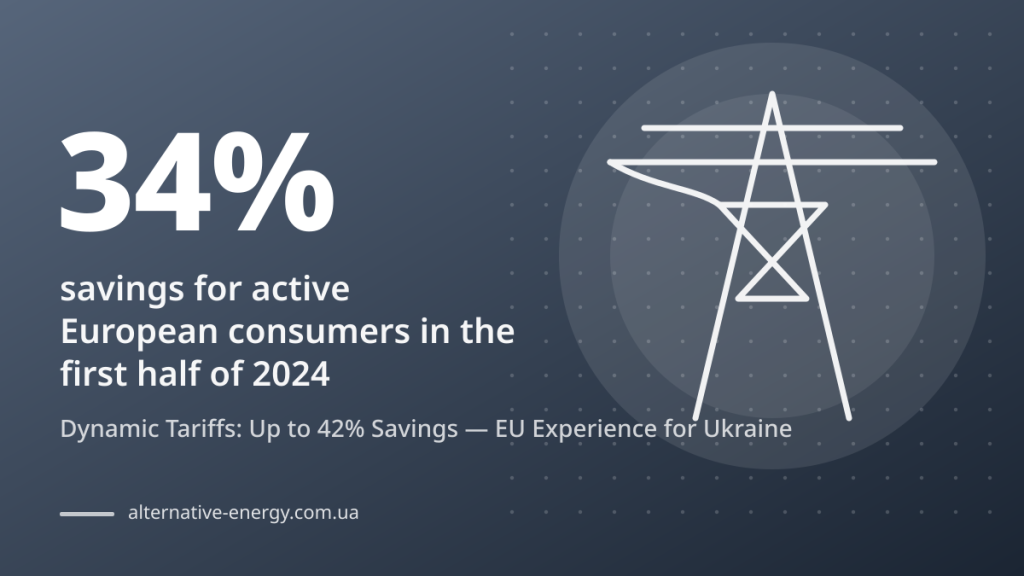
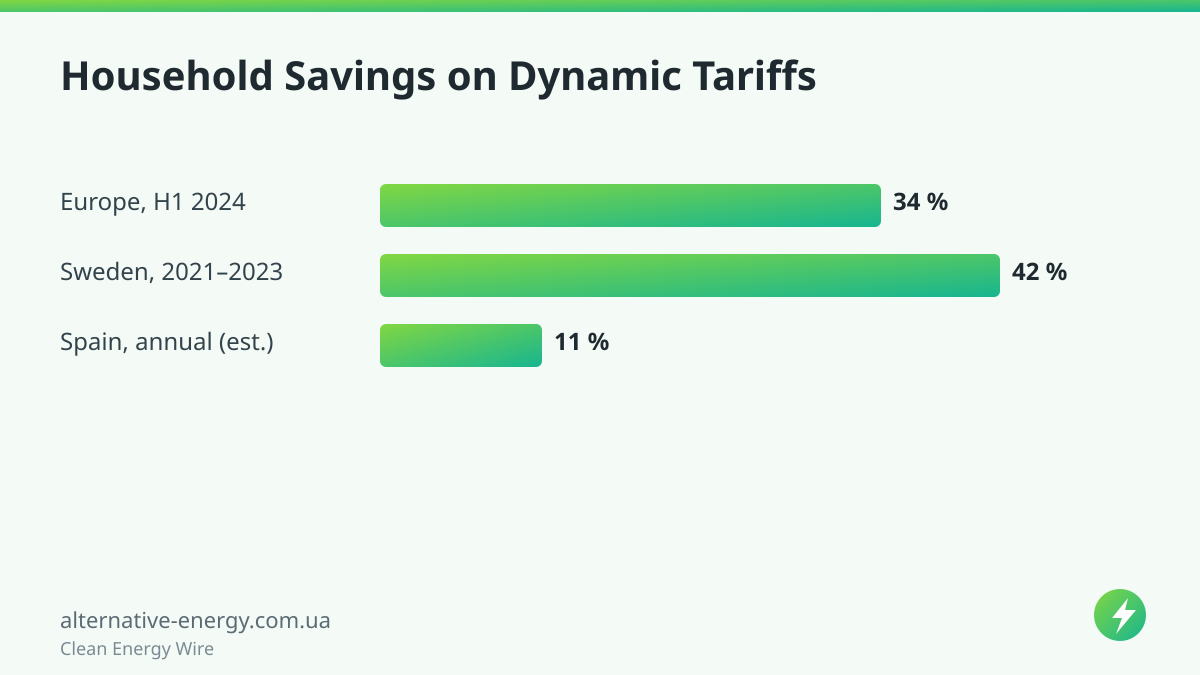
- In H1 2024, active European consumers who shifted load to off-peak hours saved up to 34% compared with the average wholesale price.
- In Sweden, hourly contracts delivered around 42% savings against fixed one-year tariffs over 2021–2023.
- Spain’s estimated savings potential stands at 8–11% per year with smart load management.
- As of 2024, 73% of EU households were still on fixed contracts; from 2025, all German suppliers are required to offer a dynamic tariff option.
How Dynamic Tariffs Work
A dynamic tariff is a contract where the price per kWh changes throughout the day. It is pegged to the day-ahead and intraday wholesale markets, so consumers can see a day in advance when electricity will be cheap and when it will be expensive. The logic is straightforward: run the washing machine, charge an electric vehicle, or pre-heat a hot water tank during hours with surplus wind and solar generation — and you pay less. Miss those windows and you risk landing in a peak-price slot.
The technical prerequisite is a smart meter: a conventional meter only records total consumption without any time-of-use breakdown. According to Clean Energy Wire, Denmark, Estonia, Finland, Italy, Spain and Sweden have near-universal smart meter coverage, while Germany, Hungary, the Czech Republic and Belgium lag considerably behind.
European Numbers: From 11% to 42% in Savings
In the first half of 2024, European households on dynamic contracts that shifted consumption to the cheapest hours saved up to 34% against the average wholesale market price — excluding grid charges and taxes. That figure comes from the company tado°, cited by Clean Energy Wire.
In Sweden, where hourly tariffs are a mainstream product, savings over 2021–2023 reached roughly 42% compared with fixed one-year contracts. Spain’s estimate is more modest: 8–11% per year through sensible load shifting. The spread between these figures depends on individual consumer behaviour, wholesale price volatility and how many flexible appliances a household runs. The downside risk is real too — during peak-demand hours prices surge, and without any load adjustment a bill can actually increase. Some EU contracts therefore include a price cap to limit that exposure.

Who Benefits Most
Clean Energy Wire notes that the biggest gains go to households with electric vehicles, heat pumps and home energy storage systems. The reason is simple: these are the largest and most flexible loads in any home. An EV charge can be pushed to the overnight trough; a heat pump can pre-heat a storage tank at midday when solar generation peaks; a battery can absorb energy when wholesale prices dip and discharge it in the evening at peak.
The flipside: if a household’s consumption pattern is rigid — lights and appliances switched on whenever needed — a dynamic tariff adds little benefit and more risk. That is precisely why across the EU it is offered as an opt-in, not set as the default.
What NEURC Is Proposing for Ukrainian Consumers
According to Kyiv Post, the draft published on 15 September 2026 ties dynamic prices for Ukrainian consumers to the day-ahead and intraday markets. Access will be limited to households with smart meters capable of recording consumption on an hourly basis. Before signing such a contract, suppliers will be obliged to explain to the customer exactly what drives the price changes and to disclose the risks, costs and benefits in a transparent manner.
The draft also streamlines supplier switching: it will be free of charge for residential and smaller non-residential consumers. Ukrainians will also be able to choose a supplier registered in an EU or Energy Community country, provided that supplier is authorised to operate in the Ukrainian market. Participation in dynamic tariffs is voluntary, and the draft is currently open for public consultation. For context: in Germany, the obligation to offer such a tariff has applied to all suppliers since 2025.
What This Means for a Ukrainian Household
The European benchmarks — from 8–11% in Spain to around 42% in Sweden — cannot be transplanted directly onto Ukraine: the price structure differs, as does the solar and wind resource mix and the typical home appliance portfolio. But the direction is clear: the greater the share of flexible load in a household, the more meaningful the potential gains from hourly pricing. For those weighing the trade-off between a feed-in tariff and self-consumption for a home solar power plant, the arrival of dynamic contracts adds another variable: during midday solar surplus, grid prices will also be at their lowest, which changes the economics of a home energy storage system. For those planning an energy-efficiency retrofit, consumption flexibility becomes a tradeable asset that the market is prepared to reward.
While the NEURC draft is still under consultation, two practical conclusions stand out. First, without a smart meter there is no access to dynamic tariffs — so the question of installation is worth keeping on the radar. Second, it is worth calculating what share of your own consumption can realistically be shifted in time: that single factor will determine whether hourly pricing becomes a money-saving tool or an additional source of financial risk.
Sources: Clean Energy Wire, Kyiv Post
Prepared by the Alternative Energy editorial team with the help of AI based on the sources listed; facts and figures were checked against them during automated editorial review. How we prepare articles