


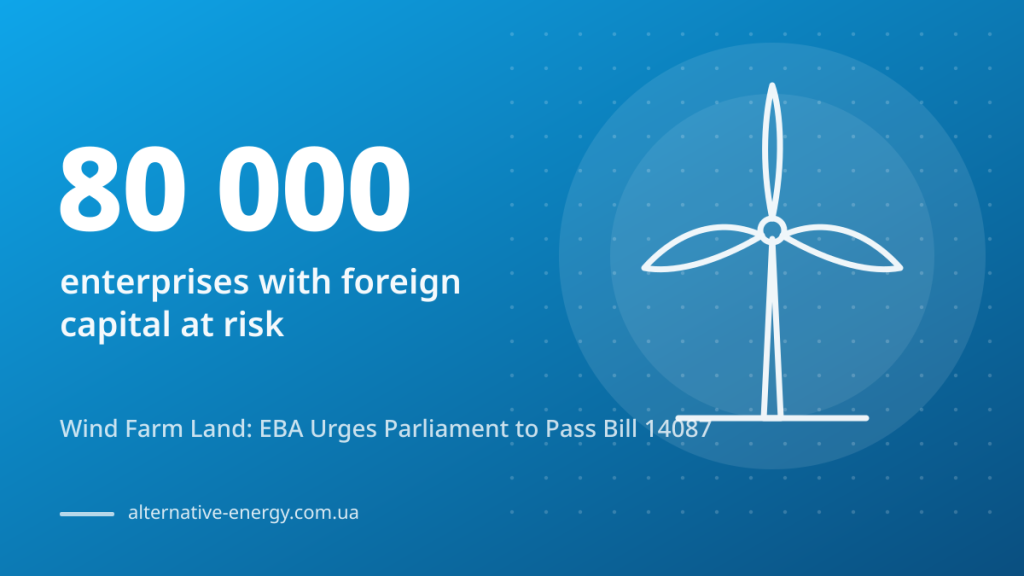
The European Business Association (EBA) is once again urging the Verkhovna Rada to schedule a vote on Bill No. 14087, which would liberalise land relations. For wind energy developers, the legislation removes a key obstacle: a legal ambiguity under which companies with foreign capital risk losing their title to the land for wind farms beneath their turbines. Until parliament acts, that land remains legally exposed.
Key points:
- EBA is approaching parliament for the second time — its first appeal went unanswered.
- Bill No. 14087 resolves a contradiction in Article 82 of the Land Code.
- The new rules apply exclusively to non-agricultural plots — industrial sites, energy facilities, and telecommunications infrastructure.
- According to experts, the legal uncertainty potentially affects over 80,000 Ukrainian companies with foreign ownership.
What Bill No. 14087 Proposes
The bill — formally titled “On Amendments to Certain Legislative Acts Regarding the Liberalization of Land Relations” — has not yet been placed on the plenary schedule.
Its core aim is to eliminate the ambiguity in Article 82 of the Land Code. The current wording leaves a critical question unresolved: at which point should a company’s Ukrainian status be assessed — at the moment of registration as a legal entity, or on the date a land purchase agreement is signed? Bill No. 14087 proposes a clear rule: any legal entity registered under Ukrainian law would be entitled to acquire non-agricultural land, regardless of when or in what proportion foreign capital entered its ownership structure.
Restrictions under Article 130 of the Land Code on agricultural land remain in force — companies with foreign participants are still barred from purchasing such plots until a nationwide referendum decides otherwise.
Why This Issue Is Critical for the Wind Energy Sector
Wind farms are built precisely on non-agricultural land — the same category used for industrial facilities, energy infrastructure, and telecommunications networks. According to experts, the ambiguity in Article 82 potentially affects over 80,000 domestic companies with foreign capital, spanning industrial manufacturers, telecoms operators, energy producers, and logistics centres.
For the wind farm sector this creates several simultaneous risks: challenges to already registered land titles, complications when acquiring new turbine sites, and potential difficulties in securing international financing. EBA stresses that passing Bill No. 14087 would minimise unfounded claims against investors’ property rights, ensure stable operation of critical infrastructure during wartime, and strengthen foreign business confidence in Ukraine’s legal system.
Context: Who Else Has Called for Fixing Article 82
EBA is not the only voice in this debate. In August 2026, the Ukrainian Telecommunications Operators Association “Telas” addressed the government, the National Security and Defence Council (NSDC), and relevant ministries with the same request — to close the gap in how Article 82 is applied. In September, the Ministry of Digital Transformation backed this position, stating that without legislative amendments it is impossible to establish consistent enforcement practice or reliably protect infrastructure assets.
This simultaneous pressure from telecoms operators, industry associations, and a government ministry shows that the problem extends well beyond a single sector. Yet for the emerging regulatory landscape of renewable energy, the land question remains among the most sensitive — legal uncertainty can directly complicate project financing.
What This Means for the Wind Energy Market
If parliament passes Bill No. 14087, developers with foreign capital will gain a predictable rule: a company’s right to hold land under turbines will no longer hinge on how an individual court or registrar interprets the norm. For an industry counting on an influx of private and international investment in post-war recovery, that is a meaningful difference.
Sources: РБК-Україна
Prepared by the Alternative Energy editorial team with the help of AI based on the sources listed; facts and figures were checked against them during automated editorial review. How we prepare articles