



A team from the University of Edinburgh, working with Michelin, has demonstrated that flexible turbine blades made from rubber with an internal steel spar can perform on par with traditional rigid variable-pitch designs — while experiencing significantly less fatigue. Passive deformation of the trailing edge absorbs peak loads and eliminates the most failure-prone components in underwater machines: pitch motors, sensors, and bearings. The findings are published in Nature and primarily concern tidal energy, though the underlying principle is relevant to wind power as well.
Key takeaways:
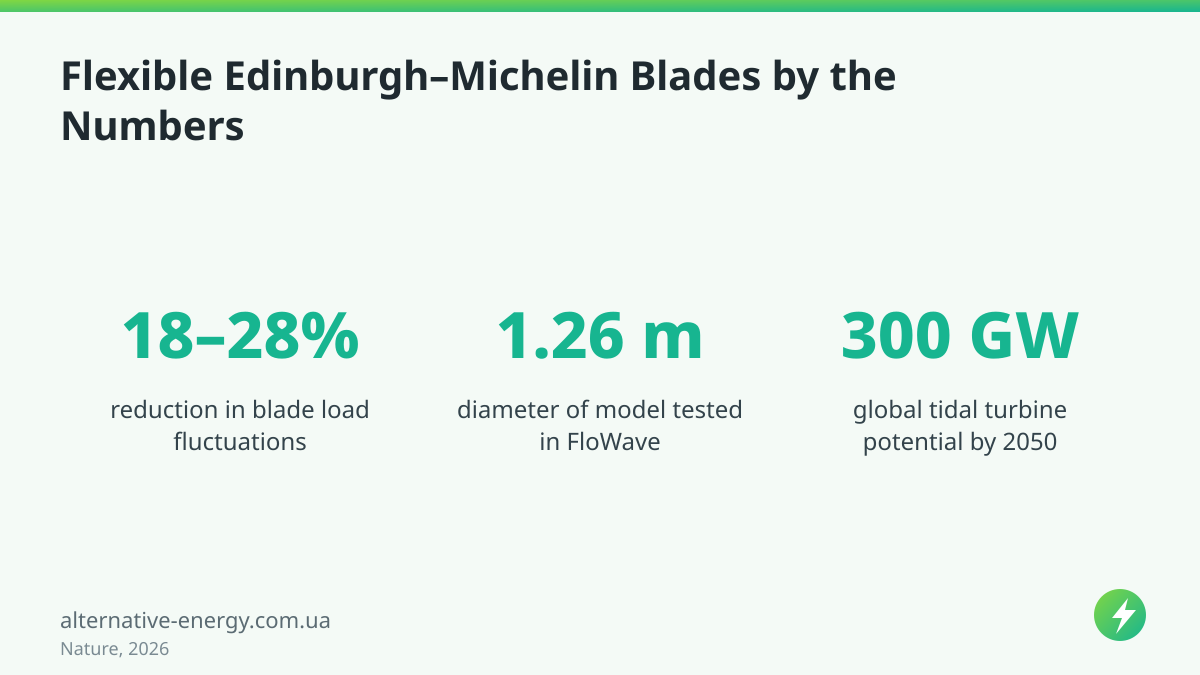
- Rubber blades with chordwise trailing-edge deformation reduce load fluctuations by 18–28% while delivering the same power output as active pitch-controlled systems.
- Tests were conducted on a 1.26 m diameter model in the 25-metre FloWave Ocean Energy Research Facility in Edinburgh.
- The peak power coefficient reached approximately 0.37.
- Results are published in Nature (vol. 659, pp. 666–670; DOI: 10.1038/s41586-026-11278-w).
How flexible blades work
According to techxplore.com, the rubber blades contain internal steel spars and passively flex and straighten in response to flow changes — with no external control. In the Nature paper, the authors describe this as chordwise trailing-edge deformation, which “provides structural reliability without additional mechanical complexity.” The principle mirrors how fish fins and tree branches automatically adapt to load.
This design eliminates the components most likely to fail underwater: pitch-control mechanisms, motors, sensors, and bearings.

FloWave test results
The 1.26 m turbine model was designed to represent a 20-metre commercial installation. Flow speeds during testing ranged from 0.5 to 1.0 m/s, the design optimisation speed was 0.85 m/s, and tip-speed ratios spanned 3 to 9. Reynolds numbers fell in the range 0.49–1.16 × 10⁶.
The flexible blades matched the power output of rigid blades with active pitch control, while high-frequency cyclic loads responsible for material fatigue dropped by 18–28% across thrust, torque, and bending moment measurements. Computer simulations indicate the efficiency gain holds at the 20-metre commercial scale. Michelin, which co-led the research through its composites division, has filed patent applications; further validation is still required before commercialisation.
Why the wind industry is paying attention
The stakes for tidal energy are high: according to estimates cited in the Nature paper, Europe’s tidal resource alone stands at 50 TWh per year, with the US resource at 220 TWh per year. The UK is targeting 1 GW of tidal capacity by 2035, and global deployment forecasts for such turbines exceed 300 GW by 2050.
The subsea environment is among the most demanding for mechanical equipment, and the principle of “fewer moving parts, longer service life” applies with particular force here. At the same time, dampening peak loads without active mechanics is a challenge shared by offshore wind: the reliability issues are closely analogous. We covered a similar concept in adaptive aerodynamics in our piece on the ECOWIND project with its variable-tip blade, and a broader review of underwater energy concepts can be found in “Underwater Energy Generation: Global Innovations”.
What this means
The Edinburgh–Michelin work is, for now, a laboratory result on a 1.26 m model representing a 20-metre turbine. But the “rubber plus steel spar instead of pitch mechanism” approach opens a rare opportunity to simultaneously reduce construction costs, extend service life, and lower the risk of failure in an environment where repairs are extremely expensive. If full-scale testing confirms the effect, passively adaptive blades could become a compelling option not only for tidal turbines but also for the harsh conditions of offshore wind — and that is a development worth watching over the coming years.
Sources: techxplore.com, Nature
Prepared by the Alternative Energy editorial team with the help of AI based on the sources listed; facts and figures were checked against them during automated editorial review. How we prepare articles