


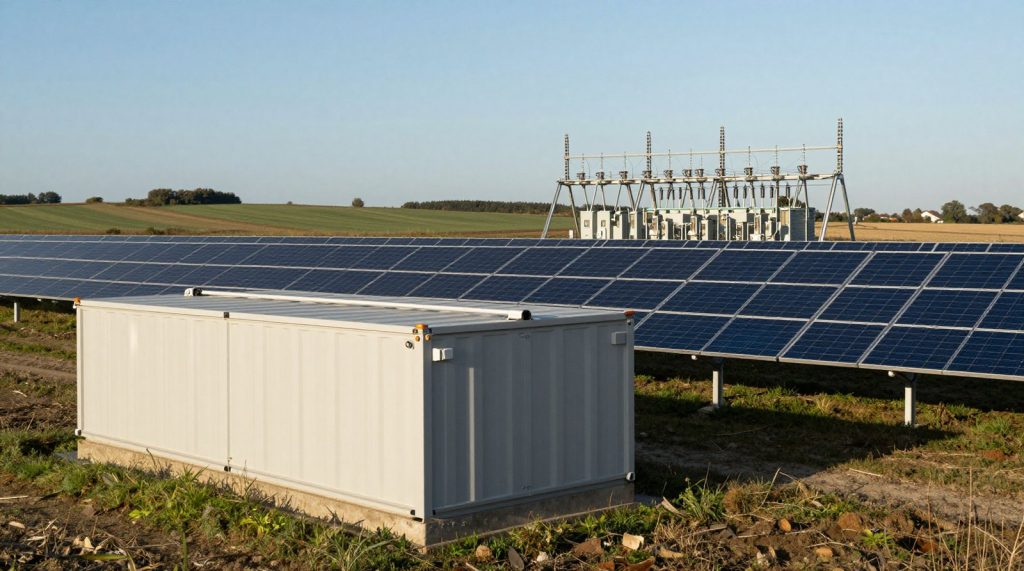
By the end of 2026, France will allow solar power plants paired with battery energy storage systems (solar-plus-storage) with an installed capacity of up to 25 MW to connect to the grid under simplified rules — provided that maximum instantaneous grid injection does not exceed 17 MW. The announcement was made by government spokesperson Maud Bregeon as part of a new package of measures to accelerate economic electrification and improve demand flexibility.
Key points:
- Solar-plus-storage projects with installed capacity up to 25 MW will be able to bypass the existing 17 MW grid connection limit — while keeping the 17 MW cap on grid injection.
- The measure is aimed primarily at hybrid renewable energy projects with storage.
- The government is simultaneously preparing new smart-control requirements for heat pumps, water heaters, and EV charging.
- Energy regulator CRE is testing tariffs designed to incentivize consumption during peak solar generation hours.
What exactly is changing in grid connection rules
According to pv-magazine.com, the change specifically targets hybrid installations: the installed capacity of the solar array may reach 25 MW, but maximum instantaneous grid injection remains capped at 17 MW. The battery energy storage system “absorbs” the difference — charging during periods of excess generation and discharging when the grid can accept less. For developers, this means that within the same grid connection “slot,” more solar panels can be installed, improving the utilization rate of the connection point.
This step follows on from the April 2026 package. The government estimates that smart management of heating, hot water, and EV charging in the residential sector alone could reduce related energy costs by up to 35%. From 2027, heat pump subsidies in France will be conditionally tied to the availability of remote-control functionality.
Industrial flexibility targets through 2030
Alongside the government package, a number of French companies and industry associations announced their own flexibility capacity deployment commitments:
- Gimelec — mobilize 6 GW of flexibility in commercial and services buildings by installing energy management systems in 50% of existing facilities.
- EDF — connect remote control of energy-intensive equipment in 5 million households via the EDF & Moi app.
- Neoen — commission 1 GW of flexible capacity.
- NW Group — invest €1 billion and add 1.5 GW to its flexibility platform.
- Octopus Energy France — manage 1.5 million connected devices, estimated to represent 5–6 GW of flexible capacity.
Regulator CRE is in parallel testing new electricity supply products through EDF Obligation d’Achat that will reflect a typical daily solar generation profile with a noon peak. The aim is to encourage suppliers to offer tariffs that shift consumption toward hours of surplus, lower-cost solar energy.
Why this precedent matters for the Ukrainian solar-plus-storage market
As an EU candidate country, Ukraine is aligning its legislation with the acquis communautaire — meaning the French approach to connecting mid-scale hybrid projects could well inform future decisions by the Ukrainian regulator. In September 2026, demand at Ukraine’s first solar-plus-storage support auction exceeded the quota by nearly four times: developer capacity and capital are available, and the grid is increasingly becoming the bottleneck.
The logic of “installed capacity larger than the permitted injection, with storage smoothing the difference” allows more solar panels to be deployed within the same connection point. For distribution system operators, it is a way to avoid “frozen” capacity without forcing costly grid expansion — while maintaining technical injection limits. Combined with new permitting timelines for solar power plants, this creates conditions for accelerating actual commissioning over the coming seasons.
For developers in Ukraine, the signal is straightforward: if the French regulator formalizes this hybrid connection model, the argument that “hybrids save grid capacity” shifts from a marketing claim to a regulatory principle. It is worth watching whether a similar provision appears in Ukrainian secondary legislation — it would directly affect the economics of future solar-plus-storage auctions.
Sources: pv-magazine.com
Illustration generated with AI
Prepared by the Alternative Energy editorial team with the help of AI based on the sources listed; facts and figures were checked against them during automated editorial review. How we prepare articles