


The International Energy Agency’s Energy Efficiency 2024 report takes on the question that most owners of older homes face before replacing their boiler: can a heat pump in a poorly insulated house actually save energy? The short answer is yes — even under those conditions, a heat pump will cut consumption. But the size of the financial benefit depends less on the heat pump itself than on the condition of the walls and the local ratio between electricity and gas tariffs.
Key figures:
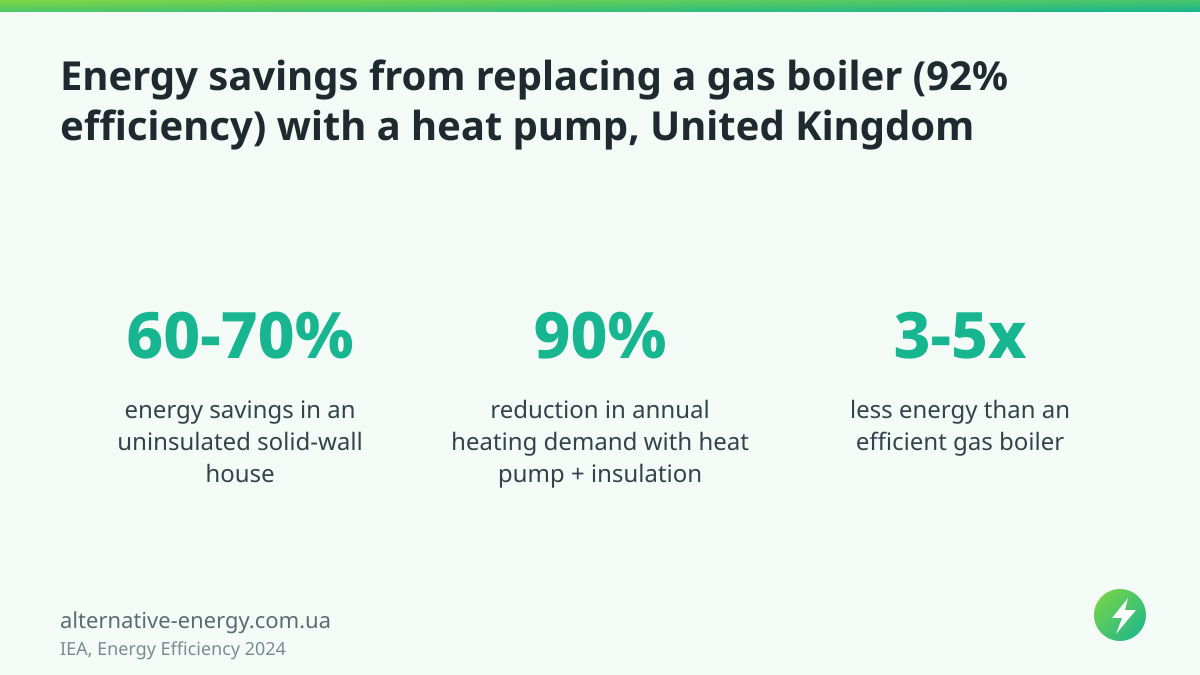
- a heat pump uses 3–5 times less energy than an efficient gas boiler;
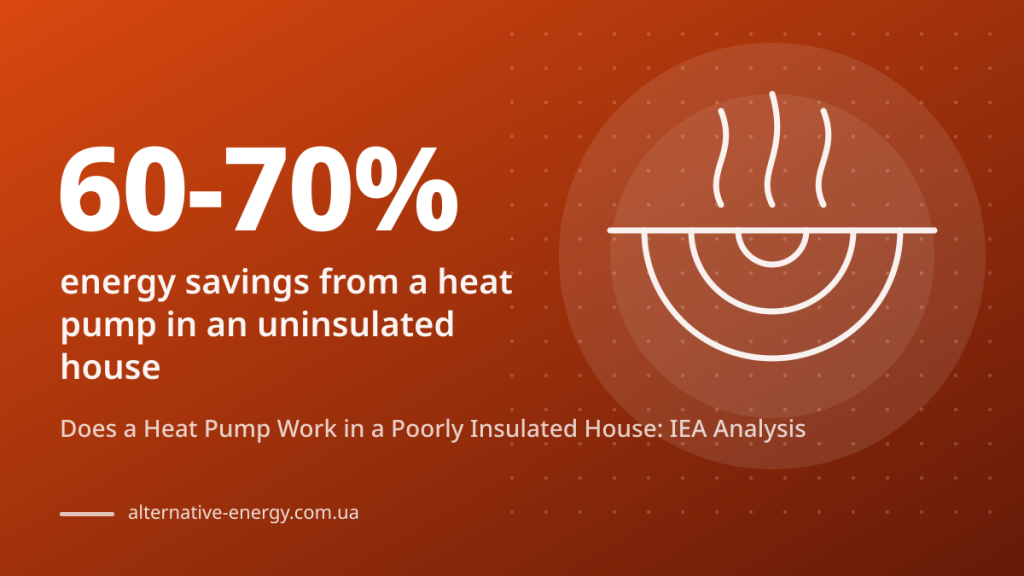
- replacing a 92%-efficiency boiler with an air-source or ground-source heat pump in an uninsulated solid-wall house (United Kingdom) delivers 60–70% savings on heating energy;
- combining insulation with a heat pump installation reduces annual heating demand by 90%;
- in Sweden, where gas and electricity prices are nearly equal, bills can fall by 60–90% depending on the level of insulation.
Why wall condition directly determines efficiency
According to the International Energy Agency, a heat pump performs best where the thermal envelope can be held at a lower supply temperature than a conventional boiler and maintained stably with minimal heat loss. When a house loses a large amount of heat through walls, windows, and gaps, the pump must produce more thermal output — which means a larger unit is required. A bigger heat pump costs more both to purchase and to run.
The IEA’s conclusion is unambiguous: the optimal strategy is to insulate and install a heat pump together, rather than choosing one or the other. A well-insulated home needs a smaller, less expensive unit to deliver the same level of comfort. That said, even without insulation the switch to a heat pump pays off in energy terms. IEA calculations for a typical two-storey UK home show that replacing a 92%-efficiency gas boiler with a high-performance air-source or ground-source heat pump cuts heating energy consumption by 60–70% — even in a solid-wall building with no insulation at all. Adding quality insulation alongside the heat pump brings the combined reduction to 90% of annual heating demand.

Sweden, France, United Kingdom: same technology, different bills
The IEA specifically emphasises that savings in kilowatt-hours do not automatically translate into savings on the bill. Everything hinges on the ratio between electricity and gas prices.
- Sweden (electricity $0.23/kWh, gas $0.22/kWh): heating bills can drop by 60–90% depending on insulation level.
- France (electricity $0.25/kWh, gas $0.11/kWh): savings are real but smaller, particularly in poorly insulated homes.
- United Kingdom (electricity $0.31/kWh, gas $0.08/kWh): the financial benefit is considerably more modest, and in some cases bills may actually rise — insulation is what softens that outcome.
The IEA adds that as tariff mechanisms increasingly incentivise low-carbon electricity, the financial case for heat pumps will grow stronger.
Installation: the second hidden weak link
Even a perfectly specified heat pump can be undermined by installation errors. Material from the Building America Solution Center, drawing on DOE data, reports that between 70% and 90% of residential air conditioners and heat pumps have at least one installation or maintenance defect that reduces performance; when duct leakage is included, the figure reaches 90–100%. According to an NREL model, approximately 9% of all energy consumed by HVAC systems in the United States is the result of installation faults — equivalent to roughly $2.5 billion in additional utility costs per year.
NIST data show that even moderate deviations — a 15% reduction in airflow or a 20% refrigerant undercharge — measurably increase energy consumption. A breakdown of typical losses looks like this: 4% of energy losses stem from incorrect refrigerant charge, 3% from airflow issues, and 15% from duct leakage. In practical terms this means one thing: buying the right heat pump does not by itself guarantee the promised figures on the bill — a proper commissioning process is essential, including pressure testing, evacuation, refrigerant charge verification, and static duct pressure checks.
What to take away from this
The IEA’s analysis gives a clear-headed answer to a question many owners of older properties face. In energy terms, the gain from installing a heat pump in a poorly insulated house is almost certain: the technology remains 3–5 times more efficient than a gas boiler. In terms of the bill, the picture is narrower: the larger the gap between electricity and gas tariffs, the more critical insulation becomes. Where that gap is wide and the walls leak heat, insulation should come first — before the heat pump, not after. It is also worth understanding how a heat pump behaves in cold weather — our article on heat pump performance in cold climates covers this in detail. For those considering a heat pump alongside home generation, the case study of an eco-home with a solar installation and heat pump is a useful reference.
Sources: International Energy Agency, Building America Solution Center (PNNL)
Prepared by the Alternative Energy editorial team with the help of AI based on the sources listed; facts and figures were checked against them during automated editorial review. How we prepare articles