


According to a new forecast from the International Energy Agency (IEA), global renewable capacity will grow by more than 4,770 GW between 2026 and 2031 — 57% more than in the previous six years, at an average of roughly 800 GW per year. Renewables will account for over 80% of all new power capacity added worldwide, with solar generation delivering three-quarters of that growth. The figures come from Mercom India, citing an IEA report.
Key takeaways:
- Renewable capacity additions in 2026–2031: more than 4,770 GW.
- Cumulative global renewable capacity by 2030: 9,710 GW.
- Solar generation: approximately 75% of all new renewables.
- China: 53% of global additions; India rises to second place with an 8.5% share.
Solar dominates; wind and pumped hydro hold their ground
By technology, utility-scale solar power plants are set to add 2,075 GW, while distributed solar generation will contribute another 1,530 GW. Onshore wind is forecast to reach 2,040 GW by 2031, offshore wind will add 117 GW, and pumped-storage hydro around 74 GW. Against this backdrop, annual additions worldwide are expected to fall by 11% in 2026 — breaking a 21-year streak of records — primarily due to a slowdown in solar installations in China.
Growth map: China ahead, India catching up
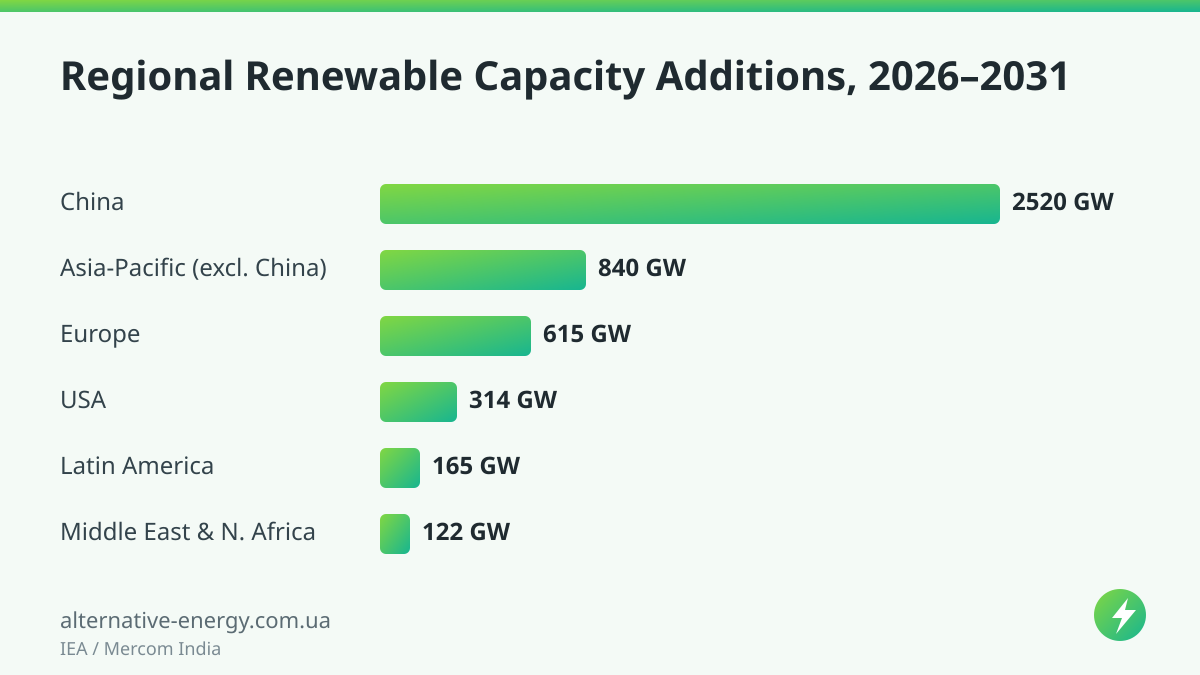
China will remain the primary driver, contributing roughly 2,520 GW of new capacity — 53% of global additions (down from over 60% in 2025). India will multiply its annual additions by 2.6 times, nearly doubling its global share to 8.5%, driven by utility-scale solar, rooftop solar power plants, and pumped-storage hydro. Europe will add over 615 GW, Asia-Pacific excluding China more than 840 GW (nearly half of which comes from India). The United States will contribute around 314 GW, Latin America 165 GW, the Middle East and North Africa 122 GW, and sub-Saharan Africa more than 120 GW. By 2030, cumulative global solar and renewable capacity will reach 9,710 GW.

Grids and storage: the bottleneck for growth
The IEA emphasizes that the pace of renewables expansion is increasingly tied to grid readiness. Global installed behind-the-meter energy storage system capacity is set to exceed 670 GWh by 2031 at a power rating of around 290 GW. In 2026–2031, more than 550 GWh of capacity and roughly 230 GW of power are planned to be added — more than five times the figures for the previous six years. At the same time, roughly 4,400 GW of projects are queuing for grid connection, including over 1,500 GW of energy storage system applications. Annual curtailment of wind and solar output could increase nearly fivefold by 2031. The IEA identifies grid transmission expansion, affordable financing, streamlined permitting, and accelerated deployment of energy storage systems as priority actions.
What the numbers tell us
The IEA forecast marks a meaningful shift: renewables are no longer an “alternative” — they are the default for any new generation project. When more than 80% of the world’s new power capacity comes from renewables, and wind and solar already compete with conventional generation at scale, the central question moves from “where to source renewables” to “how to prepare the grid and storage to absorb this volume.” For countries currently modernizing or rebuilding their power systems, this is an argument for planning grids and storage in parallel with new generation — not as an afterthought. For households and businesses weighing a standalone solar power plant against a hybrid system with batteries, the generation-plus-storage combination is increasingly the standard configuration.
Sources: Mercom India
Prepared by the Alternative Energy editorial team with the help of AI based on the sources listed; facts and figures were checked against them during automated editorial review. How we prepare articles