


The International Energy Agency (IEA) published its annual Renewables 2026 report on November 6, 2026. The IEA forecast points to an unprecedented acceleration in renewable energy development against a backdrop of geopolitical turbulence: the US and Israeli war against Iran and the threat of disruptions to oil and gas supplies have pushed renewables “to the top of the policy agenda in many countries,” with solar photovoltaics emerging as the primary driver of that shift.
Key figures from the report:
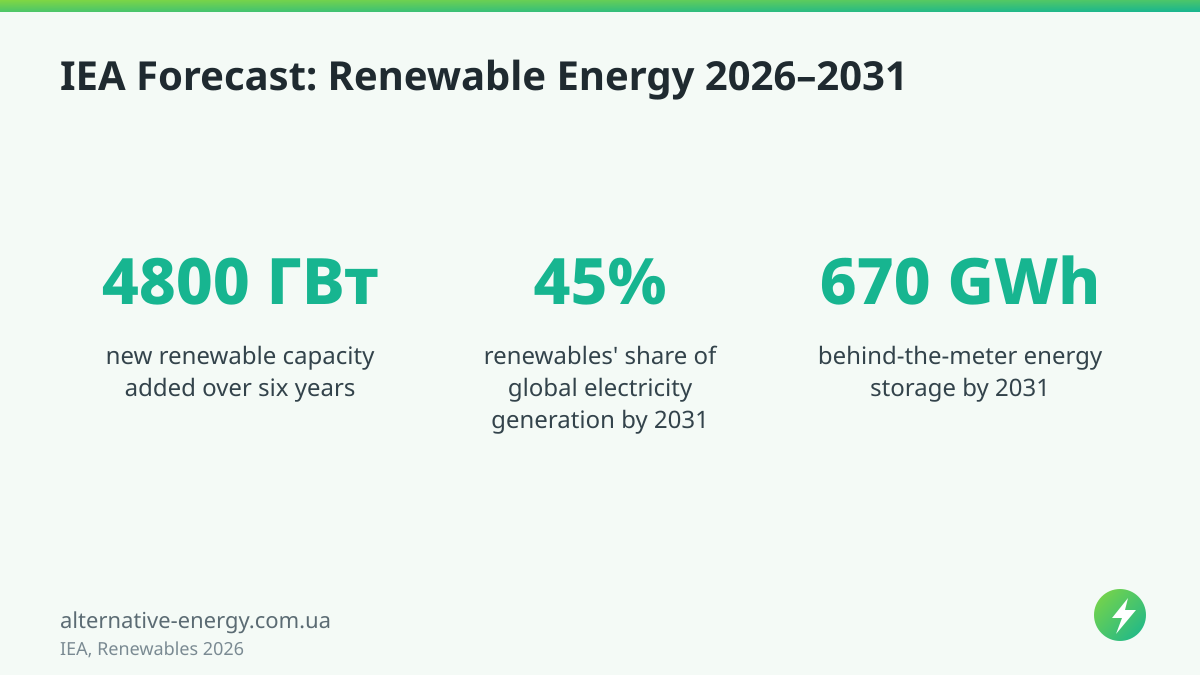
- +4,800 GW of new renewable capacity in 2026–2031 — 57% more than in the previous six years.
- 45% — renewables’ projected share of global electricity generation by 2031, up from 33% in 2025.
- 670 GWh — projected volume of behind-the-meter residential energy storage systems, nearly a sixfold increase.
- 53% — China’s share of new renewable additions through 2031; India becomes the world’s second-largest market.
Energy Security as the Engine of Transition
According to RenewEconomy, the IEA explains the policy shift with straightforward logic: “Since renewable resources are widely distributed, every country has its own potential that can be developed competitively to strengthen energy security.” The agency stresses that governments no longer have to choose between security, affordability, and climate goals.
The IEA forecast for emerging economies has been revised upward by nearly 20% compared to last year’s report, driven by stronger ambitions, supportive policies, and falling costs for wind and solar. For the first time, capacity additions outside China are projected to match those in advanced economies.

Solar Overtakes Hydro, Batteries in One in Three Homes
Wind and solar PV together will double their share of global electricity generation, exceeding 28% by 2031. As early as 2029, solar will surpass hydropower to become the largest source of renewable electricity. Off-grid solar generation will grow 2.5 times — to roughly 80 GW by 2031 — with Pakistan, sub-Saharan Africa, and Southeast Asia leading the way. Since 2022, rooftop solar installations have improved electricity access for at least 70 million households.
Behind-the-meter energy storage systems will grow nearly sixfold — to more than 670 GWh by 2031. More than a third of residential solar systems will include a battery. The IEA links this trend to falling battery prices and consumers’ desire to shield themselves from energy price volatility.
China, India, and a New Production Map
China’s share of new global renewable additions will fall from over 60% in 2025 to 53% by 2031. Outside China, the Asia-Pacific region will add more than 840 GW of new capacity over the six-year period — more than double its 2020–2025 figures. Forecasts for the US, India, the Gulf states, sub-Saharan Africa, and Latin America have all been revised upward. Renewable installation rates in the Middle East, Southeast Asia, and Africa are set to nearly triple.
At the same time, China’s solar manufacturing sector is under pressure: more than 90% of large PV producers reported losses in 2026, and over 70 companies have filed for bankruptcy since 2024. The IEA notes that by 2031, India will become the second country after China capable of manufacturing all key solar PV supply chain components at industrial scale — a development that will diversify global supply.
What This Means for the Energy Policy Debate
War and fossil fuel supply risks are no longer arguments against green investment — in the IEA’s framing, they have become arguments for it. The agency’s emphasis on the distributed nature of renewable resources resonates with hard lessons learned in conflict zones: a generation asset that is spread across thousands of rooftops cannot be taken out by a single strike. For households, the trend toward rooftop solar with battery storage is not just a convenience but a tool for energy resilience; for policymakers, it is a signal that competitive local generation strengthens a country’s negotiating position in fossil fuel markets. It is worth watching how these projections feed into the next revision of national programs supporting solar power plants and energy storage systems.
Sources: RenewEconomy, IEA Renewables 2026
Prepared by the Alternative Energy editorial team with the help of AI based on the sources listed; facts and figures were checked against them during automated editorial review. How we prepare articles