


Ukraine is steadily aligning its regulatory framework with EU standards in the field of renewable energy. On 2 September 2026, the Verkhovna Rada passed Law 4963-IX (draft bill registration number 14271), advancing RED III implementation Ukraine has committed to under the Energy Community Treaty. In December 2025, the Ministry of Energy published a review of how closely existing Ukrainian legislation matches EU requirements. Below is a breakdown of the key figures and exactly what is changing.
Key takeaways:
- Biofuel sustainability criteria are met at only 15% — the weakest link overall.
- 260 MPs voted in favour of the new law.
- The maximum permit timeline for solar power plants is 3 months.
What the Energy Community Assessment Showed
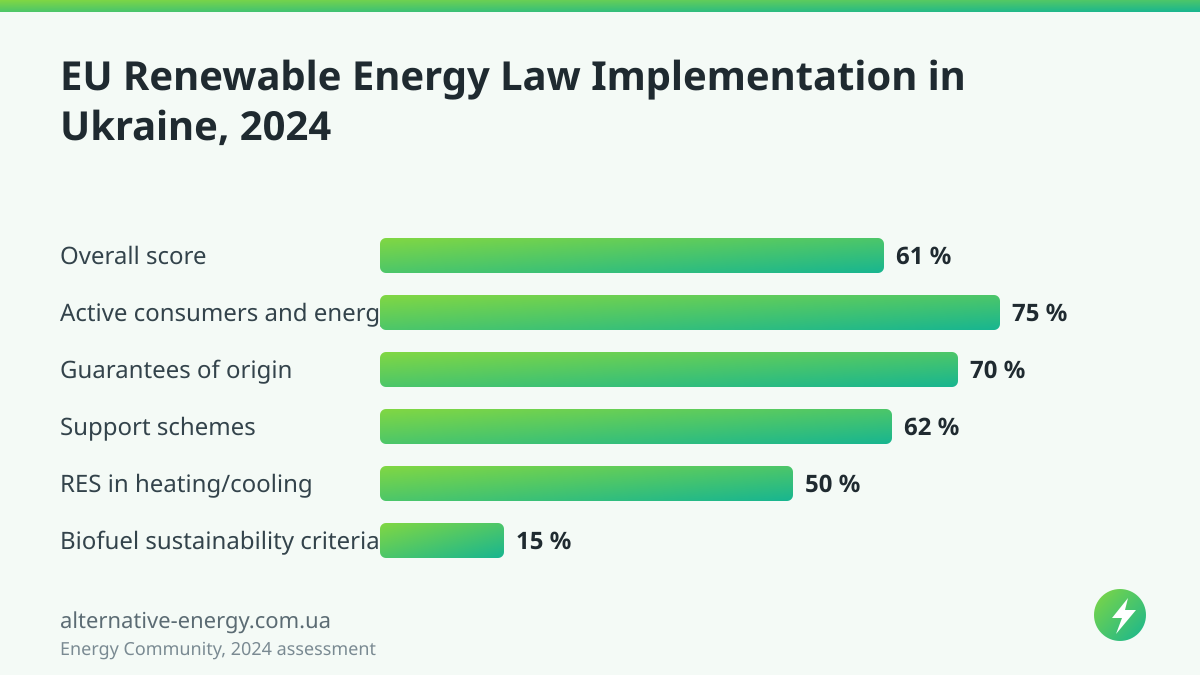
According to the Ukrainian Ministry of Energy, the Energy Community rated Ukraine’s overall compliance with EU renewable energy legislation at 61% in 2024. The target set for 2030 is 85%. That gap is precisely what prompted the adoption of the new law.
The breakdown by key area is as follows:
- active consumers and energy communities — 75%;
- guarantees of origin — 70%;
- quality of support schemes — 62%;
- renewables in the heating and cooling sector — 50%;
- sustainability criteria for biofuels and biomass — 15%.
That last category represents the most significant gap — and explains why the new law places particular emphasis on accounting, certification, and independent supply chain audits for biofuels.
What Law 4963-IX Introduces
The law updates terminology to RED III standards, introduces sustainability criteria for the full range of biofuels and biomass fuels, and establishes independent verification procedures. It formalises the legal status of energy communities — collective actors that can produce, consume, sell, and store renewable energy, with access to auction-based support. Active consumers gain a transparent self-generation framework.
Other key provisions include:
- the possibility of statistical transfers of RES indicators between states and joint projects with EU countries;
- qualification requirements for specialists working with solar installations, heat pumps, energy storage systems, and charging infrastructure;
- a mandatory obligation for grid operators to disclose the share of renewable generation and greenhouse gas emissions data;
- for industrial consumers — a peer-to-peer model: direct automated contracts with generators, with no intermediaries.
According to Forbes.ua, 260 MPs voted in favour in the chamber.

New Permit Timelines
One of the most investor-sensitive provisions is the reduction of approval procedures. The law sets the following maximum timelines:
- up to 3 months — for solar photovoltaic installations;
- up to 12 months — in accelerated renewable energy development zones;
- up to 24 months — for all other projects.
During preparations for the second reading, parliament prohibited the creation of such zones above 1,000 metres above sea level — including in the Carpathians, where new generation capacity may only be developed through the standard procedure with a mandatory environmental impact assessment.
In parallel, the law opens more practical legal frameworks for communities and businesses through new permit timelines for solar power plants and tools for collective generation. The underlying logic is to shift the question from “can we?” to “when exactly?”
Where This Fits in Ukraine’s European Integration
The law fulfils obligations under the Energy Community Treaty, the EU–Ukraine Association Agreement, and the Ukraine Facility programme. It also supports Ukraine’s negotiating position under Chapter 15 “Energy”. Alignment with shared EU rules likewise expands the scope for attracting investment in the sector and simplifies joint projects with Energy Community partners.
What This Changes for the Industry
The primary effect is predictability. If the increasingly tight deadlines function in practice, project development costs will fall, and smaller solar power plants will have the fastest route to launch. Communities and businesses gain a transparent instrument to build their own generation capacity and participate in the market on equal terms with large players. But the operative word is “if”: the practical force of these rules will be demonstrated by secondary legislation and the first cases that pass through the updated permitting system. It will also be worth tracking how the 2024 indicator set begins moving toward the 2030 target — particularly in the biofuels segment, where the gap remains the widest.
Sources: Міністерство енергетики України, Верховна Рада України, Forbes.ua
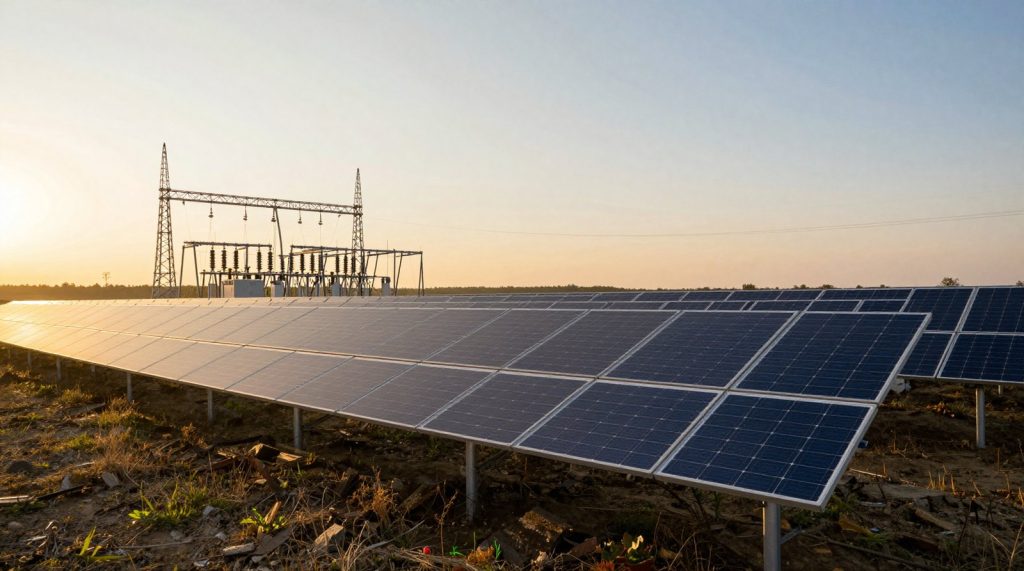
Illustration generated with AI
Prepared by the Alternative Energy editorial team with the help of AI based on the sources listed; facts and figures were checked against them during automated editorial review. How we prepare articles