


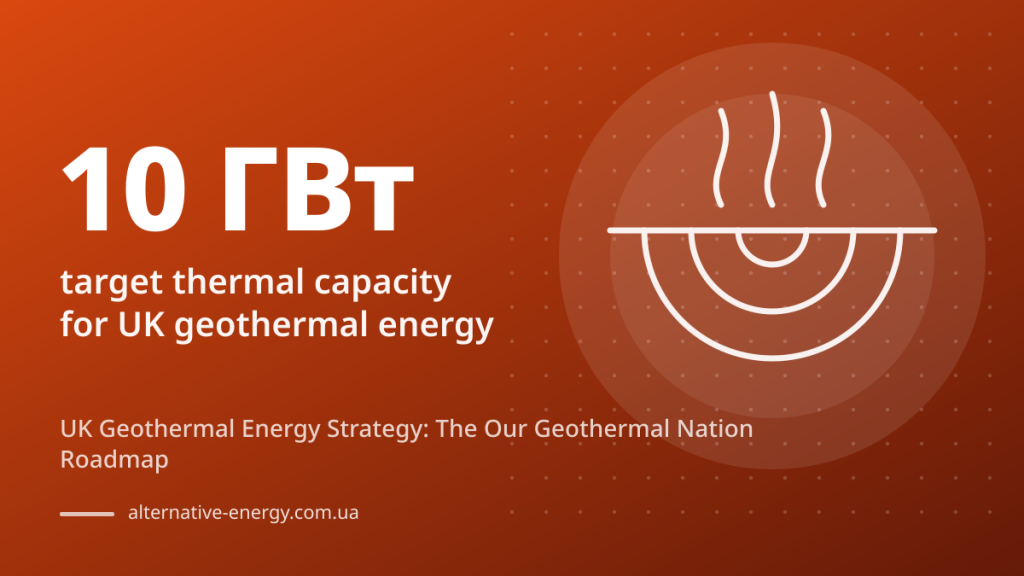
The UK’s National Geothermal Centre (NGC) has published “Our Geothermal Nation” — the country’s first national geothermal energy strategy. According to ThinkGeoEnergy, the roadmap is addressed directly to government and sets out three immediate asks, 16 recommendations, and a 24-month launch programme with concrete targets through to 2050.
Key figures:
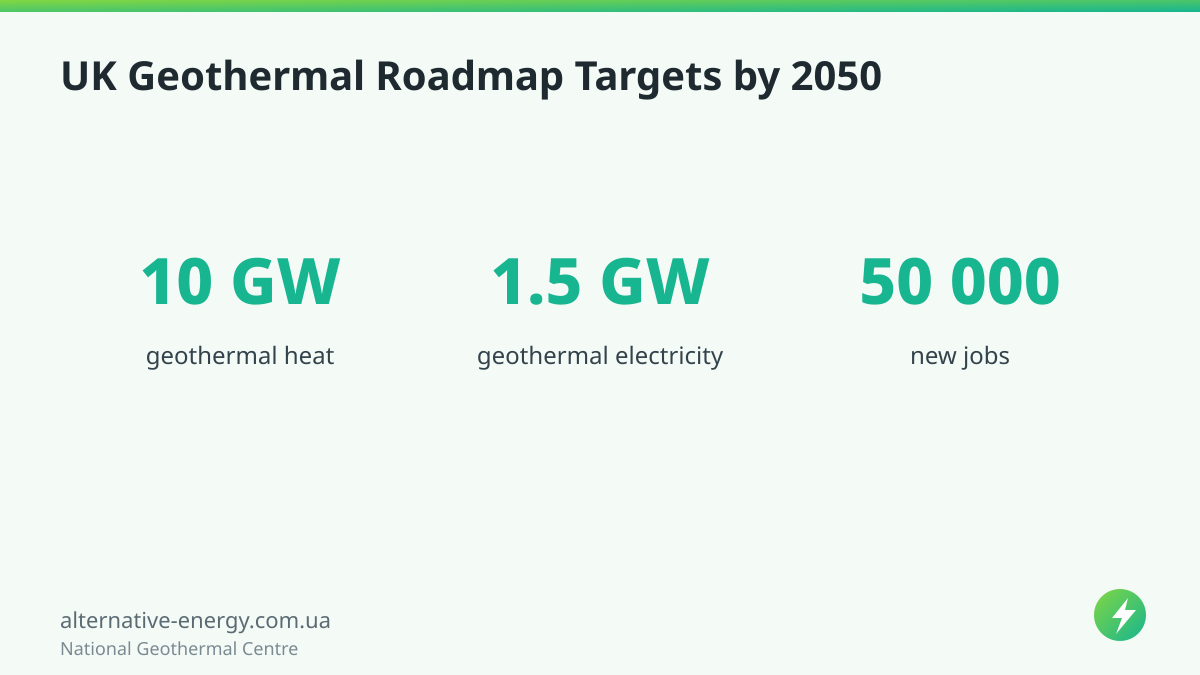
- By 2050 — up to 10 GW of geothermal heat and 1.5 GW of geothermal electricity capacity.
- Up to 50,000 new jobs created through delivery of the strategy.
- A 6 MW mine-water geothermal scheme is already operational in Gateshead.
- In February, the United Downs geothermal power plant in Cornwall became the UK’s first.
What “Our Geothermal Nation” Proposes
NGC — a UK non-profit — produced the document in three formats: an 8-page summary, a full version, and a standalone recommendations brief with an implementation timeline. The 16 recommendations are grouped across five themes: policy and regulation; market and finance; knowledge, education and skills; technology, research and innovation development; and infrastructure integration.
The proposed 24-month launch programme begins with the formation of a geothermal task force within the first six months, which would formally confirm NGC’s mandate as the national delivery body. Within 12 months, the plan calls for a pilot first-well guarantee and a technology development fund.
Three immediate asks are directed at government: recognise and resource NGC as the national coordinator; commission a pilot geological risk-sharing mechanism for the exploration phase; and stimulate demand by assessing geothermal potential across heat networks and public-sector assets, then publishing a project pipeline showing stages and barriers.

The Main Barrier: First-Well Risk
The roadmap’s authors conclude that the primary obstacle facing the sector is the investment environment — not the resource itself or the technology. Geothermal projects carry high upfront drilling costs and significant geological risk at the first well, yet once operational they run at low marginal cost. Investors, however, see uncertain long-term revenue, a lack of risk-sharing mechanisms, and an unclear licensing framework.
This is why the centrepiece of the strategy is a government-backed “first-well guarantee” — a pilot mechanism designed to remove the most painful element of early-stage exploration costs. In parallel, NGC calls for the skills and expertise of the UK’s oil and gas sector to be retained and redirected into geothermal; we explored the same logic in our piece on applying oil and gas technologies to geothermal drilling.
What Is Already Working: Gateshead and Cornwall
Gateshead’s mine-water geothermal scheme operates at 6 MW, supplying heat to consumers at a price at least 5% below the equivalent market gas tariff. In Cornwall, United Downs came online in February as the country’s first geothermal power plant.
“Beneath our feet lies a source of heat and energy that no other country can switch off, available day and night. Geothermal energy offers secure, home-grown power, and this roadmap shows the government how to deploy it at scale,” Adams is quoted as saying by ThinkGeoEnergy.
A Lesson for Energy Policymakers
The British model is instructive not so much for the headline numbers as for the architecture of the approach: a dedicated national coordinator, a prioritised pipeline of assets (heat networks, public buildings), and — critically — a mechanism for sharing geological risk at the first well. As the NGC’s experience shows, the absence of precisely these instruments is what holds back investment even where the resource and the expertise already exist.
It will be worth watching whether NGC can secure the first milestone — the creation of a government task force — within the stated six-month window. That will be the clearest early indicator of whether the 2050 targets are realistic.
Frequently Asked Questions
What is a mine-water geothermal system?
It is a technology that extracts heat from warm water that accumulates in the flooded workings of closed coal and ore mines. The water circulates through heat exchangers, and a heat pump raises the temperature as needed to a level suitable for a district heating network. The approach makes use of existing underground voids without the need to drill deep boreholes — the principle applied at Gateshead in the UK.
Sources: ThinkGeoEnergy
Prepared by the Alternative Energy editorial team with the help of AI based on the sources listed; facts and figures were checked against them during automated editorial review. How we prepare articles