

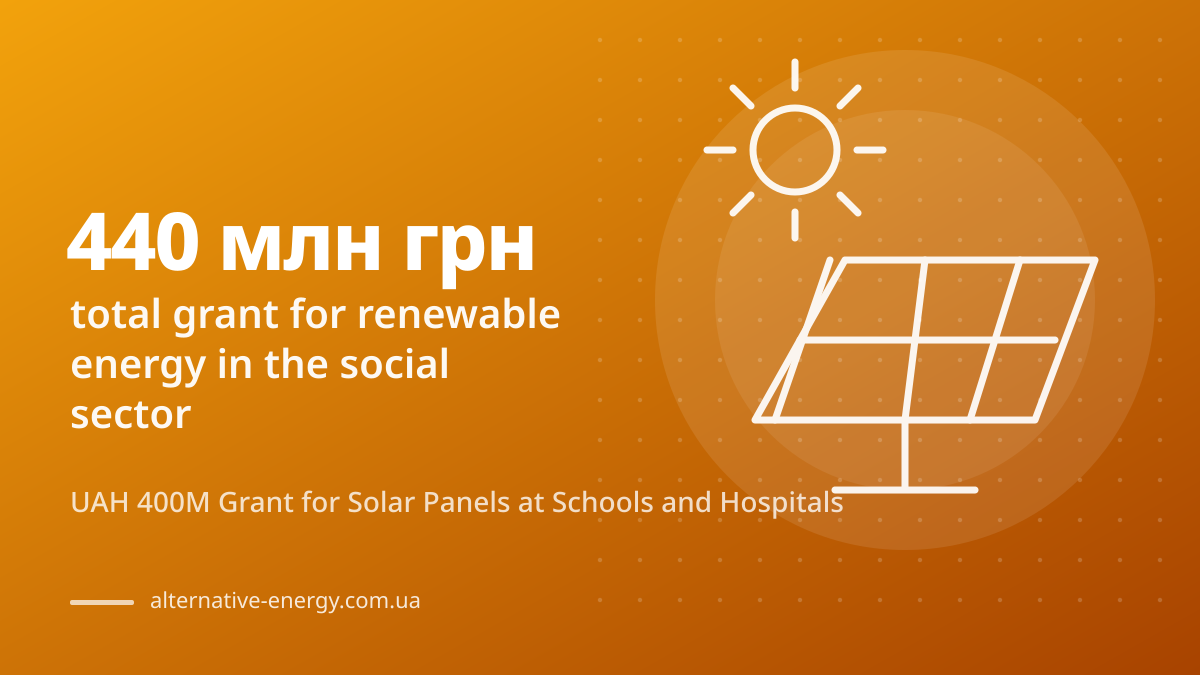
On October 30, 2025, Ukraine’s Cabinet of Ministers approved a major grant package for communities — covering photovoltaic systems, heat pumps, and energy storage at social-sector facilities. The total envelope is UAH 440M, targeting solar panels for schools, hospitals, and kindergartens. Here is how the mechanism works and who will implement it.
At a glance:
- UAH 396M — state budget subvention to local budgets for equipment procurement and installation
- UAH 44M — UNDP technical assistance to support procurement procedures
- Donors: European Investment Bank, Federal Government of Germany, International Climate Initiative (IKI)
- Implementation: GIZ as technical partner, UNDP as procurement agent
Which facilities are eligible
According to the Cabinet of Ministers of Ukraine, the list is specific: hospitals, schools, and kindergartens. The key condition is that the facility must have already undergone renovation or modernisation under European Investment Bank programmes. Newly constructed buildings are not included — the funds add a renewable energy layer to already-upgraded infrastructure rather than building it from scratch.
The standard technology package for making a public building more self-sufficient includes photovoltaic modules, a heat pump, and a battery energy storage system to hold electricity generated during the day. This combination allows a facility to maintain basic operations even when the centralised grid is unstable due to wartime risks.

How the funding is structured
Formally, the arrangement runs along two parallel tracks. The first is a UAH 396M subvention distributed from the state budget to local budgets and directed straight to equipment procurement and installation. The second is UAH 44M in technical assistance that UNDP uses to manage tendering procedures.
Three organisations form the donor side: the grant is provided by the European Investment Bank with support from the Federal Government of Germany and the International Climate Initiative (IKI). GIZ — Germany’s international development agency — acts as the technical implementation partner, while UNDP serves as procurement agent. The government has labelled this arrangement the Renewable Energy Solutions (RES) mechanism.
What communities gain beyond the funding
Beyond the financial support, programme participants will receive training workshops and mentoring. This matters because installing a solar power plant is only the first step: ongoing operation, generation monitoring, battery maintenance, and heat pump servicing all require competencies that municipal institutions have often lacked. Without that knowledge layer, equipment gradually stops delivering the expected results.
Solar panels and energy storage systems at hospitals, schools, and kindergartens ensure these facilities can operate continuously regardless of external conditions.
What this means for community leaders and public institutions
For heads of consolidated territorial communities and municipal institutions, this is a concrete illustration of how international donor financing works in the social sector: funds flow not directly to equipment suppliers but through the local budget and UNDP as procurement agent. If your facility has previously been within the scope of EIB projects, it is worth checking with the regional administration or the relevant department whether it is included in the current RES wave.
In broader terms, this is another step toward a model of decentralised energy where critical facilities — medical, educational, and social — are less dependent on the centralised grid. For readers tracking the renewable energy market, the mechanism shows a replicable template: donor (EIB) + technical partner (GIZ) + procurement agent (UNDP) + subvention to the local budget. If it delivers results in the current wave, the same structure can reasonably be expected to appear in future funding rounds.
Sources: Кабінет Міністрів України
Prepared by the Alternative Energy editorial team with the help of AI based on the sources listed; facts and figures were checked against them during automated editorial review. How we prepare articles


