


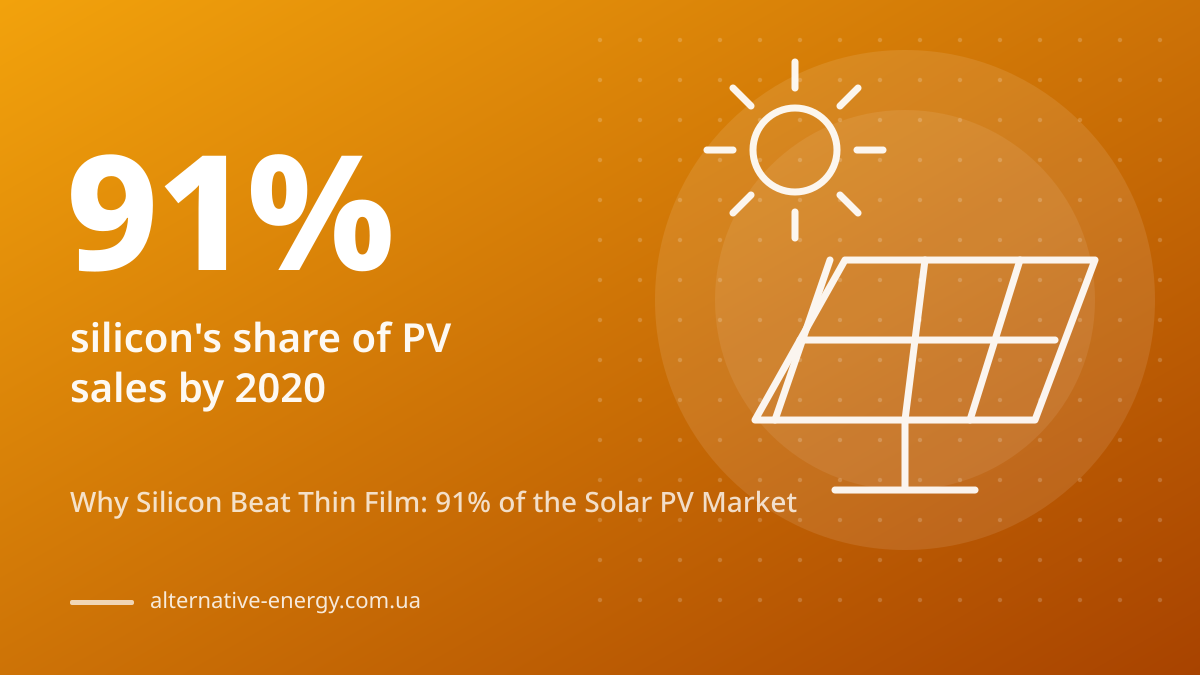
New research from London’s Bayes Business School explains why silicon solar panels pushed out thin-film technologies to claim 91% of global PV module sales by 2020. The study, published in the journal Organization Science, finds that a technology’s fate is decided not only in the laboratory but also by the willingness of an entire ecosystem — suppliers, investors, governments, and end users — to get behind it.
Key takeaways:
- By 2020, silicon solar panels accounted for 91% of PV module sales worldwide.
- Three-quarters of thin-film panel manufacturers exited the market.
- At the outset, both technologies had roughly equal prospects and a comparable number of producers.
- The analysis covers the US solar industry from the 1950s through 2020.
What the Researchers Did
According to techxplore.com, the paper’s authors — Dr. Mara Guerra, Senior Lecturer in Strategy at Bayes Business School (City St George’s, University of London), and Professor Rajshree Agarwal of the University of Maryland — traced the evolution of the US solar industry from the 1950s to 2020. The study appeared in Organization Science; DOI: 10.1287/orsc.2022.17185.
Notably, both platforms — silicon and thin film — started from a very similar position. Roughly the same number of manufacturers entered each technology segment. Yet over the following decades the balance shifted dramatically: silicon took 91% of sales while 75% of companies that had bet on thin film left the industry.
Reinforcing Loops vs. Balancing Loops
The authors frame the core mechanism through systems dynamics. Silicon benefited from a reinforcing loop. Established supply chains and existing manufacturing equipment made it possible to scale up production. Scale, in turn, improved reliability, strengthened the technology’s reputation, and reduced costs — which attracted further investment and new entrants, perpetuating the cycle.
Thin film found itself caught in the opposite dynamic — balancing loops. Its supply chains were largely customized, economies of scale were weaker, and financial resilience was lower.
What the Co-Author Says
Dr. Mara Guerra sums up the central argument this way: silicon won not because it was the technically superior solution, but because it made better use of the ecosystem that had already formed around solar energy. The authors stress that even promising technologies may never achieve widespread adoption if ecosystem participants are not ready to support them.
Why This Matters for Evaluating New Technologies
The findings are relevant to anyone tracking alternative PV platforms and next-generation solar technologies. The Bayes Business School paper does not assess those technologies directly, but it offers a useful framework: the question is not only about the efficiency of a single module, but also whether a technology has ready supply chains, investor appetite, and demand from energy companies behind it. For readers comparing module options or following the ongoing decline in solar panel prices, this is a prompt to look carefully at the ecosystem surrounding a product — not just the efficiency figure in a manufacturer’s press release.
Sources: techxplore.com
Prepared by the Alternative Energy editorial team with the help of AI based on the sources listed; facts and figures were checked against them during automated editorial review. How we prepare articles


