

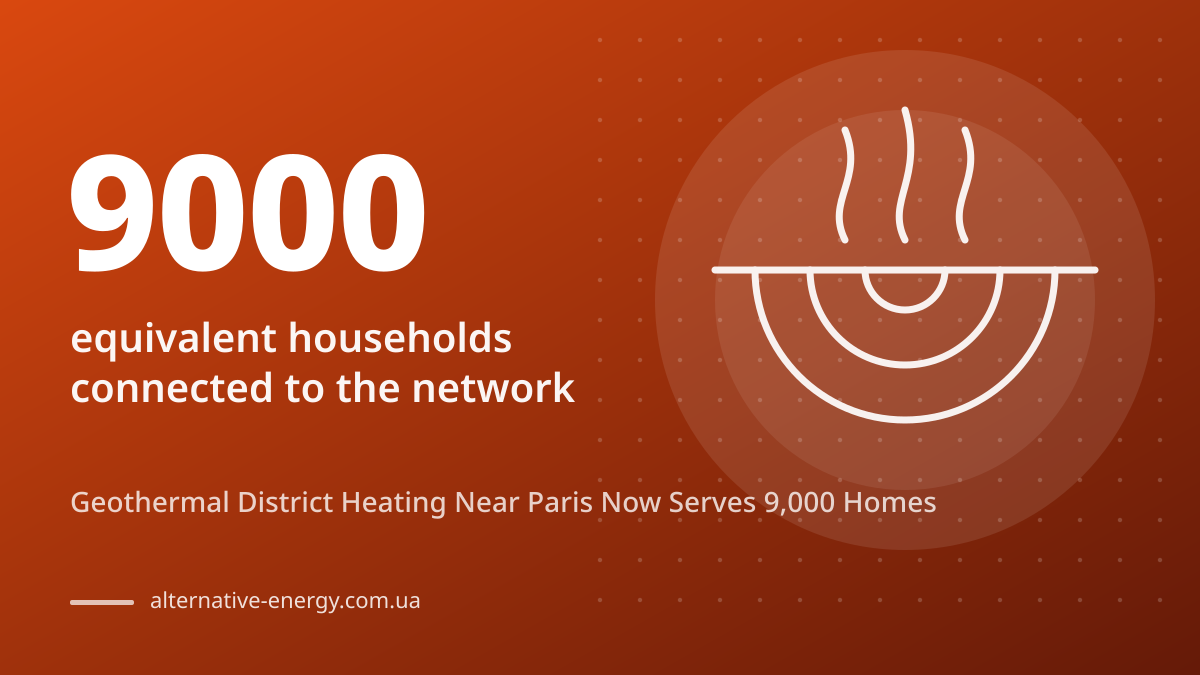
In the French towns of Dugny and Le Bourget in the Seine-Saint-Denis department, a geothermal heat plant has officially entered commercial operation. According to ThinkGeoEnergy, geothermal district heating is now up and running in this Paris suburb: a 20 km network serves around 9,000 equivalent households.
Key facts:
- Operator: Energie verte de Dugny – Le Bourget (EVDB), a wholly owned subsidiary of Groupe Coriance; concession awarded in 2022.
- Heat network length: 20 km, covering approximately 9,000 equivalent households.
- Total investment: €55 million; €18 million from ADEME via the Heat Fund.
- Connected: Paris–Le Bourget Airport and the former Media Village from the 2024 Olympics and Paralympics.
How the geothermal district heating system was brought online
The project is delivered by Energie verte de Dugny–Le Bourget (EVDB), a wholly owned subsidiary of Groupe Coriance. EVDB received its district heating concession in 2022. Drilling of the geothermal doublet began in mid-2025, and the plant was commissioned in mid-2026.
The commercial launch ceremony was attended by representatives of the municipalities of Dugny and Le Bourget, Greater Paris Metropolis, the Île-de-France region, Paris–Le Bourget Airport management, and Groupe Coriance.
A 20 km network: the airport, the Media Village, and an interconnection with Blanc-Mesnil
Alongside the plant start-up, the heat network was expanded. In Dugny, an additional 1.5 km of pipes were laid, bringing the city’s total to 3 km. In Le Bourget, a further 2.6 km were built. A separate interconnection with the neighbouring Blanc-Mesnil network was also completed, enabling energy exchange between the two systems and optimising source utilisation.
Paris–Le Bourget Airport was connected to the network, as was the former Media Village that hosted journalists during the 2024 Olympic and Paralympic Games. The site has since been redeveloped into a residential neighbourhood for Dugny residents. The project spans both transport infrastructure and new housing, and has attracted significant public funding.

How the €55 million investment breaks down
The total budget for the Dugny–Le Bourget geothermal heat project stands at €55 million. France’s environmental and energy management agency ADEME contributed €18 million through its Heat Fund. The Île-de-France region and Greater Paris Metropolis each added €2.5 million.
For broader context: heat projects of this kind are already delivering measurable impact at the city level.
What cities with district heating networks can take from this
The Dugny–Le Bourget case is notable because the geothermal source has been integrated into existing urban heating infrastructure in a densely populated suburb of an EU capital — rather than anchored to a standalone new development. For cities where centralised district heating is a historic baseline, this is an example of how network upgrades can be combined with a shift to a renewable heat source and the ability to exchange surplus heat between neighbouring systems. Whether a similar scenario is viable in any given city depends on the local geology, the condition of the existing infrastructure, and the availability of support mechanisms comparable to France’s Fonds Chaleur.
Sources: ThinkGeoEnergy
Prepared by the Alternative Energy editorial team with the help of AI based on the sources listed; facts and figures were checked against them during automated editorial review. How we prepare articles


