


A question we often hear: does pairing solar PV panels with geothermal generation still make sense when solar costs keep falling and battery storage is becoming increasingly affordable? A new study from LUT University (Finland), published in pv magazine Global, offers a direct answer: the solar-geothermal hybrid has moved well beyond a niche solution and delivers competitive levelized costs in real-world regions.
Key figures:
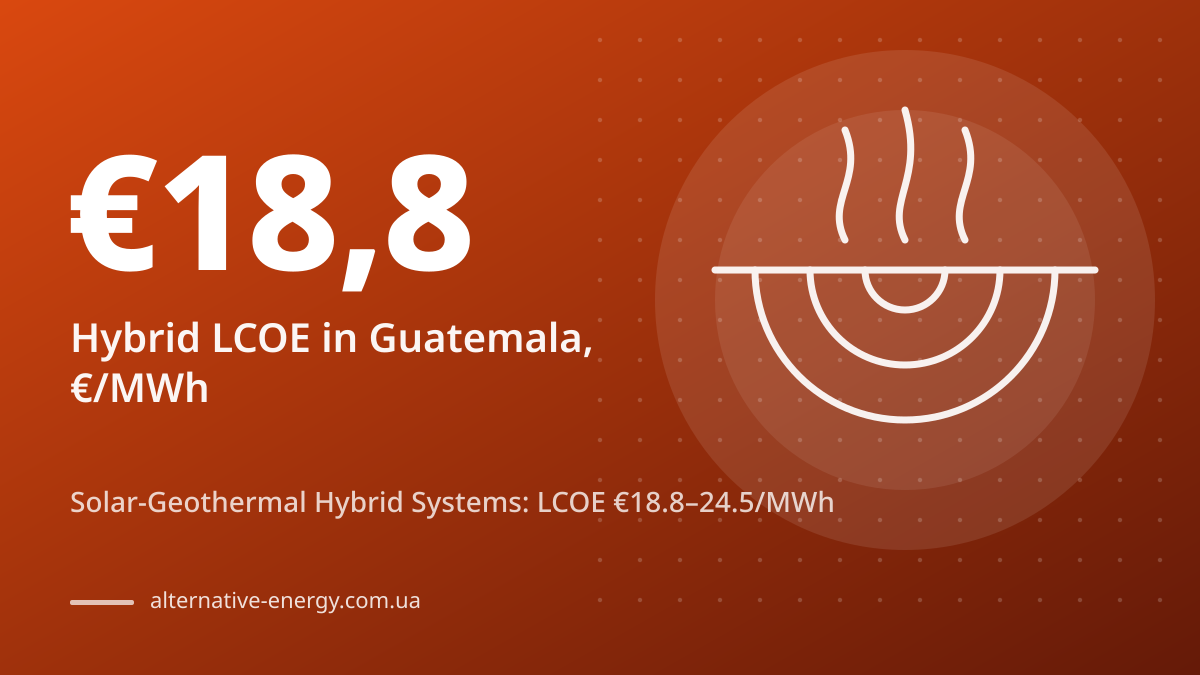
- Hybrid LCOE — €18.8/MWh in Guatemala, €21.9 in Costa Rica, €24.5 in Honduras.
- Battery storage demand is 51–60% lower compared to scenarios without geothermal.
- Excess generation (curtailment) is reduced by approximately 76% with grid interconnection.
- The global potential of enhanced geothermal systems (EGS) is around 4,600 GWe at €10–50/MWh.
What the LUT University study found
The research team analyzed three Central American countries that combine strong solar and geothermal resources — Guatemala, Honduras, and Costa Rica. Solar reduces overall system costs, while geothermal provides stability during periods of low solar output.

Why batteries do less work
A geothermal plant runs at steady output, so dips in solar generation are covered not by batteries but by reliable baseload capacity. According to LUT University, this cuts energy storage system requirements by 51–60%. Regional integration amplifies the effect: with grid interconnection in place, the system spills roughly 76% less surplus energy that would otherwise be curtailed.
The system-level LCOE across the region is €20–21/MWh with interconnection and around €23/MWh without it. For anyone weighing “solar plus batteries” against “solar plus geothermal,” the core argument is straightforward: the geothermal component reduces exactly the cost item hardest to forecast — storage expenditure. For the Ukrainian context, see our article on Geothermal Energy in Ukraine: Prospects and Characteristics.
Land use and water: where the constraints lie
A common objection to geothermal is its land and water footprint. The LUT University researchers address this directly: solar PV requires 0.1–0.4% of a country’s territory, while geothermal installations occupy 0.2–0.7% (baseline factors: 75 MW/km² for PV and 7.5 km²/TWh for geothermal). Water consumption for binary-cycle and EGS geothermal plants stands at 0.01–0.2 km³ per year — a negligible share of annual precipitation.
In the electricity mix of the three countries, the solar share during the transition ranges from 4–90% and the geothermal share from 7–38%. Even under similar climatic conditions, the balance between technologies turns out differently — and that is a strength of the approach, not a weakness. For other examples of combining multiple renewable sources in a single installation, see our article on the SolarMill — a hybrid unit generating power from both wind and solar.
What this means for technology selection
The LUT University work confirms that solar-geothermal hybrids have left niche status behind. Where a region has strong geothermal resources, a hybrid delivers a lower LCOE and reduced storage needs compared to a solar-only system backed by large batteries. For anyone choosing between the two paths, the key takeaway is not to automatically equate “the future of solar” with “solar plus large-scale storage”: given the right geological conditions, a geothermal combination can prove both cheaper and more reliable.
It is worth tracking how this approach adapts in regions with different geology — the global EGS potential of 4,600 GWe suggests that the room for scaling extends well beyond Central America.
Sources: pv magazine Global (LUT University)
Prepared by the Alternative Energy editorial team with the help of AI based on the sources listed; facts and figures were checked against them during automated editorial review. How we prepare articles


