

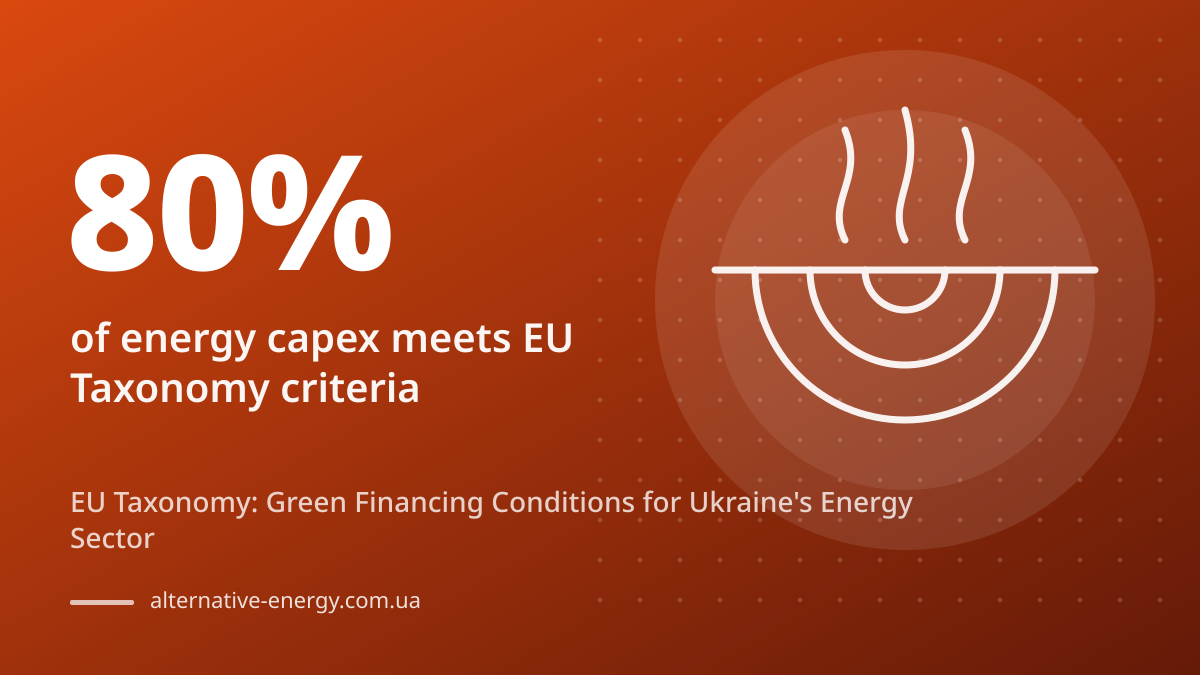
At the ReBuild Ukraine 2026 forum in Warsaw, the DiXi Group think tank presented its assessment of the conditions under which Ukraine’s energy sector can attract green financing from European institutions. According to the analysts, roughly 80% of the sector’s capital expenditure already meets EU Taxonomy sustainability criteria — a figure that meaningfully opens the door to funding from the EIB, EBRD, and other reconstruction funds.
Key takeaways:
- 80% of Ukraine’s energy sector capex meets EU Taxonomy criteria;
- 31 of more than 100 economic activities covered by the EU Taxonomy relate to energy;
- Ukraine’s national taxonomy draft law has completed consultations and is being prepared for government review;
- Technical criteria and non-financial reporting requirements are still under development.
What DiXi Group Presented in Warsaw
A presentation by Dmytro Sych, General Manager for Green Finance at DiXi Group and expert at the Green Transition Office, was delivered on 13 November 2026 during a panel discussion at the ReBuild Ukraine forum. The session also included representatives from the Ministry of Economy, the EU Delegation to Ukraine, the EIB, and Ukrenergo.
According to dixigroup.org, European financial institutions — including the European Investment Bank, EBRD, NEFCO, and a share of private funds — base their investment decisions on sustainability criteria. For Ukrainian companies, meeting those criteria means access to a broader pool of financing and a stronger negotiating position with investors.
Where Ukraine’s Draft Law Stands
The next steps are approval by the Cabinet of Ministers and submission to the Verkhovna Rada.
In parallel, technical criteria for specific activity types are being developed in collaboration with industry experts. Non-financial reporting requirements for real-economy companies are being drawn up together with the Ministry of Economy. In the banking segment, DiXi Group is supporting the rollout of taxonomy-based reporting for the NBU under the PAABS project, funded by BMUKN (Germany) and implemented by GIZ.

Why This Is the Top Issue for Geothermal Projects
Until Ukraine adopts its own legal act with aligned criteria, project developers working with geothermal heat cannot officially position their assets as “green” under the same standard as the EU. Yet that is precisely the data format expected by the European Investment Bank, EBRD, and the funds financing energy reconstruction.
Once the law is in place, investors will be able to match their emissions calculations, environmental assessments, and permitting documentation against the same benchmarks used by European banks.
What Energy Companies Should Do Now
Dmytro Sych advises businesses not to wait for the draft law to be finalized, but to begin preparation early:
- review the existing project portfolio against the list of sustainable activities and identify gaps;
- build environmental impact assessment into the feasibility study stage, including lifecycle emissions calculations;
- gather supporting documentation: calculations, certificates, permits, and environmental conclusions;
- introduce due diligence on human rights compliance across supply chains;
- appoint a dedicated responsible for sustainable finance, raise the topic to management level, and train the team.
These are the same questions already facing Ukrainian investors in renewable energy: what exactly qualifies as a sustainable asset and how to document it.
What This Means for the Sector
For Ukraine’s geothermal project market, the adoption of a taxonomy is the moment when the word “green” stops being marketing rhetoric and acquires legal substance. If technical criteria and reporting requirements are aligned with European standards before large-scale infrastructure tenders for reconstruction are launched, developers will be able to apply directly for EIB and EBRD financing. Those planning capital investment in geothermal assets over the coming quarters would do well to start preparing documentation to European standards now — once the criteria receive official status, the path to an international lender’s approval decision may become considerably more straightforward.
Sources: dixigroup.org
Prepared by the Alternative Energy editorial team with the help of AI based on the sources listed; facts and figures were checked against them during automated editorial review. How we prepare articles


