


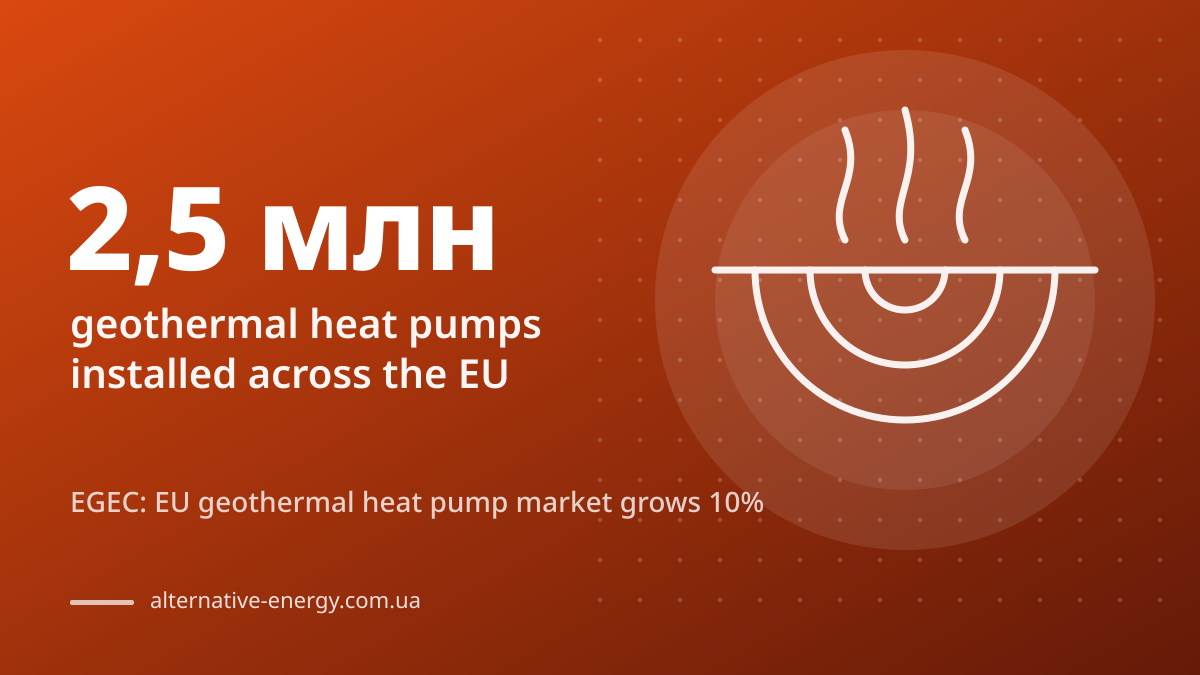
The European Geothermal Energy Council (EGEC) has released its first dedicated report on the geothermal heat pump market in the EU. The document — The Geothermal Heat Pump Market in Europe 2026 — records a sales recovery following the 2024 downturn and outlines a scenario in which the EU’s installed base of such systems could exceed 10 million units by 2040.
Key figures from the EGEC report:
- 123,000 geothermal heat pumps were sold in the EU in 2025 — 10% more than the previous year.
- Over 2.5 million units are already installed, with a combined thermal capacity of 39.2 GW.
- In 2025, these systems delivered approximately 88 TWh of heat to more than 10.6 million people.
- Under the accelerated scenario: 4.5 million units by 2030 and over 10 million by 2040.
Why the market returned to growth
According to bioenergyinternational.com, 2024 ended with a sharp contraction for the European geothermal heat pump market, but 2025 brought it back into positive territory. EGEC attributes the rebound to a stronger policy framework: the revised Renewable Energy Directive (RED) and Energy Efficiency Directive (EED) are pushing the heating and cooling sector toward decarbonization, while the forthcoming EU Electrification Action Plan is expected to accelerate uptake further.
A geothermal heat pump uses the relatively stable temperature of the ground or groundwater as a low-grade heat source: a compressor raises it to a level suitable for building heating. The same system can run in reverse for summer cooling, and boreholes can serve as underground thermal energy storage.

Where demand is growing and which technologies open new segments
EGEC specifically highlights growth in large-scale systems — for multi-family residential buildings, commercial and public facilities, industrial applications, and district heating and cooling networks. A new wave of interest centers on fifth-generation district heating networks and underground thermal energy storage (UTES).
Among the technological developments broadening adoption:
- advances in borehole drilling technologies;
- passive cooling without compressor operation;
- underground thermal energy storage;
- solutions for data centers and industrial facilities.
The report also highlights the Heat-as-a-Service (HaaS) business model — where the customer pays for heat as a service rather than purchasing equipment outright — which reduces upfront investment for large projects.
What is holding back deployment
The report identifies permitting procedures as the primary barrier: despite provisions in the revised RED requiring their simplification, transposition across member states remains slow and uneven. Additional constraints include a shortage of qualified specialists, regulatory uncertainty, and high upfront capital costs — which EGEC acknowledges as significant, though offset by long system lifespans and low operating expenses.
At the same time, citing a 2024 study by the French agency ADEME, EGEC notes that geothermal heat pumps are the most cost-effective renewable heating solution for multi-family and commercial buildings. The question of upfront costs and real-world payback periods for these systems is covered in more detail in our article Geothermal Heat Pump 2026: Cost and Real Payback.
What this means for heating decarbonization
“The market recovery in 2025 is encouraging, but now we need to work on the barriers — permits, financing, skills,” the report quotes Philippe Dumas, Secretary General of EGEC. For countries planning gas-replacement programs in heating, the EGEC figures set a concrete benchmark: the EU market is measured in millions of installations, and the main obstacles are administrative, not technological. The geothermal potential of Ukraine itself is discussed in our article Geothermal Energy of Western Ukraine: 10 Billion m³ of Gas.
For readers evaluating geothermal heat pumps for a multi-family or commercial building, the report reinforces the logic of a long investment horizon: the high entry cost is offset by low per-unit heat costs in operation. And at the policy level, the central question is the same as in the EU — whether the permitting system can avoid becoming a bottleneck for projects that are already ready to move forward.
Sources: bioenergyinternational.com, EGEC
Prepared by the Alternative Energy editorial team with the help of AI based on the sources listed; facts and figures were checked against them during automated editorial review. How we prepare articles


