
Energy communities are associations in which residents, local governments, or small businesses jointly produce and consume electricity — primarily from renewable sources. In 2026, this model moved from concept to law in Ukraine: two acts were passed that defined exactly how such structures must operate. Below we explain the essentials, the latest survey data, and the new rules of the game.
Key figures:
- Over 80% of Ukrainians view the launch of an energy community in their region positively (according to a survey cited by ZN.ua).
- Nearly 50% of respondents encountered the concept for the first time during the survey itself.
- Two laws — 4834-IX and 4963-IX — gave the model legal standing in 2026.
- Eligible organizational forms: LLC, association, homeowners’ association (OSBB), or cooperative, provided governance is democratic.
How It Works
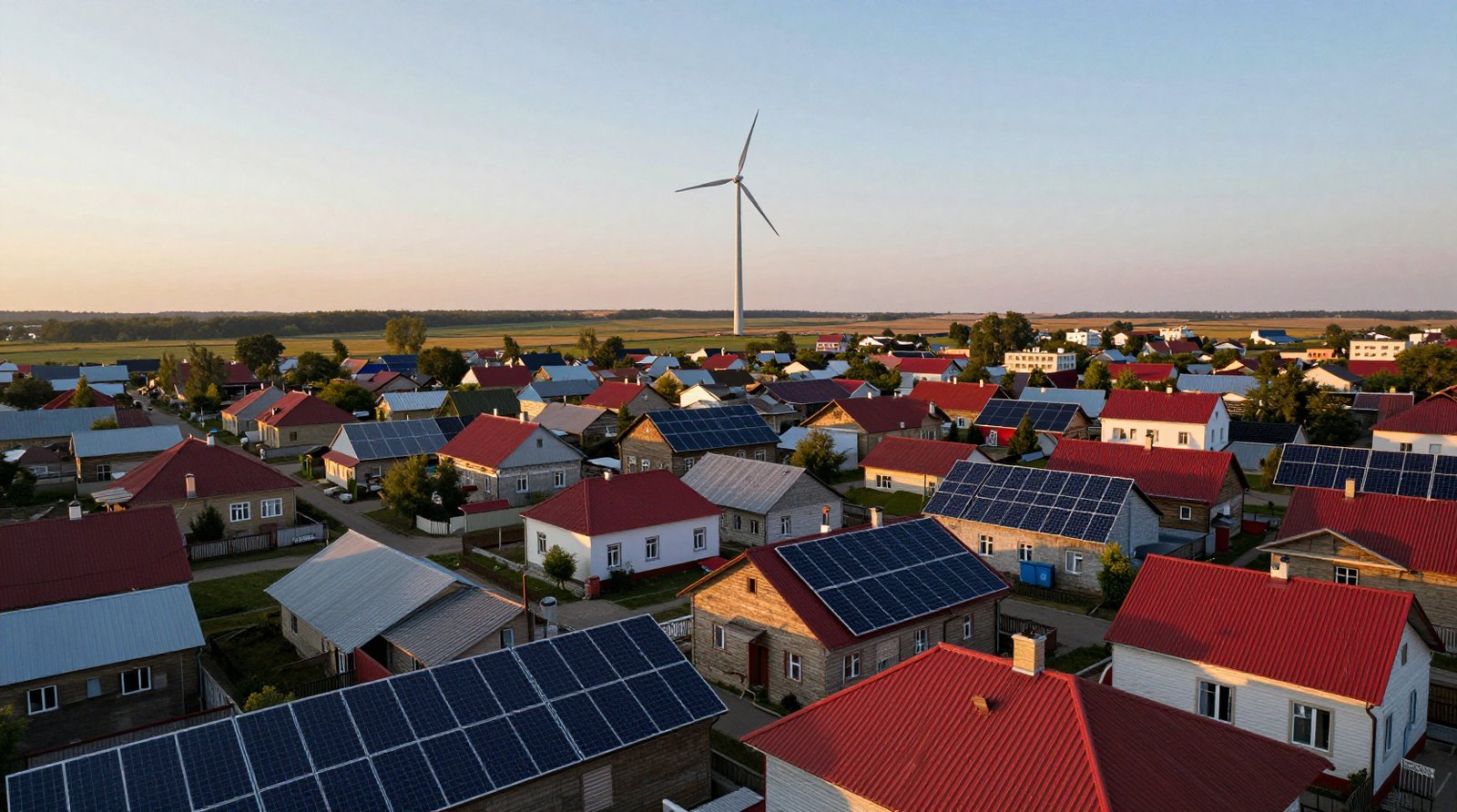
An energy community is an organized group of citizens, municipalities, or small companies that jointly own energy infrastructure: a solar power plant, a wind turbine, an energy storage system, or thermal equipment. Members use the energy produced, and any surplus can be sold on the market. The structure can be connected to the main grid or operate as an autonomous microgrid — for example, supplying a school, healthcare facility, or village during outages from the centralized network.
The concept draws directly from EU law. The guiding frameworks were Directive RED II (2018/2001), which promotes renewable energy development, and Directive 2019/944 on the internal electricity market. According to ZN.ua, these instruments served as the template for Ukraine’s adaptation.
High Interest, Low Awareness
The survey data cited by ZN.ua reveals a striking paradox: over 80% of Ukrainians are ready to support an energy community in their own region, yet nearly half of those respondents had never heard of the option before taking part in the survey. For the sector, this is a mixed signal — public appetite for community-level energy self-organization already exists, while practical knowledge of the available mechanisms lags well behind.
The ZN.ua article’s authors — Yuliia Usenko of the Energy Transition coalition and Daryna Yaroshovets of Ecoaction — stress that simply copying European models is not enough for Ukraine, since some of those models were not designed for wartime conditions and require simplification.

What Laws 4834-IX and 4963-IX Actually Establish
Before 2026, energy communities had no legal status in Ukraine. Two pieces of legislation changed that, as reported by NGO Ecoaction:
- Law No. 4834-IX amended the core Law on the Electricity Market, introducing the concept of a “community energy association” and basic rules for its operation. It entered into force on 23 April 2026.
- Law No. 4963-IX added the term “renewable energy community” to Ukrainian legislation. Its provisions took effect on 1 October 2026.
Both terms originate in EU law, yet they describe somewhat different organizational models. During the drafting process, Ecoaction argued that a strict prohibition on generating economic benefit would limit the range of viable projects — and the final versions dropped that requirement. The logic is straightforward: if participants cannot recover at least part of their investment, the new model will develop slowly, or not develop at all.
An energy community can take a variety of legal forms — from an LLC to an association, a homeowners’ association (OSBB), or a cooperative — provided decisions are made democratically and any profit is directed toward infrastructure development or community needs. For more on the cooperative form specifically, see Energy Cooperatives in Ukraine.
Practical Benefits of the Model
As ZN.ua explains, the value of energy communities extends well beyond lower electricity bills. The systemic effects on the grid include:
- reduced losses in distribution networks;
- relief for centralized generation;
- greater system flexibility and faster grid digitalization.
For local communities, this translates into new jobs, more predictable energy costs, and a genuine say in shaping local energy policy. For critical infrastructure, it means the ability to keep operating during outages through local generation and stored electricity. For an international perspective on how this scales, see Energy Cooperatives Around the World.
What Is Still Missing for Mass Adoption
Setting up an energy community requires real resources: legal registration, technical expertise, and coordination with the distribution system operator. ZN.ua notes that if a community plans to sell surplus energy on the market, it will need tools for balancing, scheduling, and trading — meaning specialists who understand how the energy market actually works.
Ecoaction describes the passage of both laws as a first step. For energy communities to function at scale, secondary legislation and detailed market operating rules are still needed. Those rules will ultimately determine how straightforward the process is for a local community or homeowners’ association launching a project.
Where Things Stand as of October 2026
The core definitions and two models of energy communities are now embedded in Ukrainian law. For communities, homeowners’ associations, and local businesses, the question has shifted from “is this even permitted?” to “under what rules do we begin?” Anyone approaching the topic from a practical angle should track upcoming secondary legislation and start laying organizational groundwork — choosing a legal form, assessing energy consumption, and defining roles among participants. Public demand for such initiatives, judging by ZN.ua’s data, is already there. The working tools just need to follow.
Sources: Дзеркало Тижня (ZN.ua), Екодія
Illustration generated with AI
Prepared by the Alternative Energy editorial team with the help of AI based on the sources listed; facts and figures were checked against them during automated editorial review. How we prepare articles


