


Ukraine’s energy regulator NEURC has introduced seasonal time windows that define when the home solar feed-in tariff applies to residential rooftop installations. Outside these hours, any surplus electricity exported to the grid is purchased at the day-ahead market price for that specific hour — a change that meaningfully shifts the economics of rooftop solar power plants and how their owners should plan generation and consumption.
Key points:
- NEURC Decision No. 1360, dated 11 August 2026, established seasonal time windows for the feed-in tariff applied to home solar power plants.
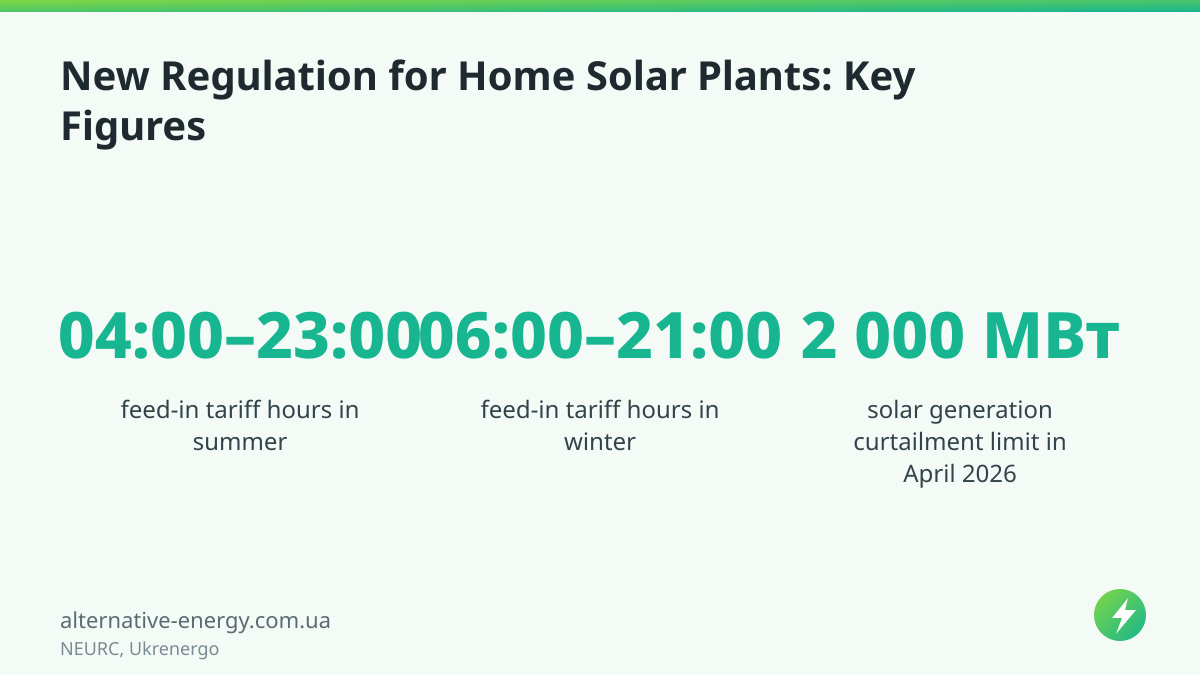
- In summer, the tariff applies from 04:00 to 23:00; in winter, from 06:00 to 21:00.
- Outside these windows, the universal service supplier purchases exported kWh at the hourly day-ahead market price.
- The trigger was the curtailment of up to 2,000 MW of solar generation in spring 2026 due to system oversupply.
What NEURC Changed
According to LIGA.net Business, the summer feed-in tariff window runs from 04:00 to 23:00, covering the period from 1 April to 31 October. The winter window is shorter: from 06:00 to 21:00 in November through March. Before Decision No. 1360, no separate time boundaries existed — home solar power plants received the feed-in tariff around the clock, including hours when panels physically produce no electricity at all.
The regulator also established a per-hour output cap: the volume of electricity credited to the owner in any single hour cannot exceed the installed capacity specified in the grid connection agreement. If the agreement records 10 kW, no more than 10 kWh will be counted for any given hour. This “hourly ceiling” is designed to standardise accounting between distribution system operators and Ukrenergo, which funds the feed-in tariff payments.
Generation that falls outside the approved windows — power exported after 23:00 in summer, or morning output before 06:00 in winter — will still be purchased by the universal service supplier, but at the hourly day-ahead market price. The kilowatt-hours are not forfeited; they are simply paid at the floating market rate for that hour rather than the fixed feed-in tariff.

Why Time Restrictions Were Introduced
The immediate cause is surplus solar generation during low-demand hours. In April 2026, Ukrenergo CEO Vitaliy Zaychenko reported that on some days the transmission system operator was forced to curtail up to 2,000 MW of solar output due to overproduction. For the grid, this creates balancing risks; for the industry, it means technical disconnections during which a portion of the electricity produced by solar plants never reaches consumers.
The windows set in Decision No. 1360 are calibrated so that the “night tail” — largely irrelevant for conventional panels without battery storage — falls outside the feed-in tariff, while peak daytime output stays within the permitted window. Combined with the hourly cap tied to contracted capacity, this gives the regulator a tool to limit situations where actual grid exports exceed declared capacity and generate accounting inconsistencies between operators.
It is worth recalling the basic mechanics of the feed-in tariff: it is a fixed rate at which the state — through Ukrenergo and universal service suppliers — purchases electricity from private generators. When grid balancing requires curtailments, a fixed rate combined with unlimited hours becomes increasingly costly for the system operator and increasingly disconnected from the real market value of that electricity. We covered the broader comparison between feed-in tariff and self-consumption models in our article «Feed-in Tariff or Self-Consumption: What to Choose for a Home Solar Plant».
What This Means for Rooftop Solar Owners
For a standard solar power plant without battery storage, the direct financial impact of the summer night exclusion is minimal: between 23:00 and 04:00, panels produce virtually nothing. Winter is where the change is more tangible: the 05:00–06:00 morning slot and the 21:00–22:00 evening slot now fall outside the feed-in tariff window, even though a system may begin generating before 06:00 on a clear winter day. In practice, however, output volumes during those hours are generally small.
The bigger long-term signal is different. For those weighing pure grid export against increasing self-consumption or adding battery storage, these time windows add weight to the case for flexible solutions. Electricity exported outside the permitted hours is now valued at the day-ahead market rate — one that reflects actual system balance. It can be low during periods of surplus and higher during periods of scarcity. For planning purposes, this means the economics of “just export everything the panels produce” become less predictable, while consuming your own energy during the evening peak becomes objectively more attractive than before.
A second practical point concerns the contracted capacity. Since hourly accounting is now capped at that figure, solar homeowners should verify that their grid connection agreement correctly reflects the actual installed capacity of the system — and that it was updated if modules were added after the initial connection. Any discrepancy means peak-hour output could go unrecorded and unpaid under the feed-in tariff.
Finally, NEURC Decision No. 1360 is not an isolated step but part of a longer overhaul of market rules for distributed generation. It should be read alongside other legislative changes governing permits and operating conditions for solar power plants — which we outlined in the article on new permit timelines under the renewable energy law. For a rooftop solar owner, the message is clear: operating conditions are no longer locked in at the point of connection, and tracking regulatory developments matters just as much as tracking the weather.
Sources: LIGA.net Бізнес, Інтерфакс-Україна
Prepared by the Alternative Energy editorial team with the help of AI based on the sources listed; facts and figures were checked against them during automated editorial review. How we prepare articles