


Planning to order a heat pump but unsure how many kilowatts your home actually needs? Hungarian engineering company SMARTAIR published a detailed heat pump sizing methodology in September 2026, complete with tables for five insulation levels — and it highlights something installers often gloss over: in cold weather, the nameplate kilowatts quietly shrink.
For anyone heating through a harsh winter, that detail is critical.
Quick summary:
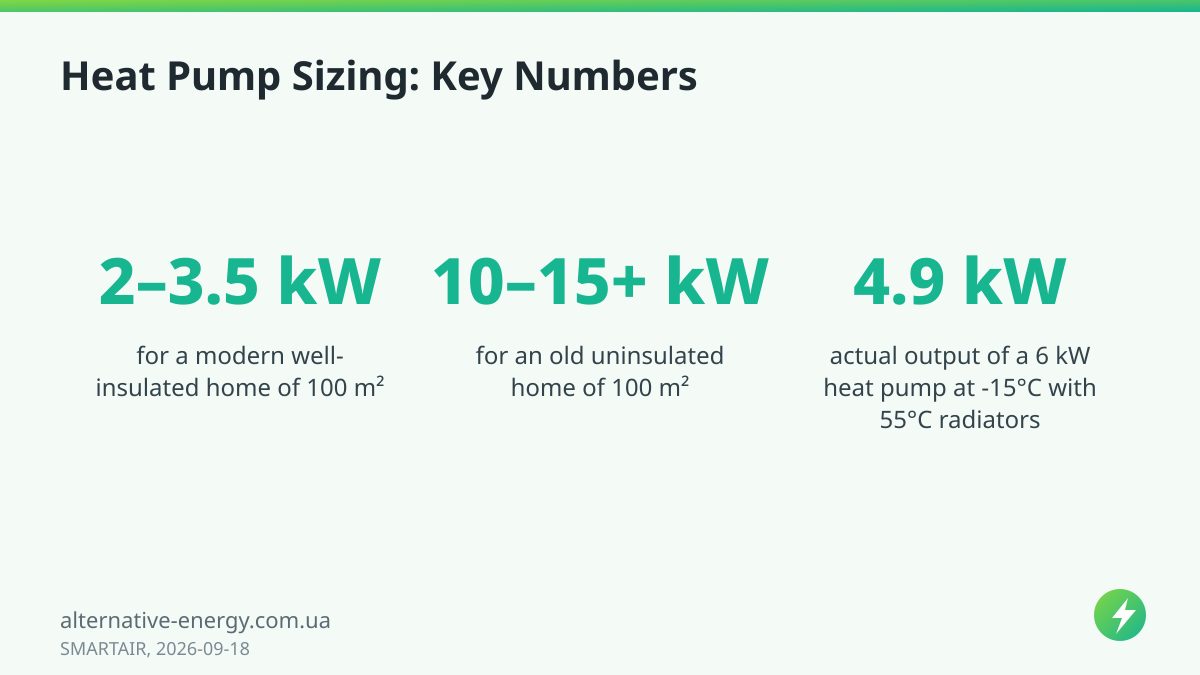
- Modern well-insulated home, 100 m² (20–35 W/m²) — heat pump 2–3.5 kW.
- Old uninsulated home, 100 m² (100–150+ W/m²) — 10–15+ kW.
- At -15°C with 55°C radiators: a 6 kW unit delivers 4.9 kW.
- Add 10–20% on top of the heating figure if the pump also covers domestic hot water.
The formula that starts every sizing exercise
SMARTAIR describes a simple preliminary estimate — enough to have a productive conversation with a supplier before commissioning a full calculation. Output (kW) = heated floor area (m²) × specific heat demand (W/m²) / 1000. For a 120 m² home with a specific demand of 50 W/m², that works out to 120 × 50 / 1000 = 6 kW.
This is not a substitute for a proper heat-loss calculation covering walls, windows, roof, floor, and ventilation. SMARTAIR specifically calls out thermal bridges — structural discontinuities where heat escapes faster than the main envelope would suggest. According to the company, they can increase a building’s theoretical heat losses by 5–30%.
Five insulation levels: how many kW per 100 m²
| Building condition | Specific demand | Heat pump for 100 m² |
|---|---|---|
| Modern, insulated above standard | 20–35 W/m² | 2–3.5 kW |
| New build to current code | 35–50 W/m² | 3.5–5 kW |
| Retrofitted a few years ago (10–15 cm insulation) | 50–70 W/m² | 5–7 kW |
| Lightly insulated (5–10 cm insulation) | 70–100 W/m² | 7–10 kW |
| Old, uninsulated | 100–150+ W/m² | 10–15+ kW |
The gap between the top and bottom rows is striking. Homeowners who insulate first and install the pump second end up buying a smaller unit that operates closer to its rated conditions. An oversized unit chosen “just in case” will, according to Calculytic, short-cycle in normal operation and lose 10–15% of its efficiency.

Why cold weather steals kilowatts — and why emitters matter
The key practical point SMARTAIR stresses is that nameplate output is specified for favourable test conditions, not for the coldest night of the year. A pump rated at 6 kW delivers 4.9 kW when it is -15°C outside and the system is supplying 55°C to radiators. This matters precisely because the type of heat emitter determines the supply temperature: the lower that temperature, the closer the unit stays to its rated output in cold weather.
The practical takeaway: if the house has conventional radiators running at 55°C, size the pump with enough headroom for peak cold. If underfloor heating at a lower supply temperature is used instead, the output drop in a cold snap is smaller. For more on how systems behave in severe cold, see the article covering PNNL field data on heat pump operation at -20°C.
DHW: why you add another 10–20%
When the heat pump also provides domestic hot water (DHW), an additional allowance goes into the sizing. SMARTAIR recommends starting from household habits: 30–45 litres per person per day for modest use, 45–60 litres for average, and 60–80 litres for high consumption (such as power showers). On that basis, a family of four uses 120–240 litres of hot water daily.
Storage tanks are typically maintained at around 50°C; tap water is drawn at 38–44°C. In a larger home (over 200 m²), pipe losses can reduce the tap temperature by 2–3°C below the tank temperature. To avoid constant reheating cycles, a hysteresis band is set — the permitted drop in stored water temperature before the next heat cycle begins. A typical scenario: supply at 50°C with an 8 K hysteresis, giving a lower threshold of 42°C. Taken together, DHW adds 10–20% to the calculated heating output.
What to take away before you order
The SMARTAIR method reduces heat pump sizing to three practical checkpoints: specific heat demand based on insulation level, a DHW uplift, and a check on how many kilowatts will remain at peak cold given the type of heat emitter. For a continental climate with severe winters, this means “6 kW for 100 square metres” is not an answer on its own. The correct figure comes from combining insulation level, supply temperature, and DHW usage, calculated for the design cold night rather than average seasonal conditions. If a ground loop is also on the agenda, it is worth running a separate calculation for the borehole depth required for a given floor area.
Sources: SMARTAIR, Calculytic
Prepared by the Alternative Energy editorial team with the help of AI based on the sources listed; facts and figures were checked against them during automated editorial review. How we prepare articles