


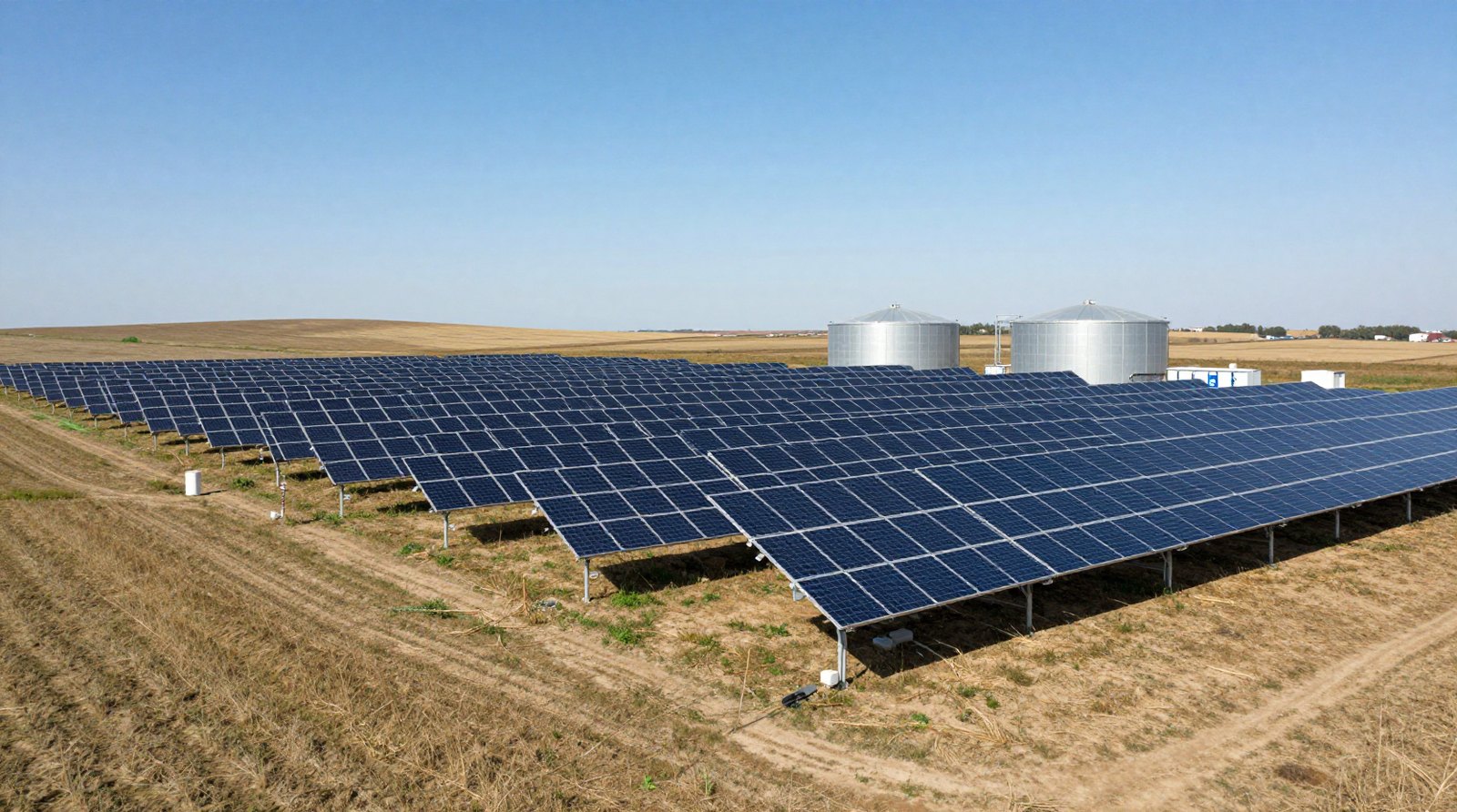
At the international conference “Rebuilding Ukraine: Security, Opportunities, Investment” in Bucharest, Roman Nitsovych, Research Director at DiXi Group, outlined priorities for attracting foreign capital to Ukraine’s energy sector. Among the fast and resilient solutions he highlighted were gas piston units and renewables with storage. For the solar segment, the message is clear: solar generation paired with BESS remains one of the foundational building blocks of Ukraine’s emerging energy system.
Key takeaways:
- The Rebuilding Ukraine forum in Bucharest hosted a panel on “Investment in Ukraine’s Energy Transformation: Strategic Projects and Market Opportunities.”
- Fast-track solutions include gas piston units and renewable generation combined with battery energy storage systems.
- Large wind, hydro, and solar projects remain on the agenda but require longer implementation timelines.
- Scaling up investment requires predictable revenue streams, war-risk insurance instruments, and accessible financing.
How technologies are evaluated
According to dixigroup.org, Nitsovych stressed that the right approach is to assess not a single technology in isolation but a combination of parameters: reliability (especially during the heating season), contribution to grid resilience and flexibility, and long-term operating costs. Under this framework, solutions capable of rapid deployment while simultaneously supporting system balance during peak demand and supply shortfalls gain a clear advantage.
Gas piston units and renewable generation paired with battery energy storage systems meet exactly these criteria, according to the expert. For prospects of investing in Ukraine’s solar energy sector, this makes a strong case for bundling storage with generation — such configurations, in the expert’s view, satisfy the reliability and flexibility benchmarks that matter most to investors.
Large solar, wind, and hydro projects — a longer runway
Nitsovych does not remove large wind, hydro, and solar projects from the investment landscape, but he notes they require considerably longer implementation timelines. Over the horizon of the next few heating seasons, these assets cannot substitute for fast-track solutions, though they remain an integral part of long-term generation development.
For developers in the solar segment, this effectively creates two tracks: small and mid-scale installations with storage that can be commissioned relatively quickly, and large solar parks that go through longer permitting, financing, and construction cycles.
Instruments for predictable revenue
The DiXi Group expert outlined the mechanisms that give investors a calculable revenue model for years ahead:
- auction-based support schemes for renewable and flexible generation;
- long-term contracts in the ancillary services market;
- government subsidized lending programs — primarily for small and medium-scale installations;
- programs funded through the Ukraine Investment Framework and other international financial institution instruments.
This “package” allows market revenues to be combined with more predictable cash flows and partly addresses the war-risk question — one of the most critical concerns for foreign capital. Read more about which types of alternative energy attract investment in Ukraine in our dedicated article.
What changes for the solar segment
The signals from Bucharest may be sketching out the optimal architecture for new solar power plants: solar generation with BESS, embedded within auction mechanisms and the ancillary services market. For large developers, this is a cue to build financial models that account for a longer investment cycle and to leverage instruments such as the Ukraine Investment Framework.
It is worth monitoring the specific parameters of upcoming auctions and long-term ancillary service contracts: if they deliver foreseeable returns, the solar-plus-storage combination may prove to be the fastest technology to bring new megawatts online.
Sources: DiXi Group
Illustration generated with AI
Prepared by the Alternative Energy editorial team with the help of AI based on the sources listed; facts and figures were checked against them during automated editorial review. How we prepare articles


