


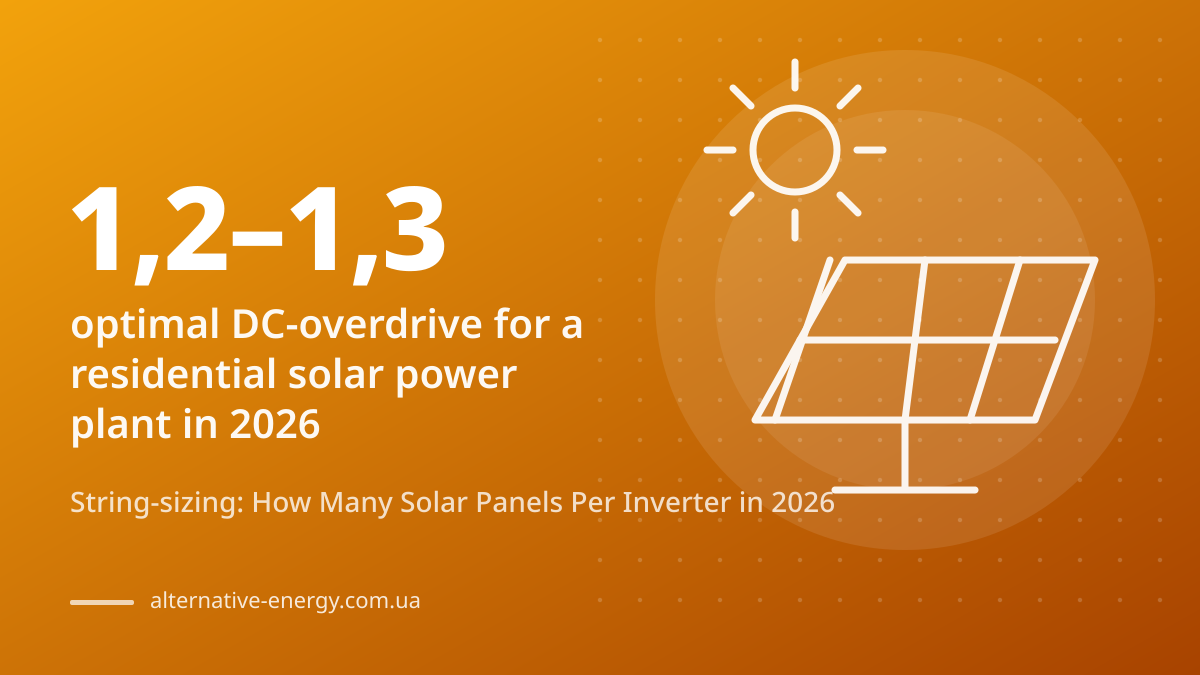
An installer quotes you “twenty 545 W panels, two strings of ten” for a 10 kW system — and it sounds straightforward, until you realise that this arithmetic determines whether your inverter will fail in winter and how much energy you will lose over the next twenty years. The question of how many panels to connect to a single inverter input is answered by string-sizing — the engineering calculation of a series-connected module string. In a technical breakdown published on May 10, 2026, the engineering team at SolarEdge Ukraine explains why DC-overdrive 1.2–1.3 has become the 2026 standard for residential solar power plants, and identifies the thresholds beyond which a solar system starts losing money.
Key takeaways:
- DC-overdrive 1.2–1.3 is the 2026 standard for residential solar power plants.
- Minimum string length — around 6 panels; maximum — up to 14 for 10 kW systems.
- Correct sizing adds 5–7% to annual energy yield.
- Sizing mistakes cost 5–15% in energy losses.
What is a string and MPPT
A string is a group of series-connected panels: voltages add up while current stays the same. Ten modules with a Vmp of 41.5 V deliver a combined DC voltage of 415 V. MPPT (Maximum Power Point Tracker) is an electronic circuit in the inverter that continuously seeks the maximum power point for an individual string. According to SolarEdge Ukraine, a standard hybrid 10 kW inverter — such as the Solis S6-EH3P10K, Huawei SUN2000-10KTL-M2, or Deye SUN-10K-SG04LP3 — has 2–3 MPPT channels, meaning 2–3 independently optimised strings. For more on inverter architecture, see the article on what a solar battery inverter is for.
How to calculate the number of panels in a string
The minimum is determined by the inverter’s lowest operating voltage adjusted for summer heat; the maximum by the highest Voc adjusted for winter cold, when panel voltage rises. SolarEdge Ukraine provides an example using the Solis S6-EH3P10K inverter (Vmin 200 V, Vmax 1000 V) and a LONGi 545 W panel (Vmp 41.5 V, Voc 49.5 V) with a −25°C temperature coefficient of 1.15: the minimum comes to five panels, the maximum to seventeen. The practical optimum for a 10 kW system is two strings of ten panels — 20 modules in total and 10.9 kW DC at an overdrive of 1.09. If the designer targets overdrive 1.2, the configuration becomes 22 panels — two strings of eleven. The broader method for determining the number of modules is covered in a dedicated article on calculating the required number of solar panels.
| Parameter | Value for a 10 kW solar power plant |
|---|---|
| MPPT channels in the inverter | 2–3 |
| Minimum panels per string | around 6 |
| Maximum panels per string | up to 14 |
| Optimum for a residential inverter | 8–10 panels |
| DC-overdrive ratio | 1.2–1.3 |
| Maximum inverter voltage | 1000 V DC |
| Typical string current | 13–15 A |
Why DC-overdrive 1.0 is no longer relevant
Before 2020, panels and inverter were matched one-to-one — DC power equalled AC power. The SolarEdge Ukraine breakdown gives two reasons for the shift. First: a 10 kW inverter operates at its rated 9 kW output for only 200–300 hours a year; the rest of the time it delivers 30–70% of its capacity. The “extra” panels unlock exactly those suboptimal hours — mornings, evenings, and overcast conditions. Second — economics: panels cost less per kilowatt than an inverter, so paying UAH 12,000–18,000 extra for additional modules pays off. The gain from overdrive 1.2 on a 10 kW system is 5–7% in annual yield, which the company estimates at approximately UAH 3,000–4,000 per year under a feed-in tariff.

Four common installation mistakes
- String too short. Six panels at 41.5 V give 249 V Vmp — right at the edge of the inverter’s operating range. After 5% degradation within a year, the string drops below the minimum and the device shuts down.
- String too long. 14 panels × 49.5 V = 693 V Voc; in winter at −10°C the voltage rises further, approaching the 1000 V limit. The safety margin becomes critically thin, and one cold morning could destroy an MPPT channel.
- Imbalance between strings. One line with eight panels, another with twelve — asymmetric load across the MPPT channels and a 5–10% output loss.
- Mixing module ratings. Combining 545 W and 580 W modules in one string limits the entire string to the weaker panel’s output, squandering the stronger panels’ potential — a 7% loss.
The worst-case scenario per SolarEdge Ukraine is a burned-out MPPT channel from overvoltage; inverter repair costs UAH 15,000–25,000 or a full unit replacement. The most common outcome is a silent 5–15% yield shortfall throughout the system’s entire operating life.
What solar power plant owners should watch for
For the system owner, the conclusion is practical: you don’t need to master the formula, but you should demand a specification from the installer with concrete numbers — inverter model with Vmin and Vmax, panel model with Vmp and Voc, number of strings and panels per string, and the final DC/AC ratio. If the proposal amounts to “20 panels on a 10 kW system,” that’s a cue to ask about the winter voltage margin and the balance between MPPT channels. When the calculation shows an overdrive in the 1.2–1.3 range with equal strings, the design meets the 2026 standard.
Frequently Asked Questions
When do microinverters make sense instead of a standard string connection?
A microinverter is a dedicated inverter per panel with independent optimisation, eliminating the “weakest link” constraint. According to SolarEdge Ukraine, the premium is 50–80 USD per panel, or 1,000–1,600 USD over a standard scheme for a typical 10 kW system. The approach is primarily justified for complex roofs with frequent shading — where shading losses in a string configuration exceed that added cost.
Sources: SolarEdge Ukraine
Prepared by the Alternative Energy editorial team with the help of AI based on the sources listed; facts and figures were checked against them during automated editorial review. How we prepare articles


