


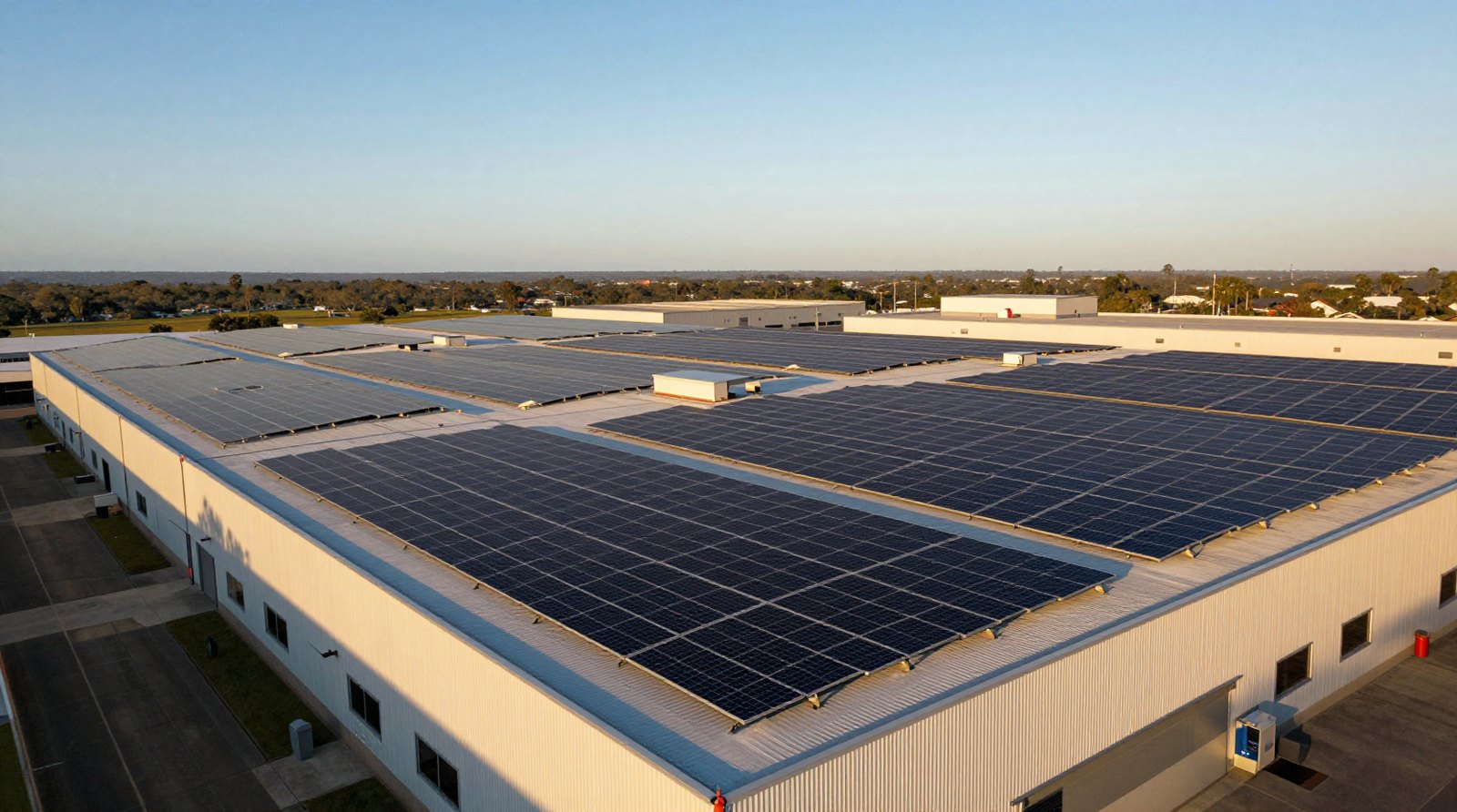
Australia’s expanded Small-scale Renewable Energy Scheme (SRES) is already reshaping the market: demand for commercial solar systems and battery storage is climbing noticeably. The Australia solar rebate now covers substantially larger installations, opening up small and medium business rooftops to the commercial and industrial (C&I) segment. RenewEconomy reports on the trend, citing one of the world’s largest solar module manufacturers — Trina Solar.
Key figures:
- The SRES cap has been raised from 100 kW to 1 MW as of October 2026.
- A rebate of approximately 20% saves $68,000 on a 250 kW system and around $50,000 per year on electricity bills.
- Average battery capacity in Trina Solar installations has roughly doubled — to 24 kWh.
- Trina Solar has shipped more than 350 GW of capacity since 1997 (as of June 2026).
SRES raises the ceiling to 1 MW — what it means for business
From the start of October 2026, the maximum system size eligible under SRES grew from 100 kW to 1 MW. According to government figures cited by the publication, a rebate of approximately 20% reduces the cost of a 250 kW system by $68,000, with owners saving an additional ~$50,000 per year on electricity bills.
Edison Zhou, Trina Solar’s head of operations for Australia, New Zealand, and the Pacific Islands, says the company is already receiving “positive feedback” from the industry, distributors, and EPC contractors. The C&I segment currently accounts for 20–30% of Trina’s Australian sales, and that share is set to grow, according to Zhou. Because commercial projects involve longer design and connection cycles, the peak of commercial installations is expected to arrive later than in the residential segment. For a comparison of ground-mount versus rooftop deployment strategies, see our earlier piece on where solar power plants perform better — on the ground or on a roof.
Trina’s representative Ryan Sequeira highlights another key feature: mid-scale certificates do not lose value over time. Installing a system in 2026 or 2028 will generate the same number of mid-scale certificates — providing stable project economics for commercial operators several years into the future.
Batteries are now the first item on the agenda
In the residential market, the logic of conversations with customers has fundamentally shifted. Following the launch of Australia’s Cheaper Home Battery program, the average capacity of home batteries installed by Trina roughly doubled — to 24 kWh. Inverter and battery now typically come as a package, so according to Sequeira, solar panels have become the last thing discussed, not the first.
At the same time, after the government trimmed part of the same program’s subsidies, the average size of new residential solar systems in Australia fell from around 12 kW to below 10 kW — figures from analytics firm Sunwiz, as cited by RenewEconomy. Meanwhile, many owners of older systems are using replacements as an opportunity to add battery storage and upgrade their panels simultaneously.
The picture is similar on commercial rooftops. Grid operators closely scrutinize how much energy a site will export. When a system is designed with storage from the outset, a portion of generated electricity is consumed on-site — making the grid connection process considerably more straightforward.
New products for the Australian market
Trina Solar timed several announcements to coincide with the SRES expansion and the All Energy Australia conference. These include the Australia-exclusive Vertex S+ G3 Full Black module using TOPCon 3.0 technology, delivering up to 510 W output, 24.4% efficiency, and a 25-year product warranty. The company is also launching its C&I Integrated Engineering & Solutions package — combining modules, mounting and tracker systems, and energy storage systems — and presenting the Elementa 3 battery with a capacity of 6.25 MWh.
According to the company’s website, Trina Solar consistently ranks among the world’s top three photovoltaic module manufacturers and has shipped more than 350 GW of generating capacity since its founding in 1997. For context on Chinese players’ global ambitions in clean energy, it is worth recalling how the world’s largest coal company from China is moving into solar generation.
Why this case matters beyond Australia
Australia has demonstrated in practice how a targeted expansion of a subsidy cap — from 100 kW to 1 MW — can activate the commercial rooftop segment for small and medium businesses within weeks, simultaneously driving demand for batteries, since storage simplifies grid connection. For any policy discussion about incentives for small-scale renewables, this is an argument to look beyond feed-in tariffs for large plants and focus on mechanisms that reduce upfront capital costs for mid-size solar power plants. For private owners, it is a reminder: the solar-plus-storage combination now changes a project’s economics more powerfully than either component alone. It is also worth tracking how equipment prices continue to fall — we have already written about how solar panel costs are expected to shift over a two-year horizon.
Sources: RenewEconomy
Illustration generated with AI
Prepared by the Alternative Energy editorial team with the help of AI based on the sources listed; facts and figures were checked against them during automated editorial review. How we prepare articles


