
Private homes have become a distinct front in Ukraine’s energy resilience effort: thousands of households are looking for ways to keep the lights on regardless of grid outages. The state Energy Independence program, launched in late winter, offers subsidized loans for solar power plants, battery storage, and generators — and the latest government figures show the instrument is being actively used.
Program results at a glance:
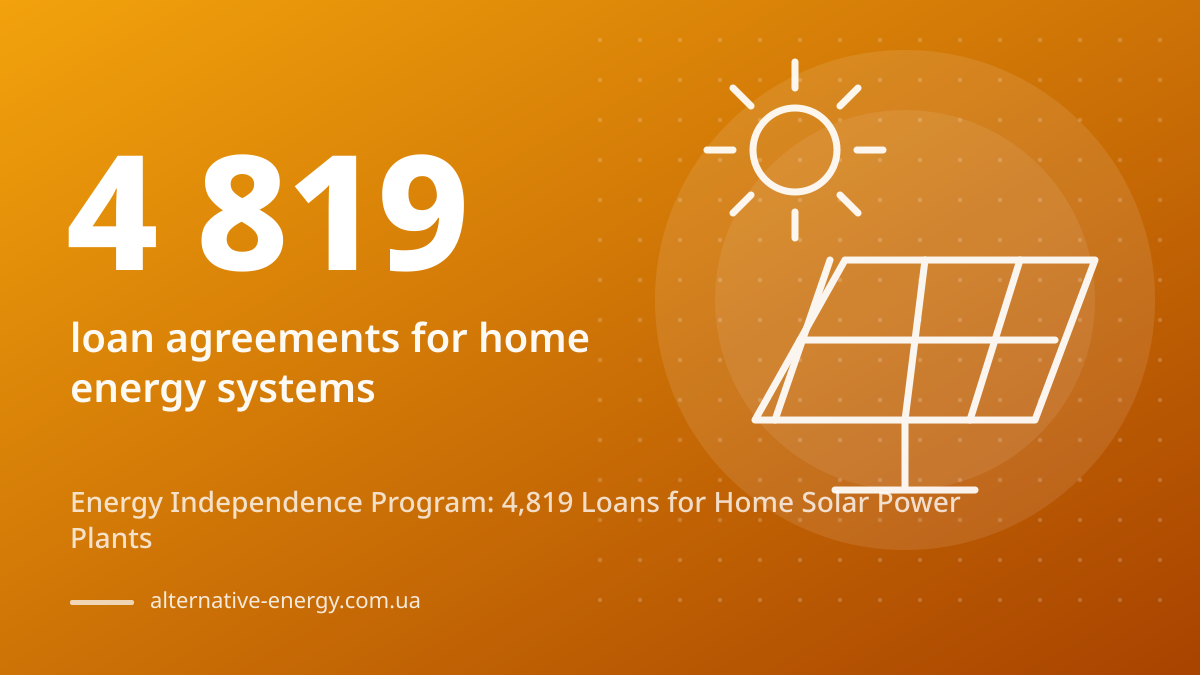
- as of March 9, 2026, partner banks had signed 4,819 loan agreements;
- total loan portfolio disbursed — over UAH 1.69 billion;
- installed capacity of home solar power plants and backup systems — 41.8 thousand kW;
- roughly 5,000 applications have been submitted since launch.
February 2026: Momentum Builds
According to the Ministry of Economy of Ukraine, in just one month Ukrainians submitted 552 new applications, and banks processed 517 agreements worth UAH 176.1 million. Equipment installed during that short window added 4.5 thousand kW of capacity. The Ministry specifically notes that the number of agreements is growing month over month.
For prospective applicants, these figures carry a clear message: money is genuinely reaching end recipients, and queues at partner banks are moving. While some Ukrainians are still weighing whether to act now or wait, others have already wired up an inverter and started counting their savings.
What the Energy Independence Program Finances
The program targets owners of private houses, townhouses, and shares in residential buildings. It operates through the state-backed “Affordable Loans 5–7–9%” mechanism and covers three equipment combinations:
- full package — solar power plant + energy storage system + generator — one-time reimbursement of 30% of the principal;
- generator paired with an energy storage system — 25% reimbursement;
- standalone generator — 20%.
Funds are transferred directly to the equipment supplier as a non-cash payment; the loan principal can also cover installation and auxiliary materials required to bring the system online.

From Application to Reimbursement
The program opened to individuals on February 18, 2026. Six institutions have already joined: PrivatBank, Oschadbank, Ukrgasbank, Sens Bank, Globus, and Poltava-Bank. The process is fairly straightforward:
- select a partner bank and submit an application describing the planned equipment;
- pass the bank’s credit scoring — creditworthiness and credit history are assessed;
- upon approval, the bank transfers funds directly to the equipment seller;
- once the solar power plant or backup system is commissioned, the state issues a one-time payment reimbursing a portion of the loan principal.
A “one address, one loan” restriction applies: two applications cannot be submitted for the same household. Each bank has its own documentation requirements, so it is worth going directly to the institution of your choice; preliminary consultation is available through the Entrepreneurship Development Fund hotline at +380 44 333 43 54.
To see what this looks like in practice, read our piece on how a Kyiv family went from application to launching their home solar power plant. Home generation in Ukraine has been developing as a trend for several years now.
What This Means for Homeowners
Nearly 5,000 approved agreements within just a few weeks of operation tell two things. First, the loan disbursement infrastructure is functional — the scenario where funds are promised but never materialize is not borne out by the numbers so far. Second, 41.8 thousand kW of home generation and backup capacity is not an abstraction; it is real power that Ukrainian families have moved from price lists into their own homes. If the cost of a solar power plant or battery storage has been holding back your decision, a zero interest rate in the first year combined with a one-time reimbursement of up to 30% of the principal make the economics considerably more attractive — at least while the program is scaling up and its disbursement budget remains available.
Sources: Міністерство економіки України (Мінекономіки), Фонд розвитку підприємництва (Енергокредит)
Prepared by the Alternative Energy editorial team with the help of AI based on the sources listed; facts and figures were checked against them during automated editorial review. How we prepare articles


