


In 2026, a geothermal heat pump remains one of the most efficient ways to heat and cool a private home: a seasonal COP of 3.0–4.5 means the system delivers 3 to 4.5 kW of heat for every kilowatt of electricity it consumes. At the same time, high upfront costs and the elimination of the U.S. federal tax credit on January 1, 2026 have noticeably extended payback timelines. According to Energy-Solutions.co (USA, December 2025), typical residential ground-source systems in 2026 run $18,000–$40,000 fully installed, depending on home size and loop configuration.
Key figures:
- ~220 m² home with a 12–14 kW horizontal loop: $20,000–$32,000 before incentives.
- Annual savings in a cold climate: ~$1,360 compared to a gas boiler with air conditioning.
- Seasonal COP 3.0–4.5 (400–600% efficiency) vs. ~95% for a gas boiler.
- Payback with a 30% subsidy: 8–14 years; without one — more than 15 years.
Cost breakdown by system size
The ground loop dominates the budget — whether that means drilling vertical boreholes or trenching horizontal loops. Energy-Solutions.co provides cost segmentation for residential and small commercial installations across the U.S. at 2025–2026 prices, before incentives.
| Property and loop type | Capacity | Installed cost |
|---|---|---|
| Small home ~150 m², vertical loop (2–3 boreholes) | 8–10 kW | $18,000–$28,000 |
| Detached home ~220 m², horizontal loop | 12–14 kW | $20,000–$32,000 |
| Large home ~300 m², vertical loop (4–5 boreholes) | 16–18 kW | $30,000–$45,000 |
| Small office, vertical loop | 30–60 kW | $70,000–$180,000 |

How much you can save by switching from gas
A geothermal heat pump doesn’t burn fuel — it transfers heat from the ground, where temperatures at depth stay within a stable, moderate range year-round. That’s why seasonal COP reaches 3.0–4.5, compared with roughly 95% efficiency for a gas boiler.
Energy-Solutions.co’s calculations for a ~220 m² home in a cold climate show that switching from a gas boiler and SEER 14 air conditioner (annual bill ~$2,800) to a vertical geothermal heat pump brings the bill down to ~$1,440 — a saving of around $1,360 per year. In milder climates the benefit is smaller: ~$940 per year compared with gas-plus-air-conditioning using a horizontal loop.
Why payback periods lengthened in the U.S. in 2026
Through the end of 2025, U.S. homeowners could recover 30% of system costs under Section 25D of the federal tax code — on a $30,000 installation that meant a $9,000 credit. As Energy Rebate Calculator reports, the One Big Beautiful Bill Act (P.L. 119-21) repealed Section 25D for geothermal heat pumps effective January 1, 2026. The residential geothermal investment tax credit no longer exists in 2026.
What remains in 2026:
- The federal HEAR program — up to $8,000 depending on income (100% of costs up to that ceiling for households below 80% AMI; 50% for the 80–150% AMI range).
- State and utility rebates: NYSERDA in New York adds $3,000 on top of the standard heat pump rebate; California’s TECH Clean California program may offer enhanced incentives for geothermal installations — check the program’s website for current eligibility status.
When geothermal makes financial sense
Energy-Solutions.co cites a mixed-climate suburban example: a 220 m² home, a 12 kW horizontal loop replacing a gas-boiler-and-air-conditioner setup. Net cost after incentives: $24,000; measured annual savings: $900; simple payback: about 11 years. For a 1,000 m² office with a 60 kW vertical loop and zone control, the capital premium was $110,000, annual savings came to $22,000, and payback was approximately 5 years.
The authors note that the economics are strongest when the owner plans to occupy the building for 10–20 years, is replacing aging HVAC equipment at the same time, and has access to incentives or green financing. If the building envelope leaks badly, there is no room to drill, or the ownership horizon is only 3–5 years, an air-source heat pump combined with insulation upgrades remains the better choice.
How to evaluate the decision for your own home
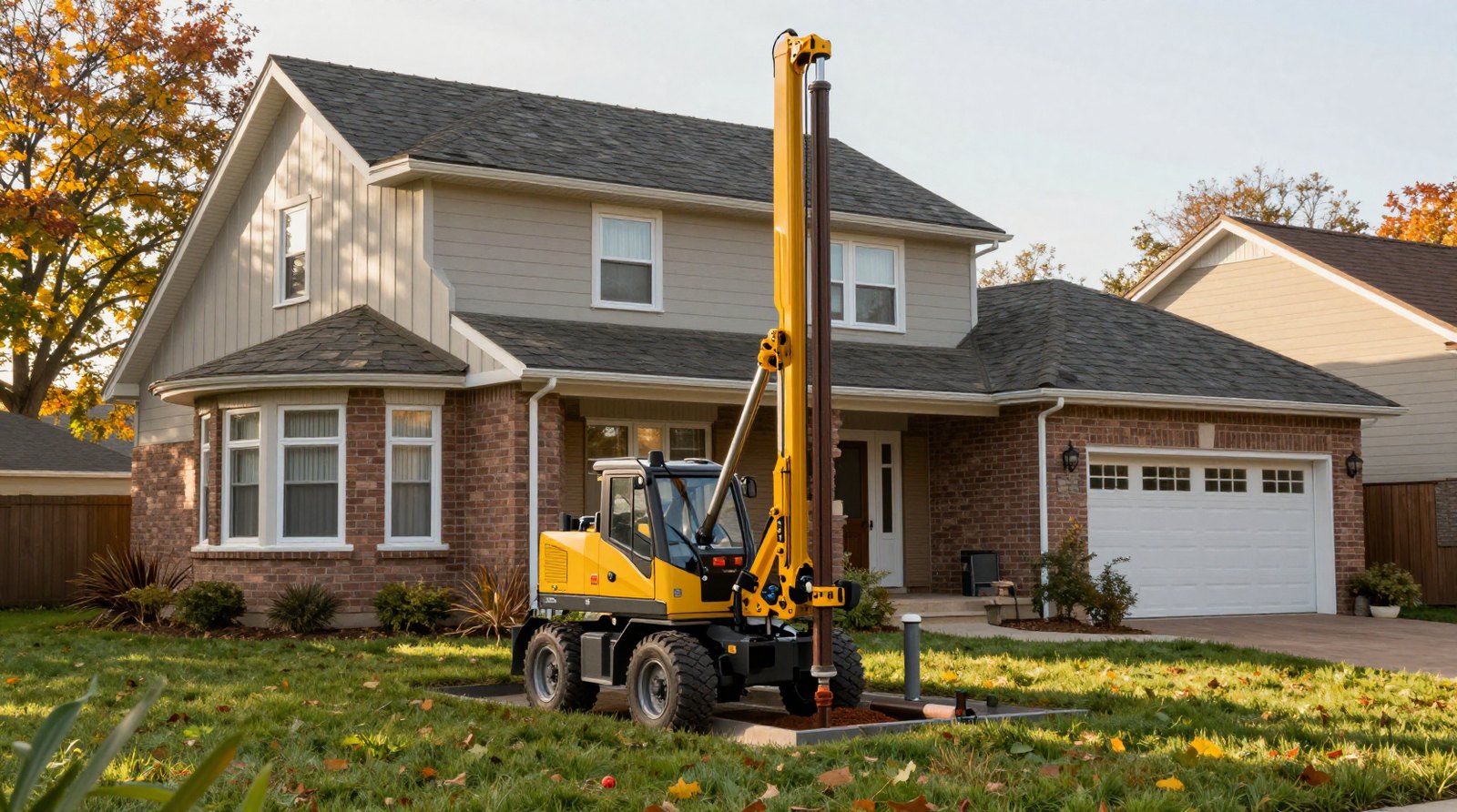
The U.S. case is instructive not for its absolute dollar figures but for the structure of the financial model: vertical borehole drilling is the single largest cost item, and subsidy availability determines whether the payback period fits within the equipment’s service life. A useful rule of thumb — compare the full installed cost including the ground loop, not just the heat pump unit itself — and keep in mind that the compressor and heat exchanger last 20–25 years while the ground loop remains functional for 50–100 years. When choosing between a vertical and horizontal configuration, confirm drilling rig access and available trench area early in the design phase — those site constraints often determine whether to look at a trenchless geothermal solution or go ahead with a conventional ground loop.
FAQ
When is an air-source heat pump more cost-effective than geothermal?
According to Energy-Solutions.co, in mild climates with moderate heating loads a modern cold-climate air-source heat pump delivers 80–90% of the savings of a geothermal system at a significantly lower upfront cost. Geothermal gains the upper hand in very cold climates and in homes with high heating loads, where consistent efficiency throughout the entire heating season matters most.
Sources: Energy-Solutions.co, Energy Rebate Calculator
Illustration generated with AI
Prepared by the Alternative Energy editorial team with the help of AI based on the sources listed; facts and figures were checked against them during automated editorial review. How we prepare articles


