


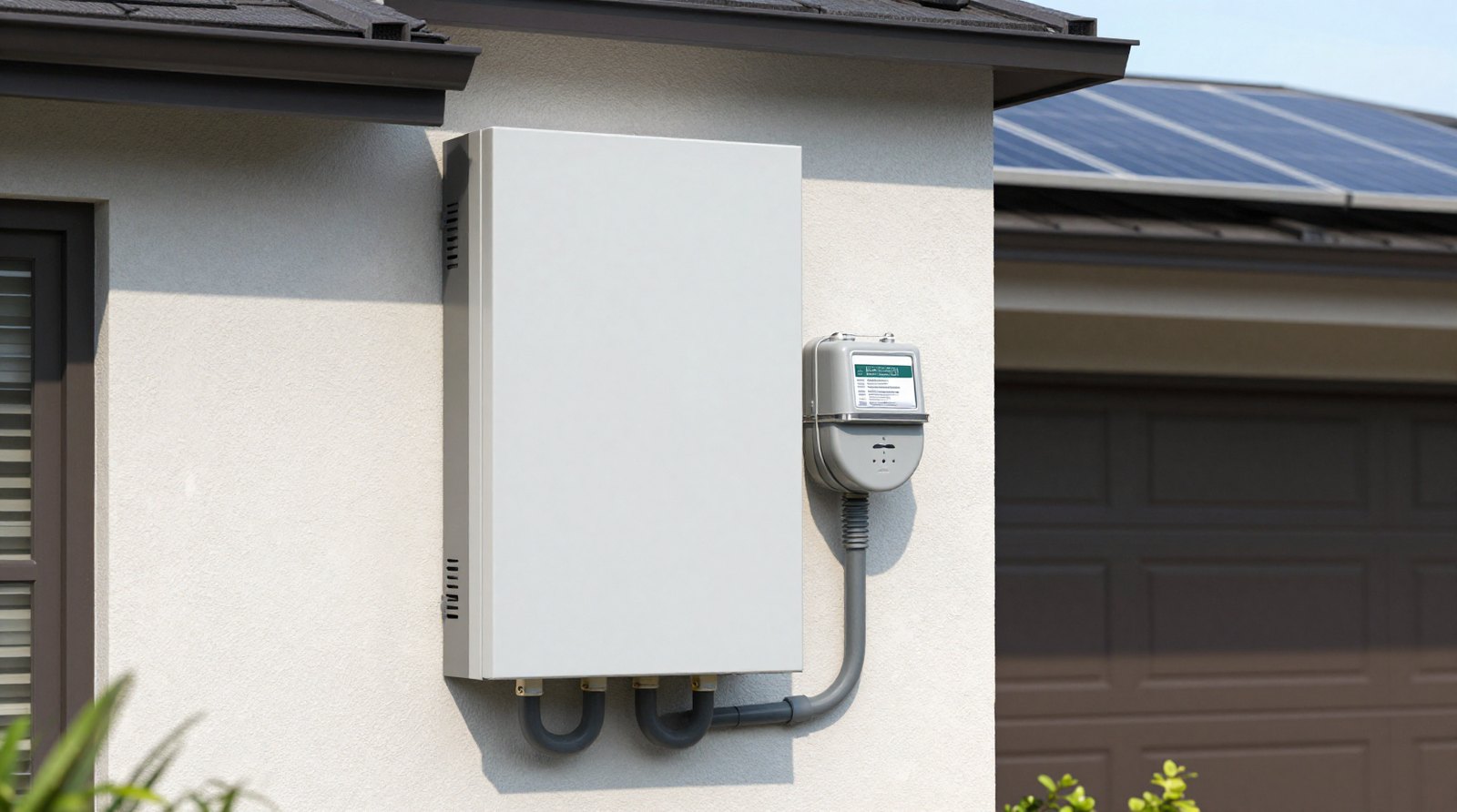
Deciding between a grid-tied, off-grid, or hybrid inverter for a home solar system in 2026 is less about the technology itself and more about the regulatory environment you’re operating in. According to the Savolture guide (May 2026, updated October 2026), utility rules increasingly determine whether the lower upfront cost of a grid-tied inverter will ever pay off — or whether going hybrid from day one is the smarter bet.
Key takeaways:
- Typical 5–10 kW inverter prices: grid-tied — $1,200–2,500; off-grid — $1,500–3,500; hybrid — $2,000–5,000.
- After California’s NEM 3.0 reform, solar export rates fell more than 75% — to roughly 4–7¢/kWh.
- A hybrid inverter with Time-of-Use optimization cuts evening electricity bills by 40–60%.
- The guide puts battery storage payback at 5–7 years.
Three Inverter Types: What They Actually Do
A grid-tied (on-grid) inverter converts DC from solar panels into AC for the home and the utility grid, but shuts down the moment grid power fails — anti-islanding protection mandates it. An off-grid inverter is designed around a battery bank and has no mechanism to synchronize with the utility. A hybrid inverter combines both modes in one unit: during the day it powers the home and charges the battery from solar, draws from the grid when generation falls short, and switches to island mode automatically during a blackout.
The Savolture guide references the US regulatory framework — NEC Articles 690 and 706 for solar and energy storage systems and IEEE 1547-2018 for grid interconnection — alongside DOE and NREL materials. Author Marvin Zhou notes that in 2026, hybrid inverters are winning more than 80% of new residential installations in the US, while grid-tied-only solutions are being steadily displaced by changes to net metering rules.
Why Grid-Tied Inverters Are Losing Their Economic Edge
The traditional case for a grid-tied inverter rests on price: it is the cheapest option in the 5–10 kW class at $1,200–2,500. But Savolture makes clear that following California’s NEM 3.0 reform, the value of exporting surplus solar to the grid collapsed by more than 75% — landing at roughly 4–7 cents per kWh. In that environment, a household that sells excess generation during the day and buys electricity back at full retail rates in the evening effectively loses the defining economic advantage of a pure grid-tied setup.

When a Hybrid Wins — and When Off-Grid Makes Sense
Redirect that surplus into a battery instead of the grid, and the numbers change. According to Savolture, a hybrid inverter with Time-of-Use optimization reduces evening electricity bills by 40–60%, with battery storage paying back in 5–7 years. Off-grid inverters ($1,500–3,500) are recommended only for sites with no grid access at all — farms, remote cabins, mobile or marine systems where connecting to the distribution network is physically impossible or prohibitively expensive. Wherever a grid connection exists — even an unreliable one — a hybrid architecture gives homeowners more control: it backs up the house while simultaneously managing energy flows between panels, battery, and grid.
What This Means for the Feed-in Tariff Debate
The California experience makes one thing plain: as soon as a regulator cuts solar export payments, the economics of a grid-tied inverter without storage essentially fall apart. Feed-in tariff structures and billing rules are being renegotiated in many markets amid grid instability, and the international evidence points in one direction — for new home solar projects paired with a battery, what matters most is not the export rate but the system’s ability to shift self-consumption in time. For anyone choosing an inverter today, that is an argument to compare hybrid and grid-tied solutions not just on sticker price but on their energy-management capabilities across panels, battery, home, and grid — that topic is covered in depth in the detailed guide to solar power plant inverters, and the full-system economics can be worked through with the 5 kW home solar payback calculator.
Frequently Asked Questions
Can I add a battery to a grid-tied inverter instead of buying a hybrid?
It is technically possible via a separate battery inverter connected in parallel, but if there is any realistic chance of adding storage later, choosing a hybrid architecture from the start makes more financial sense. Standard grid-tied and off-grid inverters are not engineered to operate synchronously with both the utility grid and a battery at the same time, and retrofitting a system after the fact typically costs more than the original price gap between equipment types.
Sources: Savolture
Illustration generated with AI
Prepared by the Alternative Energy editorial team with the help of AI based on the sources listed; facts and figures were checked against them during automated editorial review. How we prepare articles


